The Discovery Channel in partnership with British and German television channels has performed a controlled crash into the ground of a 727-200 in a Mexican desert. Here is the video:
After a week of allowing the fallout from the US Airways agreements with American Airlines’ unions to settle, the question of what it will take to see an actual merger between the two airlines comes to mind.
It’s not just the union agreements that gets this deal done. To the contrary, there are several issues that will have to see deals made.
Aircraft manufacturers: Boeing wants to see an independent AA because AA is fundamentally a Boeing customer not withstanding the Airbus order made last summer. Boeing is going to need reassurance that it remains viable in future aircraft orders and that existing orders won’t be cancelled. US Airways can make those assurances with confidence.
Hewlett Packard: Hewlett Packard sits on the creditors committee because of all the IT work it has done to date to bring AA into the future. A lot is left undone and some reportedly isn’t really ready for prime time. Currently, US Airways uses SHARES and American Airlines uses SABRE. However, SHARES, originally developed by EDS, is now owned by HP. Do you see where I’m going here? A deal can be made to put both airlines on the new system being developed called JETSTREAM.
AA Executive Team / Board of Directors: This is a sticky area. Who wants a team or board that allowed the status quo to exist that long? It’s possible we might see someone like Tom Horton retained as non-executive Chairman (a la Glenn Tilton) and a few of the existing AA team retained but that would be it. The board has to go and its tenure is so high in average age, it has an incentive to fight this. Solving these two problems is possible and these two stakeholders have the least power in making decisions in many respects.
The when is the next question. US Airways is clearly getting good advice and it is clearly motivated to make a deal. I would guess that their intent is to use their own cash holdings and AA’s cash holdings to make a deal that creditors can’t refuse. I think that deal will happen between now and the end of June.
Boeing CEO James McNerney expressed his and Boeing’s viewpoint that they support American Airlines having an opportunity to exit their bankruptcy as a stand alone company. McNerney acknowledges that US Airways hasn’t bought Boeing in a some time and sees AA as a loyal Boeing customer as well.
Is this support for AA an attempt to preserve the AA orders for Boeing 737MAX aircraft? At least a little bit, yes. In addition, Boeing has and continues to support AA’s purchases for aircraft in a variety of ways. They’re a good customer. Is that support founded on sheer love for the airline? I suspect not.
In fact, any worry about the 737MAX is kind of silly. The merged airline would, upon conclusion, have far more Boeing aircraft and far more resources to service and operate Boeing aircraft than Airbus aircraft. Furthermore, both airlines have orders for Airbus A320NEO aircraft already. Airlines of that size can no longer afford to be an exclusive customer of one manufacturer or another. Their size (and the size of several competitors) demand manufacturing positions that can’t be serviced exclusively by one manufacturer.
I suspect that if Doug Parker is able to re-assure Boeing over its existing AA orders, Boeing will go neutral or even supportive of such a merger. At the end of the day, it’s about having a customer and earning money. Furthermore, it even gives Boeing an “in” with the US Airways executive team that it has not had for some time.
Boeing has revealed more details on its definition for the 737MAX now and one significant revelation is the decision to add 8 inches to the nose gear. This was the tough choice engineering wise.
A new pylon and strut for engines will be used in the style of the 787 and the rear tail cone will be extended and the area above the elevator thickened to improve aerodynamics. Electronic bleed air will be added to improve cabin pressurization (which is much like how the A350 will use bleed air)and better means more efficient fuel burn.
Airbus boxed Boeing into this aircraft by introducing the A320NEO. I firmly believe that Boeing was leaning towards a new aircraft but also needed time and space to get where it needed to be with that aircraft. Airbus’ introduction of the NEO made it much more imperative to deliver more efficiency now rather than a decade later.
But with the decision made, I also have to credit Boeing for appearing to have decided to go all in. They are working very, very hard to bring as much advantage as possible to the single aisle wars with Airbus.
Some perceive that Boeing has been slow to release details and I understand that perception but the truth is that American Airlines’ order last summer forced their hand into a premature announcement. Had they not had to make that announcement, these new details would seem very much on time.
Most believe that the status quo between the two manufacturers will be maintained. It is thought that Boeing will have a slight advantage that, according to many, will remain about 2% better than Airbus.
I have a feeling that Boeing might be aiming higher. I don’t think the decisions they are now announcing about this aircraft reflect a company that is struggling to maintain the status quo in the marketplace. They appear to be working very hard to make every gain possible against their competitors to bring even more to the table.
Why do I think so? Because these changes add more risk to their ability to deliver this aircraft in 2017. If there is one thing Boeing knows, it’s that they cannot afford to damage their credibility with airlines further with a late arrival of the 737MAX. This is not an all new aircraft with all new materials and airlines will expect it on time or early.
This won’t be revealed a la One Big Announcement John Leahy Style. Boeing will simply add more and more substantiation to their claims as they continue discussions with airlines. At the end of the day, most airlines prefer to see results over having a grand announcement.
It’s funny, some people think Southwest showed some LUV for the Airtran 717 fleet when the merger was announced between the two companies. In fact, Gary Kelly simply said that, at that moment, the 717 was intriguing to SWA and certainly not a harmful aircraft to Southwest’s fleet plans overall.
After the merger, Gary Kelly started talking about how they don’t fit and they don’t want them.
The 717 is a good aircraft and it would fit some of Southwest’s flying quite nicely but . . . it would complicate scheduling and I think that’s what Mr. Kelly doesn’t want. If Southwest has a 737-700 go technical at an airport, it’s not a problem to drag another 737-500/700/800 up to the gate and hand it over to the pilots and flight crew to use for their needs. You can’t drag a 717 up to the gate and hand it over to the same pilots.
I think the 717 is leaving and I think it will be gone in 2 to 2 1/2 years. Holly Hegeman of Plane Business says they are going to Delta and its a done deal. I say they’re leaving and they’ll find homes somewhere. Boeing Capital if nowhere else. Delta probably could and would be interested in them as they are cheap and fit a seat count that Delta had and no longer has in its mainline fleet. (DC-9-30/40/50 aircraft are leaving the fleet)
The real shame, in my opinion, is that the 717-200 wasn’t expanded into a longer range 717-300/300ER aircraft. I think that would have breathed real life into that airframe and I think it wouldn’t have hurt the 737 line at all. But it became an orphan and, as such, it became unattractive to most airlines. That said, it will remain in the world for at least another decade if not more and it’s got some highly efficient engines that justify its purchase when combined with the used market price for a 717.
A number of analysts have noted that the real goal for Airbus this next year is to sell production slots that are open for current A320 aircraft up to and including EIS for the A320NEO aircraft. Both Boeing and Airbus need to find ways to preserve value on existing aircraft lines until their new generation aircraft enter into service as well.
It’s a delicate line they each walk. You want to satisfy airlines with new aircraft but some of those who buy aircraft are lessors and you don’t want to anger them by depreciating their assets they already hold. And a market glut of aircraft can result in depreciating demand for your new generation aircraft because the capital costs for current generation aircraft can become low enough to make sense for airlines to buy and use.
A good example of that last part is Delta buying more and more MD-90 aircraft. The capital costs are low compared to current Boeing aircraft and the airliner provides close to current Boeing efficiencies.
Both manufacturers know that their order books are soft. Both know that some who have ordered both current and next generation aircraft aren’t necessarily going to be around to take delivery on those aircraft 5 years from now. One great example is Lion Airways order from Boeing. The dirty secret about that order is that Lion isn’t an airline with significant risk both in operations and financially.
Airbus need to work hard getting their current production sold until their aircraft are in place but without depreciating values and without massive discounts to encourage orders. It’s a tall order and a difficult challenge for both manufacturers.
The current and future product lineup for both the 777 and 787 is now becoming more clear for the next 15 years or more. The 787 line is expected to be pumping out more and more 787-8 aircraft for current customers and the 787-9 is expected to fly in 2013 with deliveries taking place shortly thereafter. Those two aircraft slot themselves just under the current 777-200ER/LR which is still an attractive aircraft to many airlines.
The 787-10 is conceptual but, I think, a near certainty to arrive as a replacement for the current 777-200ER/LR. Range will be the factor on this but Boeing should be able to provide with with similar range and capacity (passengers and cargo) as the 777-200ER with improved efficiency. Suddenly, we have a 787 lineup with 3 aircraft capable of meeting the needs of airlines from the 767 range to the original 777 range and which also covers the current A330 lineup as well. It also allows airlines to operate a mixed fleet to rightsize aircraft to routes using the same aircrew for each.
Additionally, the 777-X lineups move upwards with the 777-200 and 777-300 getting about 50 seats more capacity each with similar range as today. These new variants will benefit from a larger, lighter composite wing and new generation GE90 engines that benefit from GENx technology. The expectation is that such aircraft can also deliver from 15 to 20 percent improvement in efficiency as well.
Now you have 5 aircraft derivatives from two models covering 98% of all widebody needs with class leading efficiency that brackets Airbus’ offerings in the A330/A350 models. That’s a powerful sales tool when you consider that the current 777 pilot can transition to the 787 (and vice versa) in about 8 days of differences training. I would expect that the new 777 variants may well be designed with flight decks that take that transition time down further or which may well make it possible for a pilot to be flexible across the entire 787/777-X line.
This will be attractive to airlines around the world. One airline can buy 5 variants that will seat a range of passengers from 242 seats (Boeing 3-Class Configuration) to 410 seats (Boeing 3 Class Configuration) with increments from the 787-8 forward being about 30 seats per aircraft, just where airlines like to see things.
I would expect that airlines would likely operate “skips” in their choices. A 787-8 operator might also own the 787-10 and 777-9X, for instance. A 787-9 operator might also own the 777-8X, as another example.
Flexibility and range are the key weapons here and they become very, very attractive to airlines both in the United States as well as abroad. These won’t be airliners designed to the demands of middle eastern airlines such as Emirates (who always want more range and capacity) but, rather, to the airlines that comprise the rest of the world.
I think we’ll also see range in excess of 8000 to 8500nm as being not necessary either. In other words, I don’t expect airlines to continue to try to build variants with more and more range. Yes, it would be nice to offer an airliner that can fly from London to Sydney and earn money and that may even be possible with the next generation 777 aircraft. However, it’s virtually the only market left that cannot be served by airliner and that makes it a pretty small one for aicraft. As such, I would expect that their might be a high performance 777-8X offered to those airlines capable of doing the mission profitably but that will come later rather than sooner unless it is deamed necessary to selling aircraft to the airline.
It’s 2012 and the Boeing 787 Dreamliner has delivered but only 3 aircraft so far. There are tens of aircraft in Seattle and San Antonio requiring rework and change incorporation and the assembly line in South Carolina hasn’t cranked up yet either.
By all reports, the 787 is exactly what airlines expected. Note that I said “airlines” and not “airline passengers”. For those of you that expected a transformational experience with the 787: surprise. This airliner was built for airlines, not you. It was sold on its exceptional features for passengers, yes. However, at the end of the day, it’s really a highly economical airliner for airlines. In other words: seat pitch isn’t going to change and the bigger windows, higher humidity and lower cabin pressure don’t really add up to a shocking experience. It’s better, no doubt. However, I’ll bet that most don’t really notice a big difference except, perhaps, for the windows.
So, we’ve got a great airliner that should be transformational for airlines and there is just one problem: Nobody has really gotten their 787s yet. Airlines seem to have gone into a funk and accept that they’ll get theirs when they get theirs. I’m not suggesting they have a choice at this point but I do wonder at why Boeing isn’t bearing brunt of at least a little more ire at the delays.
My prediction: Boeing will deliver no more than about 35 of these airliners by the end of the year. There are still too many signs of Boeing not quite “getting it” when it comes to the need to push these airliners out the door.
Ryanair’s CEO Michael O’Leary has decided to express his disappointment in what they’ve seen of the 737MAX so far. He mentions that what they’ve seen from the A320NEO so far, they’re impressed but what they’ve seen of the 737MAX so far does not. O’Leary, not surprisingly offers that anybody buying aircraft right now is nuts given the prices.
But the world has changed. It’s not the late 1990’s or early 2000’s and manufacturers are not struggling to sell aircraft. To the contrary, they are struggling to meet demand based on orderbooks. Ryanair got stunning prices for their original massive orders. Enough so that they could buy them, operate them for a few years and sell them at a profit. Neither Boeing nor Airbus is interested in making such deals anymore and rightfully so.
Airlines put off buying large quantities of aircraft for quite a long time and now the legacy airlines not only want them, they need them. If O’Leary and Company wish to continue to operate a successful ULCC, they’ll be lining up to buy them as well because they do offer the kind of incremental gain in efficiency that is going to make the world’s legacy airlines much more competitive with ULCC’s like Ryanair.
The truth is, I think the Airbus A320NEO does fit Ryanair’s needs a bit better these days. But that would require a fleet change that would take years to accomplish and with A320NEO delivery positions reaching “unobtanium” levels for the next decade, the 737MAX probably does offer the best option given their position. One thing is sure, the COMAC 919 isn’t going to deliver what Ryanair needs and certainly not on time. Airbus can’t build more even faster to meet the demand on the A320NEO even with some airlines orders going away. So I’m not sure why O’Leary wants to make an enemy of Boeing.
The truth is, Boeing will be happy to sell to O’Leary and take his abuse while they do it. They’re just not going to give away aircraft anymore and it appears that it will take O’Leary a while longer to realize the position he and his airline are in.
Aspire Aviation has revealed that Boeing has issued an RFP to GE and Rolls-Royce (with speculation that Pratt & Whitney got included) for a next generation engine for the 777-8X/9X development. The target appears to be about 100,000lbs of thrust (and I’m sure Boeing would like to hear about a growth path to that as well.)
With the combination of new technologies for the fuselage, composite wings that are likely a bit larger and a lower fuel consumption, these new aircraft would definitely be A350 beaters in every category. The current 777 lineup performs well against the performance definitions for the A350-900 and based on comments from A350-1000 customers, the 777-300ER probably isn’t equaled on long haul routes.
A revised 777 that upgrades the -200LR with more seats and as much range, capacity and cargo capacity would clearly be of interest to many airlines. A -300ER that also increases its capacity with equal or better range would also be of great interest to many. Boeing has rightly identified that its the -300ER that is likely the sweet spot in size (or a little larger) for most airlines requiring a high capacity/long range airliners for routes.
The A380 will be around for a long time. It won’t be a big seller over the next decade and will only ever be a success if there is enough growth on long haul trunk routes to require that aircraft. The 747-8i remains an interim solution from Boeing and it still hasn’t garnered much interest from airines. In fact, many airlines have downsized from the 747-400 in favor of the 777-300ER.
Trunk routes will remain but there will be fewer of real importance and requiring a VLA. The 787, A350 and 777 all permit airlines to fly more point to point routes and earn profits. Ultra long haul flights are likely to remain more in the style of “long and thin” than “long and fat”. After all, just how many people are likely to fly from Houston to Auckland, New Zealand even with network feed? Answer: Not enough to require a 777 or 747 for quite some time.
I do think Boeing has the right idea in offering a revised 777 instead of an all new design in this category. The 777 still incorporates some fairly cutting edge technology and with a revised composite wing alone could probably continue as a category winner.
When airlines began to use 757 aircraft for flights between the US Northeast and Europe, it was innovative to say the least. Using the aircraft’s 4000nm range, it became possible to serve those long, thin routes with non-stop flights that haven’t been possible with a single aisle airliner since the 707 and DC-8.
757s are aging aircraft now and even with winglets, some airlines are seeing the time come for them to retire these planes. Many speculate that Airbus or Boeing will develop some derivative of the 737 or A320 to replace the 757 on those routes and while it is something that I think airlines would have some interest in, it’s highly unlikely to happen. Despite how much new life the 757 found on those routes, it’s still a very small subset of 757 flights.
Even today, most 757 flights are in the domestic United States and even the trans-continental flights are a subset of all 757 flights. In point of fact, most 757 flights are not trans-Atlantic or trans-continental in nature. The trick with those long flights is to have an aircraft with enough power to carry not just passengers but a good load of cargo and a more ideal aircraft would have closer to 5000nm of range as well.
Once you find the engines (which need to be in the 40Klbs of thrust range), you still have to build an aircraft that can economically carry 180 to 200 passengers and a full load of cargo 4500nm to 5000nm. In point of fact, that starts to sound an awful lot like the 767. And it’s notable that the 767 is still being produced.
I would argue that the airliner that airlines might buy is a 767-200LR that is lightened and which has more efficient engines. Engines that, say, would look something like a downrated GEnX engine. Perhaps an engine derivative of those now being used on the 747.
I don’t think we’ll ever see an airliner like the 757 again. It was always a bit of a misfit in the airline world in that it was designed in the 1970s and had to succeed in the 1980s and 1990s. Its sweet spot was just a bit too high performance for most routes that airlines needed it for. It succeeded as a design and in production but it was not nearly as successful as the 727 or 767.
But I do wonder what a lightened 767 with modern, efficient engines would do for airlines on those trans-Atlantic routes. Or on routes from North America to South America. Or on US mainland to Hawaii routes. There might be just enough use for Boeing to do one more derivative of that airframe and get something out of it. It wouldn’t be impossible to see such an airliner becoming a KC-46B tanker model as well.
Boeing has announced that it is closing its facility in Wichita, KS in 2013 due to waning projects for that facility. Work will be transferred to its San Antonio and SEATAC area facilities primarily. The closure means a loss of more than 2000 jobs and it will hurt many in the Wichita area.
It’s become clear that Boeing realizes that it needs to locate its work in areas that can provide a cost structure that makes them competitive in the world. Sadly, that means some facilities with militant unions and/or old infrastructure are going to lose to newer sites in “right to work states”.
What it doesn’t mean is that Boeing believes it can do without the aerospace knowledge it has in Washington State. Boeing wisely recognizes that it must rely heavily upon workers there for its continued existence. At least for the next 1 to 2 decades. That said, I also think that we’ll see Boeing diversify its operations more and more across the United States as well as into other countries. Local and regional impacts to its production can’t be tolerated nearly as much in the future if Boeing is to remain a viable choice for airlines.
2011 wasn’t the worst year for airlines and 2012 won’t be either. Instead, I think we’ll see more of the same in most respects.
Airlines will continue to constrain their capacity and that will show more discipine than I thought they had 3 years ago. They’ve proven me wrong and I think the results are too good for them to not to continue over the next 12 months.
Fuel costs will continue to be a difficult thing for airlines to manage. There will continue to be volatility but I don’t think we’ll see anything like 2008/2009. The financial crisis in Europe will reduce some demand on oil but I see no real economic growth in any part of the world that will drive demand either. The truth is that the emerging economies are largely dependent upon demand from both Europe and North America and neither of those economies will see high growth in 2012.
Airlines will continue to make large orders for more fuel efficient narrow body aircraft. This only makes sense as the gains are more than enough to justify the purchases and now is the time to gain an advantage in bargaining with both Boeing and Airbus. Furthermore, airlines need to hedge against their labor costs which will only grow over time.
Aircraft manufacturers have a much more sure path for the next 10 years now. Boeing will be biding its time on improvements to the 777 until it sees more definition of the A350-1000 and it will throw its resources into ramping up 787 production, 787-9 development and 737MAX development. It’s possible that we’ll see a real 787-10 announcement in 2012 but, if so, probably not until the latter part of the year.
Airbus has to get its act together on the A350 and try very, very hard to prevent too much schedule slip. Despite its efforts, I think we’ll see more schedule slip and it won’t reveal the entire picture as that unfolds. While I don’t expect quite the same delay as the 787 saw, it will be a significant delay and it will impact Airbus. They’ll also try to flog the A380 as much as possible and may even succeed with small orders in parts of the world it hasn’t penetrated much to date. I do not see any US based orders for the A380. Furthermore, Airbus made some big promises for the A320NEO and it’s got to work hard to deliver on those. They’ve made it out like the A320NEO is a no-brainer for development and while it is an incremental improvement, the engineering to deliver is non-trivial.
Bombardier will work its tail off to sell more of the CSeries and I think it may even succeed. The sweet spot its lineup offers will become more attractive to airlines once they see Bombardier actually perform in the development and test of this aircraft. The CS100 isn’t the attractive aircraft but its the one that will fly and deliver first. Once the performance of that aircraft is established, I think we’ll see orders from US and European airlines come in large numbers.
Embraer has got a nice grip on the regional airliner business but it also has a problem in that, right now, there is no growth path into a larger plane for purchasers. It has plans to work on re-engining the E-Series but I think they’ll concede the need to develop a larger airliner as well. The Bombardier CSeries presents just a touch too much threat in the future.
I don’t think we’ll see much from the other regional airliners being developed. The Mitsubishi MRJ doesn’t feel quite right for airlines to me and doesn’t offer a growth path into a larger airliner. The orders its racked up so far are fairly paltry and at risk, in my opinion.
The Sukhoi SuperJet, on the other hand, has a real chance, I think. It’s Westernized, it’s flying and it does feel like its the right size. The real challenge in this aircraft is ensuring support and with Boeing as a consultant, it may well have some help in that arena. If it does succeed, that success will begin in Europe as well as for airlines of lesser developed areas such as the Middle East, India and the Far East. If any orders come from the US, it will be years in the making.
If anything stirs in the US airline industry, I think it will be in the LCC arena and I think it will be small(ish) if anything. I do not think we’ll see any legacy consolidation despite wishful thinkers for a US Airways / AA merger. Something like that becomes much more likely in 2013.
I think American Airlines will plod through its bankruptcy in 2012 with a bit of scandal here and there. I think its labor force is about to take a beating on wages and benefits and I think the resulting bitterness will last for years. I also think that United and Delta will be growing a bit more concerned about AA late in 2012 once they have a picture of what AA’s cost structures are likely to be.
2011 was largely a “rebuilding” year for the airline industry. 2012 will be largely so as well. Until the world economies recover, the best the industry can hope to do is manage its problems and earn a bit of money. That’s eminently possible for them to do.
Southwest is clearly positioning itself to operate a family of aircraft. They also clearly see a strong need for the -800 (5 more aircraft ordered) and I think they recognize a need to enjoy all the fuel efficiency benefits available to them at this point in the company’s life.
SWA has made its intentions to compete in major markets and at major airports throughout the country. Those airports require more capacity per flight in order to grow and enjoy health profits. In light of their challenges in getting slots to operate from NYC airports as well as slots for Washington (National), I suddenly wonder if the -900 and MAX9 won’t enter into the picture. If they can get enough frequencies in and out of those airports to operate an accomodating daily schedule, they can at least benefit from larger and larger aircraft.
The question is what to do about their traditional smaller markets that have enjoyed a lot of Southwest service. Many of those markets get served with 737-500 aircraft or they enjoy the -700 by being a part of follow on service to another destination. For example, my mother flew to the DFW area last week on SWA by going nonstop to ABQ and then onwards (on the same aircraft) to Dallas.
This is how Midland, Lubbock, Amarillo, Oklahoma City, Tulsa, and Little Rock enjoy more frequent service with mainline aircraft. In fact, each of those cities enjoys 5 daily round trips each except Little Rock which has 6. That is on Southwest alone and does not include service provided to the DFW area by American Airlines/American Eagle who offer as many or more frequencies using primarily ERJ-140 aircraft and a few MD-80s. But once Love Field in Dallas becomes available for non-stop flights to destinations within the 48 states, those cities suddenly don’t look so good for the mainline aircraft they have today. I don’t think they’ll lose that kind of service entirely but I do think that such cities will see reduced service or they’ll need smaller aircraft.
In light of Southwest’s order, I no longer think they are necessarily going to embrace the CSeries. The truth is, more and more, the turbo-prop offers the right economics for those flights. And, yet, I’m not sure SWA wants to be a turbo-prop operator. So I wonder if we’ll see Southwest morph into a larger, more mainline airline that starts to ignore those smaller cities it has so successfully served for decades.
I also notice that while they’ve made their orders today work for a stable fleet count, they can also change their minds and grow if opportunities present themselves. It’s a flexible plan and I like that. Southwest *will* order more MAX airplanes but the follow on orders will be in single digits mostly and very incremental over time. Southwest will likey obtain more options as time passes but mostly it will use the ones it has today strategically.
Finally, time for another prediction. I think we are going to next see Ryanair jump on the bandwagon for new aircraft. Odd favor the MAX and I’ll predict that their goal will be a 250 aircraft order that focuses more on the MAX than it does on replacing existing aircraft in their fleet. When? If it’s Boeing they really want, it will be very soon. I would expect it to happen in the next 30 to 40 days. If they truly want to evaluate Airbus against Boeing, then I’ll guess that we’ll see an order announcement somewhere in March or April.
Well, it’s 150 firm orders for the MAX and another 58 for the 737NG. Close enough to my own predictions that I’ll gloat for a moment.
I’m done.
Southwest becomes the launch customer for the 737MAX and this becomes Boeing’s biggest order ever. More importantly, it’s the ring of legitimacy that Boeing hears in its ears now.
Now we see some rumour developing that United Airlines is in talks to make a 200 aircraft single aisle purchase. This has credence due to the fact that United has about 200 aircraft that are some of the oldest around (these are 757s and 737s mostly from the original United Airlines) and those aircraft are likely having a real impact on the bottom line as a result of fuel costs and maintenance.
I think we’ll see an order and I suspect that order may well go all to Boeing. It may be named United but it is run by Continental executives now and those executives have found ways to effectively use the 737 on their routes. Furthermore, I think Boeing may be able to offer earlier delivery positions than Airbus can.
What might we see? I would look for a sizeable portion to be 737-900ER aircraft with some 737-800s. In addition, I think we may well see a follow on order for the 737MAX aircraft again in the -800/-900 configurations.
The current fleet of Airbus A319s are “good enough” and while some of the A320 aircraft are getting older now, they aren’t quite old enought to start planning retirement of until those older 737-500 and 757-200 aircraft are replaced. About 1/3 of the A320s were delivered in the mid 1990s with the balance showing up from around 2000 and on. Almost all of the A319s arrived in the early 2000s. There is maneuvering room left with those fleets.
Airbus will want to keep United but I think they’ll struggle to offering the delivery positions that United will need. Those positions are needed now and over the next 7 to 10 years. Airbus has sold most of those positions. The only way to offer early positions is to increase production even more.
And both Boeing and Airbus are struggling to figure out how to increase their production beyond their plans for production rates that will already be historic for commercial airliners. It would require another production line and even more suppliers for airliners that are now fairly obsolete in light of the A320NEO and 737MAX.
Look for an order announcement in the next 1 to 3 months and my bet is on a 200 to 250 aircraft order of 737s with about 100 of those coming from the 737MAX line.
Emirates has signed a deal with Boeing this past week for 50 more 777-300ER aircraft with a list value of $18 Billion. It’s a big deal for Boeing and a big one for Emirates although Emirates is rather used to making big deals.
Emirates already has the largest fleet of 777 aircraft and they like and use the -300ER very effectively on their routes. They also have 50 A350-900 and 20 A350-1000 on order. And let’s not forget the the massive number of A380s still to be delivered.
That’s a lot of capacity. Consider that Emirates uses the -300ER in capacities ranging from 354 seats to 442 seats. I suspect that some of these -300ERs will replace -200LRs which will then be used to replace A340-500s that are not nearly as economical as the -200LRs. In addition, I think even more of the -300ERs will replace some aging -300/-200 standards currently used for high density flights to cities in medium haul range of Dubai. That will also reduce the number of Rolls Royce Trent powered 777s in their fleet and convert the focus more fully to GE90 engined 777s. That said, there will still be quite a few -300ERs coming online as additional capacity.
Can they fill those aircraft? Regionally, Emirates serves cities that are mega-dense with populations and make money doing so by cramming as many people into coach as possible. Globally, Emirates is expanding to new cities in ways that does make one wonder if there is much low hanging fruit left for them. Take for instance their new flights to cities such as Seattle, Dallas, Buenos Aires, Dublin, Harare, Lusaka and Rio de Janeiro. Not a one of those cities is a mega dense destination such as those flights they’ve had to cities already served.
I continue to question the viability of Emirates in light of the evolving landscape for point to point routes around the world made possible by the latest generation aircraft coming online.
This order also gives Emirates a whip to use on Boeing. Boeing is now talking about what the next generation 777 should look like. It is a given that we’ll see a new wing and likely new or improved engines as well. Increased use of composites is also probably a given. Some think the -200LR gets stretched a bit with the goal of similar range and the -300ER gets stretched more with a goal of more payload over existing range.
Neither of those configurations necessarily makes Emirates thrilled. Emirates model is based on high capacity, long range flights and they’ll want to see more range with similar payloads in lieu of more capacity with similar range. To an extent, neither option is mutually exclusive. Airlines such as Emirates can configure aircraft for less than high density capacity and get more range. But only to a point.
This order gives Emirates and its CEO Tim Clark the opportunity to start bludgeoning Boeing into building a high capacity, ultra-long range aircraft that they need and want. Its become clear that the A350-1000XWB is not going to be that aircraft. Not the way Emirates wants them. Emirates will threaten order cancellation if it doesn’t get its way with a definition of those next generation 777s that meets its needs.
Will Boeing crumble? I think not. Boeing has rightfully valued Emirates as a customer but also recognizes that meeting the missions of other airlines is more important than just one airline. It doesn’t like all its eggs in one basket and building an Emirates 777 will result in other airlines being less than enthusiastic for the aircraft. However, I do think that Emirates can nudge Boeing into more performance overall and that would be good for everyone involved.
I got asked what I thought of the A340 last week by a reader of FlyingColors and decided to give some thought to that subject and write a post.
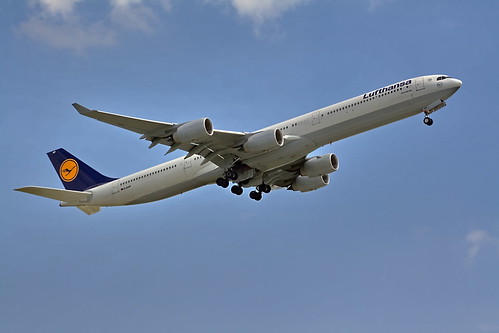
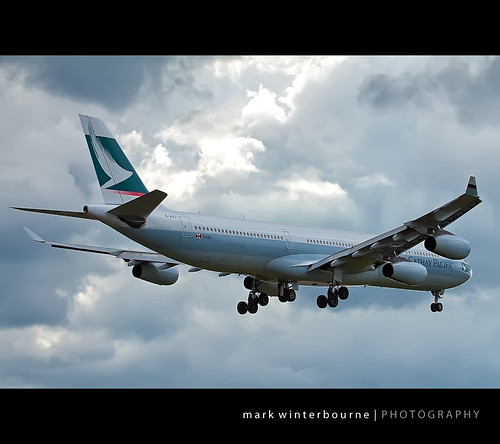
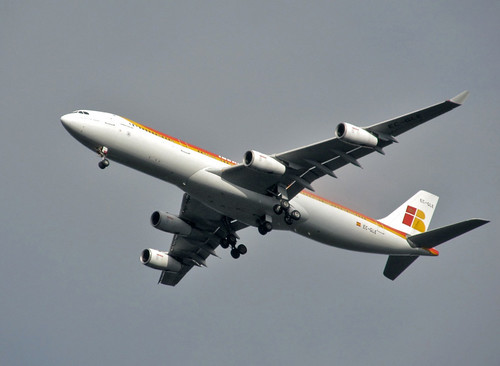
The truth is, the A340 was probably the first Airbus aircraft that I really liked visually. I liked the slender appearance of the widebody fuselage and I liked the four engines and how they were hung on the wing in a proportion that just seemed a bit sexier than other 4 engine aircraft.
I liked Airbus’ approach to the A340/A330, too. I’ve always been fond of the parts bin approach to creating value for a customer and the A330/A340 development was certainly that.
A fuselage that got borrowed from its first twin-aisle aircraft and CFM engines that were derived from the A320 aircraft. Need a medium range hauler? Use our A330. Need a long range widebody? Try our A340. Going trans-Atlantic? Use our A330 and if you’ve got trans-Pacific routes, we have this lovely 4 engine aircraft for you.
And you got to have pilots that could fly both.
It was a beautiful approach and a real answer to what was needed at the time. It was way better than McDonnell Douglas’s offering in the MD-11 and Boeing really didn’t have an aircraft that even fit the needs at all.
ETOPS was changing the game at the same time, however. So was engine development.
The MD-11 was a bit flawed in that it really needed a truly new wing and better engines to achieve its mission. But the ever frugal derivative player, McDonnell Douglas, played things just a bit too frugal.
The 747 was simply a different class of aircraft. The 767 was too small and too short ranged to fit the gap.
Airbus did a great job with those aircraft in offering a sweet spot solution for both capacity and range and then made a strong business case for both of them by making them as common as possible. You cannot blame any airline who went that route. It was, in the context of the times, the perfect solution.
What we didn’t really count on was engine manufacturers being willing to truly make game changer engines and ETOPS going far past anything anyone could envision. The 777 was born and it was an even bigger game changer. First an aircraft that solved the A330 problem just a little bit better. Not fantastically better but it offered just a touch more capacity and bit more cargo capacity and it did it with engines that were more revolution than evolution.
The A330 has survived because of its improved derivatives and any airline using them makes great money.
The A340 got hampered by a few things. It needed a bit better wing and better engines (and finally got both in the A340-500/600). The CFM engines were a great choice going in but the Rolls Royce Trents were the answer to a question that got asked a bit too late.
Airbus bet on 4 engines being preferred for long haul, trans-oceanic routes and given the dominance of the 747 in that market, it wasn’t a bad bet. Their mistake was in underestimating Boeing’s ability to look forward. Boeing saw the possibilities in ETOPS and extra high by-pass engines that were more reliable than anyone could have conceived of a generation earlier. And it should have given its customer base at the time.
Airbus was hampered by a bit of McD disease and by multi-government ownership at the time. It didn’t have enough capital to go “all in” on designs and knew it had to make its business case on flexibility which meant derivatives. In fact, it often only got capital for new investment if that investment benefitted its owners in the form of jobs programs for their citizens.
While thinking about this post, it occured to me that Airbus even produced a 747-SP. The A340-500 derivative. It could fly fantastic distances but without enough passengers to make it cost effective. Then the 777-200LR came along and was capable of doing *that* mission better and cheaper.
The 777-200ER and 777-300ER killed the A340 in all forms (And EADS CFO just admitted it in the press). It could haul more passengers and cargo for the same or longer distances for less money. It was that simple. Boeing made the business case on trip costs and won.
Even if hindsight is 20/20, you can’t say that Airbus made a mistake with the A340. The A340 killed the MD-11 and exposed the weaknesses of owning 747s. It did its job very well but it arrived just a little bit too late to enjoy its success for very long. Timing is everything.
I would criticize Airbus for the A380. Yes, it has made a few airlines some good money. It also ignores the model(s) for long haul travel over the broad spectrum in favor of trunk routes. It will never enjoy the numbers or prevalence of the 747. On the other hand, neither will the 747-8i.
I’m not sure the A350 is the answer either. I don’t think it fits long, thin routes as well as the 787 and its planned derivatives. I don’t think it fits the long, large capacity routes quite as well as the 777 either. Its smallest derivative is an A330 replacement at best and I question whether or not it will ever get built. Its largest derivative so far doesn’t respond to the 777-300 as a game changer either. They are free to prove me wrong.
It’s not that I think the A350 won’t sell. It will. But I think it’s destined to be a player among a fairly small core group of airlines. Much as the A380 is and will be. Boeing took a page from the Airbus playbook and built the 787 to fit a nice, broad piece of medium and long haul routes and positioned itself to answer the largest A350 with a next gen 777 or next gen new build large capacity, widebody aircraft.
Boeing one ups Airbus over the next 20 years with its product line up and does it in a way that has the gaps covered in distance, capacity and service.
With all of that said, I still think the A340 is one hell of an elegant and pretty airliner. It lends itself to the great airliner liveries of the world. Just look at these:
(All images from Flickr under their Creative Commons License)
Ryanair says that it may buy or lease used aircraft to fill its gaps until the COMAC C919 arrives in 2018 with a 200 seat aircraft.
I say that that statement is Ryanair standing up and yelling “Look at me! Look at me!” to Boeing and Airbus. ]
While Ryanair says its dead serious about this aircraft, they conveniently do not rule out striking a deal with Boeing or Airbus on their aircraft and I would point out that China has yet to produce a viable commercial aircraft . . . ever. They are getting closer and I do believe that China will one day manage to succeed.
However, their ARJ21 is a non-starter since it is heavy and, you know, no one has really ordered it except Chinese airlines who were told to order it. Building a first time, competitive single aisle mainline aircraft requirese a body of experience that China doesn’t have. Brazil has it. Arguably Japan has it. Canada even has it.
China doesn’t.
So why should Boeing or Airbus feel threatened by Ryanair’s moves? They shouldn’t. Sooner or later, Ryanair will have to make a move on a next generation 737MAX or A320NEO. And they will get a good deal but gone are the days of getting a deal where you can buy a 737-800 and sell it in 3 years to *make* money on the sale. Neither manufacturer are, in the least, that desperate.
The 737 Next Generation Series is the most capable single aisle airliner being built today. The 737-700 has a true transcontinental capability and the 737MAX aircraft may have trans-Atlantic capability when it is defined and built.
Question: What was the range and passenger capacity of the first 737-100?