|
December 7, 2009 on 8:00 am | In Airline Fleets, Airline Service, Death Watch | No Comments
At the first of the year, I wrote 3 blog posts shown HERE, HERE and HERE. It was really just my random speculation on what to expect over the next 12 months. Well, now it’s December of 2009. Let’s see how I did.
Boeing 787: I guessed at an April 2009 first flight. It still hasn’t flown although speculation has it flying this month either by December 14th or December 22nd.
Airbus A380: I guessed they would make their goal of producing 21 aircraft this year. As of November 30th, 2009, Airbus says they have delivered 7 A380 aircraft this year. Ouch. This is a program that is in financial trouble. No, I don’t think it will be cancelled. Not yet but please don’t try to tell me this program will make a profit.
My deathwatch had Midwest Airlines going away most likely by a sale. That did happen and while the airline has essentially evaporated (from its original form), it does remain as a brand being run by Republic Airways.
I speculated that Frontier Airlines would be bought out of bankruptcy but I guessed that jetBlue would be the buyer. In fact, Southwest Airlines and Republic Airways were the suitors and Republic won.
I thought that United Airlines and US Airways would announce a new merger with Continental a dark horse candidate for buying United. In fact, Continental became a member of the Star Alliance and firmed its relationship up with United but wisely kept its distance otherwise.
I said that Southwest Airlines would maintain its status quo but that Gary Kelly would be under fire from both employees and outsiders and he was. However, that view is already being reversed again by Southwest’s resurgent strength in the business.
I thought that the Middle Eastern airlines such as Emirates, Etihad and Qatar wouldn’t see a bankruptcy or merger but would slow their growth and aircraft deliveries. That, in fact, has happened and now we see Emirates working hard to distance itself from Dubai World’s financial woes.
China: I said deferred orders. Pretty much what happened.
The Far East: I said airlines from that region would maintain their status quo, probably would not defer orders and might make new orders to replace existing equipment for greater effiency. Again, pretty much what happened.
Australia: I saw QANTAS slowing growth, deferring some orders and fighting hard against new entrants. Again, that’s pretty much what happened. I also saw two weak competitors on the US-Australia routes: United and V Australia. That is pretty much what is happening although V Australia has been pretty smart in working into a relationship with Delta where it appears the two airlines will cooperate with codeshares. United remains alone and with weakening demand.
South America: I said the Argentine government would take Aerolineas Argentinas back from Grupo Marsans and the airline itself would muddle along or contract rather severely in some areas. Bingo. Exactly what happened. I also predicted Azul would become the jetBlue of Brazil and its not hard to guess that that airline is pummeling its competitors. A future prediction was for the airline to fly internationally in 2014 with Airbus equipment. We’ll see.
Africa: I saw Delta continuing to pursue flights to major African cities (true) and SAA (South African Airways) issuing a small RFP for 777 aircraft to replace its rather inefficient A340 aircraft (didn’t happen.)
India: I thought Jet Airways and Kingfisher might merge with the name Jet Airways being retained. In fact, both airlines continue to exist but both are suffering severe financial problems, deferring aircraft deliveries and generally flailing about trying to find a way to continue. One of these airlines will still ultimately have to exit the market and I continue to think it will be Kingfisher. They have the wrong aircraft and the wrong aircraft on order. However, Jet Airways is suffering badly from labor actions among its employees.
United States: I picked United to fail. It hasn’t happened and while they continue to live, their cash holdings are being reduced, they still have severe labor issues, their service product continues to suffer and I still think they should be the ones to disappear. I also thought Glenn Tilton would be ousted and, possibly, replaced by Doug Steenland. That didn’t happen but John Tague has been groomed as Tilton’s replacement. I still think Tilton should go if United can’t fail.
Europe: I thought we would hear of a surprise from Lufthansa. I didn’t like their purchase of SWISS and I didn’t like their flying the A340 in competition against the 777 being flown by many of their direct competitors. They’re still here, still making money and they bought BMI. I still think we’ll here of misfortune from them but apparently it will take a while longer.
Random Speculations:
- I thought Southwest might add another aircraft type. It didn’t happen but I think their interest got perked up when they looked at buying Frontier and saw the economics on the Q400.
- I thought Delta might order more Airbus A330 aircraft. Instead, Delta is parking them in the desert for the winter season.
- I speculated that both China and Japan would defer or drop their regional jet programs. That didn’t happen but the Chinese jet program appears to be a bad aircraft and unlikely to be used by anyone except Chinese airlines forced to buy it.
- I thought Bombardier would see a major order (20+) for their Q400 series aircraft from a US customer. Horizon Airlines did up their orders for 10 more but there were no other significant orders.
- Airtran to form a small midwestern hub. Yup, that happened. In Milwaukee where they’ve taken over from Midwest Airlines and now face Midwest (brand owned by Republic) and Southwest Airlines entry into the market. I think Airtran will hold on here and continue to develop business.
- Last, I hoped that jetBlue or Virgin America would enter the DFW market. Virgin’s CEO, David Cush (formerly of American Airlines) did recently speculate about adding flights to either DFW or Austin. I suspect they’ll choose Austin and DFW will remain a fortress for AA.
That’ s it for my 2009 predictions. I’ll make more at the start of 2010. On the whole, I probably did as well as anyone in making predictions in this business.
Filed under: Airline Fleets, Airline Service, Death Watch by ajax
No Comments »
December 6, 2009 on 1:05 pm | In Aircraft Development | No Comments
The Seattle Times is reporting that Korean Air Lines has signed a Memorandum of Understanding to purchase five 747-8 Intercontinental aircraft, the passenger version of the 747-8.
Amazingly enough, it’s been 3 years since Boeing landed an order for the passenger version of the aircraft and while this signals some movement on that model, all is not what it seems here. You see, without background, this is an order that should have been Airbus’ to lose given the density of many of Korean Air Lines routes.
Does it make a difference that Korean Air Lines also makes part of the Boeing 747-8? I’m sure it does. While I’m confident Korean Air Lines wouldn’t make an order for an aircraft that was fundamentally unsuitable for the airline’s routes, I’m equally sure that this was Boeing’s to lose.
Nonetheless, it’s nice to see the passenger version notch up another 5 orders. Presently there are 32 orders for the passenger version comprised of a Lufthansa order for 20, Korean Air Lines order for another 5 and 7 unidentified VIP orders. An additional 78 orders for the freighter version exist and first flight of the 747-8F is expected sometime soon.
Filed under: Aircraft Development by ajax
No Comments »
December 3, 2009 on 1:01 pm | In Aircraft Development, Airline Fleets | No Comments
That isn’t a big surprise to most readers of this blog and one very good reason why I’ve said little about the event. Despite the long program delays and disappointing news of certain developments about this aircraft, I remain extremely excited about this aircraft. Perhaps for different reasons than most, though.
Mainstream press continues to speak about the 787’s increased comfort potential for the passenger and sometimes mentions the efficiency the aircraft will offer airlines. All that is true but it excites me for different and more specific reasons.
First and foremost, it is the first truly new aircraft to come from Boeing since the 777 made it’s first flight in 1994. Since then, there have been improved variants of the 737, 767 and 777 introduced but this is the first “from scratch” aircraft to show up in 15 years from Boeing. That is exciting to me.
One of the most disappointing results from the Boeing / McDonnell Douglas merger is that, in many respects, Boeing was taken over by McDonnell Douglas managers rather than the other way around despite the fact that, for all intents and purposes, it was really a Boeing takeover of McDonnell Douglas. Since that merger, Boeing has been much more intently focused on developing its defense businesses almost at the expense of investing in Boeing Commercial Aircraft. That has been disappointing and a bit perplexing to me given Boeing’s ability to build fantastic aircraft for the commercial world.
So I hope that this aircraft, the 787, represents a return to innovation and development for Boeing Commercial Aircraft. I hope that a new, younger group of managers is being born from this program that will lead Boeing’s development of new aircraft such as a 737 replacement, a 757/767 replacement and, yes, a new 777/747 replacement too. But I remain concerned if for no other reason than Boeing seems to be ignoring new competition from Bombardier and EMBRAER who are now challenging the 100 to 130 seat domestic segment in the US and elsewhere. If Bombardier can build its new C-Series aircraft with union labor in Canada, Boeing should be more than capable of developing a new family of aircraft to compete against those two companies.
While the first flight is truly on track to happen in the next two weeks, the burning anticipation of that first flight has, if anything, died down in many respects. Those who have followed it tortuous path to first flight recognize that it isn’t the first flight that means anything now. The aircraft is so mature in its development that we know it will not only fly but fly very successfully. We know that the major teething problems are almost certainly over now. There isn’t any need to speculate on its performance on a first flight and really nothing to wonder about for its testing over the next 12 months.
The real anticipation comes from seeing it perform with an airline. We want to see it enter an airline’s fleet and see how it performs during real world use. We want to see if airline CEOs proclaim it the game changer we all ferverently hope it is. We even just want to see what the airlines’ liveries will really look like on it. The real next “moment of truth” for the 787 is when it enters a fleet in its new livery. The launch customer is All Nippon Airways (ANA) and we should see ANA put the 787 into service sometime in late 2010.
The 787 should see service with a US airline in late 2010 or early 2011 and it will be Delta Airlines who has the honor by virtue of inheriting Northwest Airlines’ orders. I suspect we’ll see Delta order more shortly after the 787 begins operating in its fleet. Continental Airlines will put the 787 into service a short while later.
This is the most anticipated large volume aircraft to be designed and built since the 1960’s. That’s exciting.
What’s also exciting is what this aircraft means to Boeing and its future development projects. Will these same technologies be used on a 737/757 replacement? Is it conceivable that they’ll be used for a Very Large Aircraft to replace the 777? Both are possibilities. Detractors say there isn’t as much “gain” to be had in using carbon fibre based fuselages for a 737 replacement with respect to efficiency and that is probably true.
However, these new techologies may mean that Boeing can produce the 737 replacement even faster. The composite carbon fibre fuselages may mean less maintenance and longer maintenance intervals for airlines like Southwest and Ryanair. The new engines coming into development will demand some changes too. Larger by-pass ratio engines or, if developed, open rotor engines means more clearance will be needed between the wing and the ground. The next aircraft will have to stand taller and that might mean a little more time spent on ground handling.
The next generation engines and Boeing decision to produce an “electric” airliner may see those approaches used in the 737 replacement. Have we reached a point in reliability that we can expect these new systems to survive the punishing schedules of a domestic airline? I think so but the 787 is the aircraft that must support that supposition.
The 787 won’t be exciting because of what it potentially offers the customer in comforts. Yes, no matter what we’ll have larger windows and a little bit more fresh air and pressurization in the cabin but if you think you’ll be getting more spacious seat pitch, you’ll be disappointed. This new aircraft will be as packed as any in service now. Overhead bins will still be crowded.
My birthday is December 12th. There is speculation that the 787 may fly as early as December 14th. That’s close enough that I find myself kind of hoping that Boeing might pull a fast one and send it up into the sky 2 days early. It would be exciting to have an airliner born on my birthdate.
Filed under: Aircraft Development, Airline Fleets by ajax
No Comments »
November 23, 2009 on 8:30 am | In Airline Fleets, Airline News | No Comments
Michael O’Leary, CEO of Ryanair in Europe has been demanding a new deal for up to 200 Boeing 737 aircraft between 2013 and 2016 according to Reuters. Keep in mind that up to 200 aircraft likely means a firm order for between 50 and 100 aircraft with options for more. Boeing, on the other hand, has so far refused to negotiate what is by all accounts a rock bottom deal on their 737. More amusing is that Airbus has so far refused to offer a better deal on their aircraft since they’re already familiar with Mr. O’Leary’s tactics when it comes to negotiating. He likes to play one manufacturer off another.
There are likely several things at play here. First, Ryanair has often made a profit by “turning” their aircraft rapidly and selling them for a profit to other, smaller players. A situation that has no doubt irritated Boeing as they are looking to sell to users, not distributors. The original pricing for Ryanair was negotiated at a time when commercial aircraft sales for the industry and Boeing in particular were pretty flat and there is no doubt that Ryanair offered a serious opportunity for cash flow at a time when Boeing was in need of filling slots in its delivery schedule.
Not so much anymore. Boeing has a health backlog of orders and many of them for airlines who will pay more per aircraft and be happy to receive their 737s early. American Airlines has continued to up its orders for the 737 in light of the fact that no new next generation 737 replacement is due anytime soon from either Airbus or Boeing. Other airlines are likely to do the same over the next year or two. There is no incentive for Boeing to make an even better price to Ryanair.
And I think Mr. O’Leary knows it. But by making his threats and going public with them, he has begun to set an argument for why Ryanair will likely do a couple of things in the next few years. One will be slowing their growth. The truth is, growth opportunities for them in their market(s) are becoming few and far between. Second, they really can’t continue to “flip” aircraft in the next few years as there are plenty of other sources developing for second hand NG 737 aircraft. Slowing their purchases will give them a public rationale for slowing growth and reduced profits from sales of the 737.
I also doubt that Mr. O’Leary will distribute money to either his executives (in the form of bonuses) or to his shareholders. If there is one thing he knows, it is that an airline lives and dies by its cash holdings. It’s a weapon that I don’t believe he would give up. Instead, they may choose to invest it.
Mr. O’Leary has publicly spoken about creating a new trans-Atlantic airline in the future. Whether or not it is just talk, we’ll never know unless he does it. However, he does need the right kind of aircraft for developing his self-described premium/economy airline for the markets he thinks he can access. Part of his plan includes flying to secondary airports again in the US to save money. A plan that, I think, he’ll learn isn’t nearly as feasible as it might be on the European continent. There are no secondary airports with good transportation to their major market centers. You can take passengers to Hartford, Connecticut, for instance, but there isn’t a cost effective way to get from there to Boston or NYC.
However, that doesn’t mean Mr. O’Leary can’t access a number of markets and do so profitably. He is a master negotiator and there are plenty of US airports that would potentially welcome such an airline. With lots of cash, reduced capital requirements for the Ryanair fleet and good timing, they can establish such an airline if they can find the right equipment to use.
And that leads us back to Boeing. I think Mr. O’Leary recognizes that the 787 might be just the right equipment for such an airline. Both the 787-8 and 787-9 offer the right kind of efficiency, size and economics for make such a venture a success. There is no way that he’ll buy second hand aircraft such as the 767 or the A330 for such routes. Its difficult to find new(ish) aircraft on the used market that are worth purchasing and the A-330 probably is just too big for the routes. But the 787 potentially offers the right package. And I wonder if the current bluster about a deal isn’t about getting Boeing “prepped” to do a deal on the 787 with earlier delivery slots at great prices.
Time will tell. One thing I’m entirely certain of is that Michael O’Leary doesn’t have nearly as much contempt for Boeing as his bluster indicates. Both companies have done very well with each other and both understand that its in their interests to find a way to continue to do business.
Filed under: Airline Fleets, Airline News by ajax
No Comments »
October 9, 2009 on 10:57 am | In Airline Fleets, Airline Service, Airports, Deregulation | No Comments
The Cranky Flier had a post today discussing Continental’s new moves in LAX which include new flights to Hawaii. Continental will have an all 737 base in the Los Angeles area with two 737’s serving new flights from Orange County to Hawaii. It made me think.
Back in the pre-regulatory days, flights from the mainland US to Hawaii were served by large aircraft such as the 707, DC-8 and, later, the 747, DC-10, L-1011 and even the 767. The routes allowed airlines to serve huge numbers of customers with large aircraft and make money. Braniff International had the franchise for Dallas to Honolulu in the 1970’s and served it with a 747 and an amazing 16 hours per day utilization.
Then deregulation came and airlines slowly began to develop new routes. It was no longer necessary to fly to a “gateway” city to catch a flight to Hawaii. More and more cities found themselves being served with those routes to Hawaii. Again, Braniff International, at one time, had a 747 flight from Portland, OR to Hawaii. (It carried little traffic, however.)
There was some consolidation after airlines learned that not everyone in a particular city was dying to fly to Hawaii. But the big change for Hawaii has been ETOPS or twin engine flights overseas. This allowed airlines to serve smaller markets with aircraft both capable of the loads as well as the distance. The truth is, when the airlines don’t have to feed 150 passengers a day to a gateway city but can fly them directly, they make more money. 20 years ago, I would have chuckled if someone told me that 737-700 aircraft would fly to Hawaii from the mainland.
Boeing and Airbus have different views for the roles of widebody, large capacity aircraft. 10 years ago, Boeing forecast that the market would continue to fracture with more and more direct routes being employed as opposed to large capacity hub to hub flying. Airbus, however, believed that the crowded skies would force more large capacity hub to hub flying onto the airlines. It turns out that Boeing was more right.
The markets drive these changes and when an airlines can make more pure profit using right sized aircraft flying direct, they will. Yes, the legacy airlines of the US (and other parts of the world) continue to follow a hub and spoke model primarily but they’re all learning that more direct flying where the loads fully justify it is a good and profitable thing.
Accordingly, this is where I think Boeing continues to have a winning strategy with its 787/777 product line. Yes, there are a few airlines capable of filling an A-380 and those airlines will make money from using that aircraft. But as more and more nations open up their skies to more competition, that is going to change. Having the right aircraft for the right route will be key to a manufacturer’s success and Boeing seems to have a better feel for the world market whereas Airbus seems more plugged into the Euro/Middle East markets they already do so well in.
I’m no longer sure there is a real place for the new 747-8 aircraft. Boeing’s 777-300 is just as capable in almost every case and carries a massive number of passengers without being so big that it adds risk during seasonal low periods. The same is true for the 777-200.
And what happens when aircraft such as the 787 family begin flying? This family is roughly 767-sized in capacity but its range is far greater and that means even more markets can be accessed via long haul direct flying. An international airline can probably make more money (through passengers *and* cargo) using the 787 and 777 families for more direct flying with aircraft that are “right sized” for the markets than they can using much of the Airbus family.
Airbus has one aircraft model suitable for this right now. The A-330. the A-340 is essentially dead since it under performs against the 777 in virtually any mission. The A-330 is right sized for a number of the current markets and many more of the future markets. The A-380 is suitable for only a few markets and those are already dwindling for some airlines. For instance, QANTAS has introduced the A-380 on their routes to the US. However, with a new Open Skies treaty between the two countries, there are also new entrants to the market like V Australia and Delta who are vying for customers with United and QANTAS very competively. Those airlines understand that it will take a while to develop their routes and build relationships with airlines in both countries to feed traffic but it will happen. As that traffic shifts from what was originally two airlines (QANTAS and United) to four airlines (QANTAS, United plus V Australia and Delta), what happens to each airlines’ loads?
It’s notable that QANTAS flies the 747 and A380 to the US and United flies the 747 exclusively. The new entrants are using the 777-300 and 777-200 for their flights. The 787 and it’s longer range capabilities will quite possibly fracture that market even more by making it possible to fly from the interior of the US to Australia instead of having to use a west coast gateway city. At that point, I don’t know that QANTAS has a use for very many A380s or 747s and, additionally, they don’t have any right sized aircraft for the route(s) until they start receiving their 787s which are late and somewhat deferred.
The Airbus A350 is capable of competing on many 777 routes and while it does have slightly lower trip costs vs the 777, it also has less revenue capabilty because it can’t haul as much cargo on the same missions.
The world’s airline routes are going to continue to expand internationally and at a far greater rate than traffic grows between any two nations. Having the right equipment for the right moment is going to be key for any international airlines survival. Those who don’t plan for it now and have it arriving in the next 5 to 10 years are going to wither to a slow death.
Filed under: Airline Fleets, Airline Service, Airports, Deregulation by ajax
No Comments »
March 3, 2009 on 4:48 pm | In Trivia | No Comments
It’s still slow in the news of airlines but I have some ideas for articles to come soon.
In the meantime, I thought I would post THIS link to a Boeing 707. The aircraft is in a park in Ho Chi Minh (ex-Saigon) and somewhat near the airport. It’s supposed to be an aircraft originally owned and operated by South African Airways that was later sold to Vietnam Airlines.
The view from Google is just entertaining.
Filed under: Trivia by ajax
No Comments »
February 9, 2009 on 10:41 am | In Airline Fleets, Airline News, Trivia | No Comments
Happy Birthday 747
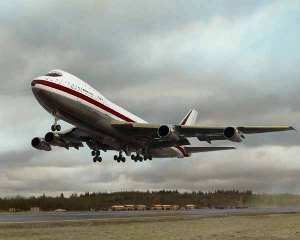
photo credit: Boeing photo
Today is the Boeing 747’s 40th Birthday. Or, at least, I count it as such since today marks 40 years since the legendary jumbo jet took its first flight.
Filed under: Airline Fleets, Airline News, Trivia by ajax
No Comments »
January 3, 2009 on 10:00 am | In Airline Fleets, Airline Service, Deregulation | No Comments
In keeping with the theme set with yesterday’s post, let’s continue on with some predictions.
The MIddle East
Emirates, Qatar and Etihad: All airlines that have aggressive growth plans (both in fleet size and the capacity of their aircraft) that don’t seem to be based in reality. While each of those airlines has successfully developed themselves into eastern hemisphere global airlines, what’s next? There are few opportunities to grow to the United States or the Far East (both range and regional prejudices apply there) and that leaves Europe (somewhat saturated already) and Africa (not a real place to grow due to low demand). But they have to fill an amazing number of widebody aircraft they’ve ordered. We won’t see a merger or a bankruptcy here but I do believe we’ll see these airlines start to reconsider the orders they have on the books and they will slow their growth by deferring these orders.
China
China’s airlines have been on a buying binge as well but, again, with a weakening domestic economy as well as a weakening international economy, they have no place to go. Like the Middle East contenders, they are likely going to start deferring orders as well.
The Far East
Airlines based in Taiwan, Korea, Japan, Thailand, Indonesia and Singapore will all maintain their status quo more or less. There is some possibility that some orders may be deferred but I will bet that some airlines will actually make new orders for new aircraft although not for growth but for greater operating efficiency.
Australia
QANTAS and its affiliate Jetstar have made major investments in new aircraft and major plans in new market development. However, development of new routes in the Far East and Southeast Asia will slow or even contract as reduced demand continues. What’s worse is the new competition they’ll experience on their routes to both Europe and the United States. I expect some order deferrals (probably for the 787) and growth plans will be slowed or deferred altogether as they retrench in the face of competition.
Virgin Blue / V Australia will be challenged in several ways. They’ll likely continue to do well in the Australian domestic market but now they face competition in the Australia / United States market not only from QANTAS, Air New Zealand and United Airlines but also from Delta. There will be too many airlines chasing too few seats in this market and the two most vulnerable airlines, in my opinion, are United and V Australia. United because its service product pales in comparison to any of the other airlines and V Australia because their business model is based more on economy travel than business and first class.
South America
We’ll not see any real growth (with one exception) and we’ll likely not see any real failures here either. The governments of South American countries tend to jump in and save their national airlines when doom is near.
Aerolineas Argentinas should be Argentina’s Alitalia but I suspect a takeover of this airline from Grupo Marsans (a Spanish conglomerate) by the Argentine government will happen sometime this year. Aerlineas Argentinas will continue to muddle through with a incoherent fleet of Airbus aircraft funded by the government and Argentina will see no growth and possibly some severe contraction in their markets because of a failed air traffic system and a very weak economy.
Brazil will continue to be stable more or less but existing Brazilian airlines will have to now contend with David Neeleman’s new airline, Azul. Neeleman (who holds dual citizenship in Brazil and the United States) understands Brazil and will be offering a highly competitive, high service airline founded with Embraer E-190 aircraft that are very well suited to the Brazilian market. It will be jetBlue all over again in Brazil for the next 5 years. However, I expect this new Neeleman airline will one day become an international airline flying both in South America as well as to Europe and the United States. I’ll go ahead and predict this development for 2014 and they will use Airbus equipment.
Africa
Not much to say here. African airlines come and go with stunning frequency and usually without much notice. Delta will continue to develop routes to Africa but this will be aimed towards the very few, relatively stable, major cities Africa has. South African Airways will find someway to continue to exist but I expect a switch from Airbus aircraft in their long haul services (A340 aircraft currently) to a Boeing fleet using the 777-200LR and 777-300ER and GE engines. This switch alone could make them profitable. My prediction is that we’ll hear about a Request For Information (RFI) or a Request For Proposal (RFP) by the end of the year but more likely at this year’s summer airshow in Paris. It will be a small order, at first, and quite possibly contingent upon Boeing finding new owners for the A340 aircraft they already own.
India
With their new, highly competitive market, India has become a rather intense version of the US market. With a weakening economy here as well, I look for consolidation and liquidation as the answer. Look for Kingfisher to merge with someone else such as Jet Airways with Jet Airways being the name retained by the end of 2009. Another possibility will be forced mergers and/or liquidations by the Indian government particularly if the current party loses power. The rather laissez faire experiment in airline deregulation in India has left a bad taste in many people’s mouths, most particularly in the opposition parties not currently in power. India’s current Prime Minister Singh holds degrees in economics and is widely credited with economic reforms in India but the fractured and unsuccessful airline industry is something for the opposition to make a point of.
Stay Tuned for Part III
Filed under: Airline Fleets, Airline Service, Deregulation by ajax
No Comments »
January 2, 2009 on 11:57 am | In Airline Fleets, Airline Service, Airports, Death Watch | 2 Comments
It’s always fun to make predictions about the coming year, right? Of course, I may well review my predictions in December of 2009 and decide against doing it again.
Boeing 787:
This aircraft will finally experience its first flight and I believe it will occur on or about its new scheduled time (early April). For Boeing, credibility is now at stake and they really do have to begin meeting deadlines. Financial analysts are becoming too skeptical of the company for comfort and airlines want their airliners. Boeing does have a reputation for being able to pull itself together and get something done in a crisis and that should serve them here.
I also believe we’ll see both static airframes begin their tests and new build airframes begin to flow from Boeing in about 6 months. My prediction? The 787 will prove to be a very capable aircraft and will meet or exceed its performance promises.
Airbus A380:
Airbus met its revised schedule of delivering 12 A380 airliners in 2008 . . . barely. Originally it was scheduled to deliver 13 in 2008 and 25 in 2009. Now Airbus says it will deliver 21 in 2009. However, it is becoming clear that Airbus is now quickly learning how to build these aircraft and turn them out. I predict they’ll exceed their 21 goal in 2009 by at least one aircraft.
Boeing and Airbus:
Both aircraft makers will begin to speak about the future of short to medium haul aircraft again. With milestones for the 787 and A380 being met, I suspect they’ll become more comfortable in speaking of the future of their aircraft lines. Look for discussions on both the 737 and A320 aircraft families and what interim technologies might be employed to improve their performance. I suspect we’ll hear about both weight saving materials being adopted as well as the potential of new incremental improvements on existing engines. Particularly the CFM-56 engines used by both makers.
US Airlines:
First, let’s take a look at my deathwatch candidates. The sudden and precipitous drop of oil prices allowed each of them to take a breather. Midwest Airlines, however, continues to speak little, fly only a little and its investors have got to be running out of patience. I still believe that they’ll ultimately go away. How they do it is the question. Rather than bankruptcy, I believe it will either be a sale or as a subsidiary airline of Delta/Northwest with the latter being most unlikely. Who will they be sold to? Good question. Perhaps Airtran will get what they wished for and develop indigestion.
Frontier continues to muddle along but faces rather intense labor strife still. I think their situation improved not only because oil prices dropped but because United continues to offer some of the worst product in the industry and because Southwest slowed its growth and took a breather. While I firmly believe United will do nothing to improve its product, I do think Southwest will return to its goal of killing Frontier as a Denver competitor some time in the late spring. I suspect Frontier will emerge from bankruptcy this year but I also firmly expect them to be out of business or acquired by December of 2009. Who buys them? I’ll bet on Jet Blue. The aircraft fleets are compatible and Jet Blue has to start building a hub somewhere else in order to continue to experience strong growth. Frontier gives them that chance. The long shot? American Airlines. Why? Because Frontier is working with AMR’s Sabre Reservations system now.
United Airlines, my favorite airline to hate. The Cranky Flier loves to rag on Alitalia and I love to rag on United. United has lost a tremendous amount of value over the last year and continues to have some of the highest hourly costs of any US airline. They’ve done nothing to improve labor relations, their service product or their fleet efficiency. Glenn Tilton is hated by airline pilots but I predict he is goint to be hated by investors before the end of summer. What happens? I’m really not sure. The best thing that could happen is for them to liquidate. However, I think some airline will see some value there and attempt to buy United and make use of its assets. Who? The logical choice is Continental but I believe they’ll hold on to their independent streak. So my next guess is a US Air / United V 2.0 merger will come about. Could it work? I doubt it but Doug Parker (CEO of US Air) wants another merger and United offers hubs he doesn’t have and some aircraft fleet compatibility. I’ll go “all in” and bet that we see a US Air / United Airlines merger announcement by December of 2009.
Moving on from the death watch, let’s look at other US Airlines for a few minutes.
American Airlines will maintain its status quo but will begin to feel pressure to conclude some union contract negotiations this year as financial analysts begin to view their lack of progress less and less favorably. CEO Gerard Arpey will begin to feel the heat but barring a large mistake on his part, will retain his position as CEO. One possibility, however, will be bringing on a potential successor as President of the airline.
Southwest Airlines will also mostly maintain its status quo but I will predict that by late summer its new CEO Gary Kelly will be under fire from both employees and investors for his shotgun approach to growth. It is beginning to look like it is unplanned and what people most value in Southwest is its ability to form and execute a coherent plan. There will be no mergers, no real growth and a sinking stock price by December but I think Mr. Kelly will hold onto his position until 2010 barring a major unforeseen development.
Continental, the best kept secret. Continental will maintain its status quo with, perhaps, very moderate growth in the international sector while it waits to see what happens domestically. They’ll enter the Star Alliance (exiting from SkyTeam) but discover it offers little value to them as well. I don’t think they’ll seek to merge with anyone in the next year but if they did, I’d pick them for going after someone like Alaska Airlines rather than United or US Air.
Stay tuned for Part II.
Filed under: Airline Fleets, Airline Service, Airports, Death Watch by ajax
2 Comments »
November 4, 2008 on 3:12 pm | In Airline News | No Comments
The Seattle Post Intelligencer aviation reporter, James Wallace, is now reporting the possibility that Boeing’s new 787 may not make its first flight until February or March of 2009. Citing the 57 day long strike just settled by Boeing, the program is now supposed to be under review. At the beginning of the strike, Boeing’s 787 program manager had stated that it would be a day for day slip until first flight.
However, late February or early March is not a day for day slip and I think this news begins to reveal that there are indeed other problems on finalizing the 787 for its first flight. The 787 is now more than a year past its original forecast for first flight and had been definitively scheduled for a 4th quarter first flight this year. Prior to the strike, that was expected to be some time in the middle of November, 2008.
The delays to the program really should come as no surprise since this aircraft involves far more innovative engineering than probably any other commercial aircraft designed in the past 40 years including the 747 and A380. Still, another schedule slip after re-defining the program schedule and including plenty of time for more unanticipated problems begins to reveal that this is in fact a program in trouble. At this point, it is safe to say that Boeing is likely to experience a great deal of trouble getting the production ramped up to meet demand.
Filed under: Airline News by ajax
No Comments »
October 31, 2008 on 10:02 am | In Airline Fleets, Airline News, Airline Service | No Comments
Delta / Northwest is not only big with respect to the number and type of airplanes they have, they are also big for the number of hubs they are currently operating. Conventional wisdom continues to bet that some of those hubs will be closed or rationalized just as it bets that the airline fleet will be reduced.
My guess is that there really won’t be a reduction in hubs of any real significance with the exception of two. This new airline has two hubs in close proximity, Memphis and Covington/Cincinatti, and each serves similar markets. However, rather than being combined into one, I suspect that Memphis will likely be de-emphasized into a “focus” city with more connecting traffic routed through Covington/Cincinatti. The yields in each city are very good but Covington/Cincinatti is by far the city with the best yields. Memphis is likely to remain as a focus city because it is a good gateway to the central midwest section of the US.
All other hubs in the US such as Atlanta, Minneapolis / St. Paul, Detroit, and Salt Lake City have the airline as a dominant carrier and there is no reason to combine any of them with respect to the routes they serve.
Now, both airlines operate significant flights from gateway cities such as Los Angeles and New York and it is quite likely that the airline will work hard to combine some flights going to the same cities. For instance, flights from the New York area going to the same destinations in Europe will be combined to raise the load factors on the equipment being used. However, Europe presents an interesting problem because Northwest has been in a close relationship with KLM and has used Amsterdam as a “hub” to connect to other cities in Europe. Delta, on the other hand, is used to flying direct flights to a variety of cities in Europe without a hub or close partner. I suspect the relationship with KLM will be reduced so that Delta can raise the loads on its own flights to smaller European cities.
Northwest comes to the table with a hub in Tokyo, Japan and they have 5th Freedom Rights to pickup and carry traffic from Tokyo to other cities in Asia. On the surface, that would appear to be a very valuable asset. However, the value of that arrangement was far greater when the political climate in Asia was much different and the range of aircraft made it more convenient to fly to a central hub. Today, it can be much more profitable to fly direct to a variety of Asian cities using newer, long range aircraft such as the Boeing 777 and the about to be introduced 787. I have no doubt that the Tokyo hub will be retained in some form because the yields from traffic originating in Tokyo to other Asian cities is still well worth the effort but I suspect that there will be a renewed emphasis on point to point flying as things evolve in the new airline.
The thing most likely to change at Delta’s hubs will be the aircraft equipment. With a wide variety of equipment to choose from, it would be unsurprising to see a shift of long haul aircraft between the hubs in order to improve yields, load factors and even to explore new routes. That will be done slowly and carefully so that Delta doesn’t have to service too many different types of aircraft at each hub. Once again, aircraft being used at various hubs to service various areas will probably be rationalized. It would be unsurprising to see A330s shifted to longer South American and African routes with B767-400’s moved to trans-atlantic routes originating in MSP and DTW.
Los Angeles will probably see a greater concentration of 747 aircraft being used on trans-Pacific flights. New York and Atlanta will probably see 777 aircraft moved in for long range, point to point flying to destinations in India, South America and even Asia.
At present, Delta has 4 different types of long range aircraft in the 747, 777, A330 and 767 with another on the the way (787). Since Delta already operates GE powered 777-200ER/LR aircraft, they’ll likely place an order for some 777-300ER aircraft and use those to replace the aging 747 aircraft. That will reduce flying by one type. The A330 aircraft will be retained until a fleet of 787-9/10 aircraft can be purchased and then the A330 will likely be let go. Delta’s 767-400 aircraft is fairly new but it will probably suffer the same fate as the A330 in being replaced by 787 aircraft in the future. Suddenly, two basic types with 2 sub-types between them can service all the long haul routes and, at the same time, offer some harmony at each hub.
I do wonder if Northwest’s 787 orders will be switched from Rolls Royce engines to GE GEnx engines. That would permit Delta to operate two basic aircraft types that would use the same brand of engine and engines that share some basic design philosophy as well.
The tricky part of managing all of these hubs for Delta will be the domestic fleet which is comprised of Airbus A320 series, Boeing 737 series, DC-9 series and MD80/90 series aircraft. Because it is more efficient to perform maintenance on a domestic fleet that keeps the aircraft close to a maintenance center, I do wonder which hubs will get which aircraft. Both Airbus and Boeing offer good choices for domestic fleets in the A320 and 737 series. The DC-9 fleet is old and will be retired over the next couple of years so it isn’t a factor. The MD-80/90 aircraft isn’t exactly old but it does become somewhat of an orphan and they don’t offer the fuel effiency that the A320 and 737 offer. It’s quite possible that Delta will retain both the A320 and 737 series and simply order more of both until they can choose a next generation domestic fleet type from Boeing or Airbus. I do believe that the MD80/90 fleet will be selected for retirement in the next 2 years.
The exciting part of this merger will be watching the decisions that Delta makes about its new future.
Filed under: Airline Fleets, Airline News, Airline Service by ajax
No Comments »
August 16, 2008 on 2:45 pm | In Airline Fleets, Trivia | 1 Comment
In the 1970’s, Japan was experiencing fantastic economic growth and both ANA (All Nippon Airlines) and Japan Airlines needed more lift for their internal domestic routes. They approached Boeing and inquired about using the 747 for these high cycle, short duration flights. After investigating the possibilities, Boeing discovered that relatively minor changes (landing gear for instance), they could produce an aircraft that met their needs.
By eliminating 3 classes of service, galleys and other long range accomodations, the Boeing 747SR was born and able to carry as many as 525 passengers in this new domestic configuration. Later, those same aircraft were replaced with 747-400 Domestics capable of carrying over 560 passengers.
That was the first 500+ passenger commercial aircraft but now the new Airbus A380 may be capable of carrying as many as 800 passengers in a similar domestic configuration. There is some debate that such an airplane would be of use since the logistics of carrying an additional 300 passengers becomes almost unsolvable for existing airport configurations. No doubt Airbus would happily build the airplane if there is, indeed, a market for it.
Filed under: Airline Fleets, Trivia by ajax
1 Comment »
August 15, 2008 on 9:26 pm | In Trivia | No Comments
During the development of the 747, the US State Department asked Boeing to meet with a group of Soviet aircraft designers in a kind of technical exchange. Otensibly it was a technical information exchange that Boeing agreed to in order to gain some knowledge about titanium.
Boeing was working on development of the 2707 SST at the same time as the 747 and had encountered quite a few problems in working with titanium which was to be used on many of the SST skin surfaces. The original plans called for the 2707 SST to travel at nearly Mach 3 and at that speed aluminum could not be used since it grew too hot. The Concorde was speed limited to Mach 2.2 for this very reason.
Since this was at the height of the Cold War (the 1960’s), Boeing was understandably reluctant to share information but thought that if they got enough data on titanium, it might be worth it. One of the people sent to this discussion was Joe Sutter, the recognized “father” of the 747. The meeting took place on neutral territory – a restaurant in Paris, France.
The instructions from Boeing to its engineers was to not share any information until they were satisfie with what the Soviets had to share. Once the Boeing delegation was satisfied that all their questions about this heat resistant metal were answered, they instructed the engineers, including Joe Sutter, to answer their questions and to not hold back.
Surprisingly, the Soviets wanted to know why Boeing had used a “pod” type mounting of their engines on wings (with the exception of the 727) and Joe Sutter engaged them in an hour long discussion about drag, efficiency and balance. The Soviets took copious notes on napkins and even the tablecloth. When the discussion was over, the Soviets rolled up the tablecloth and departed with it and the napkins.
The next Soviet airplane to be designed for commercial (and military) use by the Soviets was the Il-76 which had podded engines, a first for the Soviets.
Source material: 747 by Joe Sutter and Jay Spenser / Legend & Legacy by Robert Serling (Rod Serling’s brother)
Filed under: Trivia by ajax
No Comments »
August 13, 2008 on 1:58 pm | In Airline Fleets, Airline News | No Comments
The Dallas Morning News reported that American Airlines will be both accelerating 737 deliveries as well as taking up new orders for the Boeing product.
As they replace MD-80 aircraft (The Boeing 737-800 is as much as 20% to 25% more fuel efficient than the equivalent MD-82/83), your chances of a middle seat go from 1 in 5 to 1 in 3. That said, I still find the prospect of flying newer 737s more attractive than the alternative.
I remain completely puzzled that American Airlines and United Airlines have not ordered 787 aircraft. The 787 fits into their fleet and routes very well and offers just that kind of gain in fuel and maintenance efficiency that both airlines desperately need. Currently, only Northwest Airlines and Continental Airlines have the B787 on order among the legacy carriers although US Airways does have some A350 aircraft ordered. Indeed, the A350 ordered by US Airways seems a bit too large for their needs even when the purchase is justified with the cross-cockpit qualifications that the Airbus product offers with US Airways existing A320/A330 products.
The new DeltaNorthWest Airlines will have Northwest’s B787 orders and will continue to take deliveries on the B777-200LR it already has ordered. Those two aircraft come very close to each other in performance and seat-mile costs in the ultra-long haul market but the 777 has the advantage when it comes to cargo-carrying capabilities.
I cannot believe that for the foreseeable future, there will be no true 757/767 replacement and it is even more difficult to believe that airlines continue to make plans to retain most of those aircraft for the foreseeable future. Both the 757 and 767 have AviationPartnersBoeing winglet programs in place now resulting in fuel efficiency gains as much as 6% on the 767 but they still remain older aircraft with ever increasing maintenance needs.
Filed under: Airline Fleets, Airline News by ajax
No Comments »
August 3, 2008 on 4:14 pm | In Airline Fleets, Airline Service | 7 Comments
The competition that exists between Boeing and Airbus has to be one of the fiercest fights ever seen in commercial aviation. Among aviation enthusiasts, most are dedicated only to one or the other and just visit an aviation enthusiasts discussion website and you’ll discover debate that is even more heated than what exists between Airbus and Boeing.
Family and friends have, from time to time, asked me whose airplanes I like the most. I probably lean towards Boeing more than anyone but for different reasons than many have. Before going further, I should say that I think Airbus builds a modern, competitive airliner and is in no way materially inferior.
I like Boeing’s approach to an aircraft. I think they value customer experience just a bit more whereas I think Airbus tends to value an airline just a bit more. One example is the difference between the 737 and the A320 aircraft. Both are made for the identitical market and both are modern, fuel efficient jets. Both have had rough spots over the years and both companies work incredibly hard to sell these jets to all kinds of airlines.
I should say that I admire how well Airbus has done at making their aircraft families cross-compatible when it comes to flight crews. A pilot for an A320 can upgrade to an A330/A340 with a lot less training than a similar upgrade from a B737 to B767/B777. Airbus makes owning their entire aircraft family highly beneficial *if* their aircraft family can fill all of your missions.
However, I do find the 737 just a hair more comfortable. I’m a rather tall and big person with longish legs. Having flown numerous examples of both aircraft, I find the aisle seat experience roughly similar and the window seat experience very different. The A320’s fuselage is more “circular” and therefore curves inward more at the shoulder to head height of most people. At the window, my perception is that my head must lean away from the fuselage and that feels uncomfortable. The 737’s fuselage is more ovoid and that same curve is more gradual and starts more above the passenger than next to him.
The seats should be roughly the same but my perception is, again, different. This simply may be a function of what US airlnes are using for a seat on the Airbus vs the Boeing. My perception is that the A320 class of aircraft typically have a seat that is a touch thinner, a touch harder and therefore a touch less comfortable on flight durations of 2+ hours. I have felt it on America West aircraft, US Air aircraft, United Airlines aircraft and Northwest Airlines aircraft.
I once had a chance to fly from PDX (Portland) to DFW (Dallas / Fort Worth) via DEN(Denver). My flight from PDX to DEN was on a United Airlines A320 that appeared to be older but not “old”. Within 1 hour, I found myself fidgeting and since I was in Economy Plus next to a window, I expected to feel more comfortable. I didn’t. The next segment was on a United Airlines 757 (not a 737 but it does have the same fuselage dimensions and uses the same seats) in plain old Economy rather than Economy Plus. I was simply more comfortable. The window seat felt more accomodating and I was finally able to relax enough to nap despite less legroom.
Each aircraft manufacturer tries hard to find the right niche for aircraft and I would argue that as a result of this competition, they actually are more complimentary these days than directly competitive. An airline could be well served by both Airbus and Boeing without sacrificing efficiency.
If I were to pick a fleet for the upcoming Delta / Northwest merger, I would center on using the 737 family for domestic service (using a combination of 737-700 and 737-800 aircraft, the 767 (or 787-3) for domestic transcontinental and Hawaii service, the A330 for trans-atlantic (Europe and Africa) and South American service, the 787 for South American / Southeast Asia and trans-pacific service and the 777-200LR and 777-300ER for long haul, high density international traffic from hubs like ATL (Atlanta), MSP (Minneapolis / St. Paul), DTW (Detroit), JFK (New York City) and LAX (Los Angeles).
It’s hard to say where the new Airbus A350-XWB will fit in “mission-wise” when it comes to such an airline. While it’s passenger economies may be a tad better than the 777, it won’t haul nearly as much cargo. At present, it cannot quite adequately fill the 777 mission role and it might just be a tad too big to compete directly with a 787-9/10 either.
One thing I admire about Boeing is that they tend to “right size” their aircraft for various markets. Often people directly compare Boeing and Airbus aircraft on the criteria that one aircraft can carry more people on the same mission than another. Occasionally, that’s valid. More often, not.
An airline needs aircraft that “fit” the passenger and cargo demand of various routes. Boeing has 40 years of experience helping airlines plan their fleet on these needs and does it well. The 787 was never intended to be a 767 or 777 replacement. It was developed to fit an emerging demand that really fell in between those two aircraft.
The next replacement for the 737/757 series will fall somewhere new as well and probably will not fill a need below the 737-700 and probably will not fill a role that exceeds the 757-300. That’s a 2 class aircraft that will probably have a family range accomodating from 150 passengers to 220 passengers. Real aircraft range will probably include transcontinental capability for all variants at about 3500 to 4000 nm (nautical mile) max range. Airbus will likely target a similar set of criteria with the next generation aircraft.
The discriminators in the next battle between Airbus and Boeing will be things like the best operating efficiency, dispatch rates and passenger comfort. I would give the edge to Boeing when it comes to efficiency and dispatch rates and it is anyone’s guess on passenger comfort. I’m certain that both companies will sell an amazing amount of the next generation single aisle aircraft and I’m equally certain that airlines will praise both.
Filed under: Airline Fleets, Airline Service by ajax
7 Comments »
July 30, 2008 on 9:15 am | In Trivia | 8 Comments
John Travolta owns a Boeing 707-138B. It’s a gorgeous airplane painted in QANTAS colors, the airline that ordered and operated the very airplane he owns.
What’s more interesting, to me, is that this airplane also was owned by Braniff International. Braniff bought it and used it to operate US Armed Forces MAC flights to Southeast Asia. The Boeing 707-138 was one of the many semi-custom airplanes Boeing built for special needs customers. In QANTAS’ case, they needed range above anything else and Boeing shortened the fuselage of their standard 707 by 10 feet thereby reducing the weight and increasing the range.
Braniff also was a Boeing “special needs” customer. They were the only airline to operate the Boeing 707-227 which basically combined the more powerful engines of a the 707-320 “Intercontinental” with the fuselage and wing of the 707-120. Braniff operated flights to several high altitude airports in South America and used these “custom” jets to start jet service there. They were the fastest of all the 707 jets and only 5 were ever built with only 4 being delivered (the first one crashed while on an acceptance flight.)
Filed under: Trivia by ajax
8 Comments »
July 29, 2008 on 9:06 pm | In Trivia | No Comments
During World War II, the US Government was terrified that Boeing and its factories would be bombed. When the B-29 bomber began to be manufactured, the government could no longer stand the perceived risk and insisted that Boeing Plant Two be covered in netting. Boeing took the orders a bit farther and created an entire neighborhood on top of their plant made of canvas, netting and paint. You can see it here.
It’s actually difficult at first glance to spot the plant but then you realize there is a neighborhood with roads terminating at odd angles to other roads and it is right on top of the airport.
Filed under: Trivia by ajax
No Comments »
July 28, 2008 on 9:22 pm | In Trivia | 2 Comments
Another piece of trivia. The B-52 bomber, conceived of and built in the 1950’s by Boeing as the biggest bomber ever in the US Air Force, has 8 engines producing a total max thrust of 136,000lbs. The Boeing 777-300ER has 2 engines producing 230,000lbs of thrust or about twice as much as the B-52. One GE90-115 engine on the 777 can move enough air to fill the New Orleans SuperDome in just 1 minute and its outer diameter is roughly the same size as that of the DC-9 fuselage.
Filed under: Trivia by ajax
2 Comments »
July 28, 2008 on 8:19 am | In Trivia | No Comments
In the late 1920’s, a small airline named Pacific Air Transport decided to sell itself to another airline. One advisor talked them into selling to Boeing Air Transport. The Boeing Aircraft Company owned its own airline at the time (Boeing Air Transport) which later became a little enterprise named United Airlines. When Bill Boeing agreed to buy Pacific Air Transport, he did the right thing in buying *all* the stock as opposed to just buying a controlling interest and forcing the sale. The last 2 shares purchased were owned by an Oregon prostitute who asked for and got over $550 / share for them.
Here is a photo of the first Boeing Air Transport airplane model: Click Here.
Filed under: Trivia by ajax
No Comments »
July 27, 2008 on 5:04 pm | In Airline Fleets | No Comments
Not you, the consumer. Oh, we know your type these days. You buy on price and frequency. Next is loyalty to your frequent flyer plan (and some of you even buy based upon gathering your FF miles ahead of price.) You aren’t going to change. You never really have and you never really will. You are the girlfriend/boyfriend who promised to change and never did.
It’s time for airlines to fly smart. No, really, it is.
Southwest Airlines pioneered the modern strategy that most airlines try to emulate in one form or another. They have a single type of aircraft (Boeing 737) and trade high load factors for high utilization of aircraft and crews. It’s a model that works for them and even for some others. Legacy airlines have adopted a modified model that included narrowing the fleet types which allows not only fewer costs in equipment but also permits airlines to use their staff across a broader range of aircraft.
But it appears (to me at least) that that strategy in the current economic climate is going to prove flawed. The truth is, the airline industry tends to have to re-invent itself every 30 years or so. That reinvention has taken the form of a revolutionary change in aircraft or, in the case of the 70’s, a new regulatory climate. Traditionally, it’s aircraft.
One of the criticisms of the proposed Delta / Northwest merger is the mish-mash of fleet types they’ll have. The CEO’s of both Delta and Northwest have responded that it in fact appears to be a big advantage in the merger because it will permit them to “right-size” each city pair with the proper aircraft. What this means is that with different fleet types comprimised of aircraft capable of varying efficiencies and loads allows them to fit the right aircraft to the right flight.
For example, a flight from Atlanta to Nashville might typically carry an average of 90 passengers per flight and Delta might be using a Boeing 737 for the flight segment that carries about 130 passengers. That means their using a new (high capitol costs but more fuel efficient) airplane to fly the route with an average load factor of 69%. It’s a short flight segment so the fuel efficient engines of the 737 don’t play as big a role in savings as they would on a longer flight. Post Merger, Delta may put a Northwest DC-9-40 on the segment that carries about 110 passengers. Suddenly the capital costs are extremely low (the airplanes were paid for years and years ago and the costs to operate it are maintenance and periodic refurbishment), the load factor is now 81% and flight has about similar fuel and labor costs. What’s more, that 737 can now fly on flight segments with average loads that are much closer to its capacity and which provide greater revenue yields as well.
More airlines in the US need to re-examine their fleet strategies. Almost all flights being flown by regional jets of 50 seats or less *lose* money now. Particularly when they are used for “long and thin” routes such as DFW / CLE (Cleveland). An airline of real size (US Legacy carriers but also LCC carriers such as SWA, Jet Blue and Airtran) can benefit from a diversified fleet.
There are countless “shuttle” type routes that could yield far more profit by using new, advanced turbo-prop aircraft such as the Bombardier Q400 and ATR-72. There is no rational justification to use regional jets on short segment routes when compared to these advanced turbo-props for instance.
An airline could, for instance, fly a Q400 on flights between Dallas and Austin offering 70 seats per flight and make money by filling only half of them per flight. Time flying between cities would be virtually the same as Southwest Airlines’ Boeing 737 and seating would be about as comfortable. The capital costs, maintenance, fuel and labor costs for that aircraft are all significiantly less than the 737 but offer about the same comfort and convenience.
Reduced fleet types made sense in the 80’s and 90’s because airlines were focused on the hub and spoke model. It allowed an airline to use aircraft interchangeably and since fuel costs were extraordinarily low, load factors could be as low as 60% and an airline could still make money.
Today, airlines need aircraft that are more pin-point appropriate for their routes. Short segment shuttles should be flown by Q400’s while longer segments with greater density should be handled by 737s and A320s. Large trunk routes should be served by Boeing 757s, Airbus A320/321s and even smaller widebody aircraft such as the Boeing 767 and Airbus A330. Longer, thin routes should be served by the upcoming Boeing 787 and A350-900 aircraft while long, high density routes will be better served by the Boeing 777, Airbus A350-1000, Boeing 747-800 and Airbus A380.
There will be increased demand for a new kind of aircraft. One that is a re-birth of the original DC-9 and Boeing 737. A 100 to 120 seat aircraft that can fly 25% more efficiently over route segments of 500 to 1000 nautical miles. Bombardier (Canada), Embraer (Brazil), Mitsubishi (Japan), AVIC (China) and Sukhoi (Russia) are all working on such aircraft or already have such aircraft available for order. Boeing and Airbus don’t.
The days of flying a regional jet such as an Embraer ERJ-145 or Bombardier CRJ-200 are over. They cannot fly profitably short or long, thin routes anymore as they offer, at best, only 50 seats and a product that is quite unpleasant for trip durations over 1 hour.
Legacy airlines no longer can afford to “sit” on routes to protect them for use at later date. All of the capacity cuts made so far are squarely aimed at routes that do not generate sufficient revenue to justify their existence. To serve those routes in the future, they’ll require an aircraft whose economics ENSURE profit.
That means airlines will seek to merge and become bigger because size permits greater fleet diversity and fleet diversity means more revenue per passenger. Even airlines such as Southwest, Airtran and Frontier will have to begin considering the value of “right sizing” their fleet to their customers. To some degree, Airtran does that with their mixed fleet of Boeing 717/737 aircraft.
Greg
Filed under: Airline Fleets by ajax
No Comments »
|
|
|



