|
November 1, 2009 on 1:47 pm | In Trivia | No Comments
Air France just received their first A-380 and Lufthansa is right behind them. Lufthansa is unusual in that it has orders for both a considerable number of A-380 aircraft as well as the new Boeing 747-8i.
You can view a rather great video on Lufthansa’s new A-380 HERE. It’s actually one of the better videos of an A-380 that I’ve seen.
Filed under: Trivia by ajax
No Comments »
October 29, 2009 on 8:34 am | In Airline News, Trivia | No Comments
American Airlines announced that they will be closing the Kansas City Maintenance Base in about a year. The maintenance base was begun by TWA and has existed for oer 50 years servicing aircraft that include the Lockheed Constellation, the Boeing 747 and the McDonnel Douglas MD-80. The Kansas City newspaper has a photo gallery of this base HERE.
Filed under: Airline News, Trivia by ajax
No Comments »
October 9, 2009 on 10:57 am | In Airline Fleets, Airline Service, Airports, Deregulation | No Comments
The Cranky Flier had a post today discussing Continental’s new moves in LAX which include new flights to Hawaii. Continental will have an all 737 base in the Los Angeles area with two 737’s serving new flights from Orange County to Hawaii. It made me think.
Back in the pre-regulatory days, flights from the mainland US to Hawaii were served by large aircraft such as the 707, DC-8 and, later, the 747, DC-10, L-1011 and even the 767. The routes allowed airlines to serve huge numbers of customers with large aircraft and make money. Braniff International had the franchise for Dallas to Honolulu in the 1970’s and served it with a 747 and an amazing 16 hours per day utilization.
Then deregulation came and airlines slowly began to develop new routes. It was no longer necessary to fly to a “gateway” city to catch a flight to Hawaii. More and more cities found themselves being served with those routes to Hawaii. Again, Braniff International, at one time, had a 747 flight from Portland, OR to Hawaii. (It carried little traffic, however.)
There was some consolidation after airlines learned that not everyone in a particular city was dying to fly to Hawaii. But the big change for Hawaii has been ETOPS or twin engine flights overseas. This allowed airlines to serve smaller markets with aircraft both capable of the loads as well as the distance. The truth is, when the airlines don’t have to feed 150 passengers a day to a gateway city but can fly them directly, they make more money. 20 years ago, I would have chuckled if someone told me that 737-700 aircraft would fly to Hawaii from the mainland.
Boeing and Airbus have different views for the roles of widebody, large capacity aircraft. 10 years ago, Boeing forecast that the market would continue to fracture with more and more direct routes being employed as opposed to large capacity hub to hub flying. Airbus, however, believed that the crowded skies would force more large capacity hub to hub flying onto the airlines. It turns out that Boeing was more right.
The markets drive these changes and when an airlines can make more pure profit using right sized aircraft flying direct, they will. Yes, the legacy airlines of the US (and other parts of the world) continue to follow a hub and spoke model primarily but they’re all learning that more direct flying where the loads fully justify it is a good and profitable thing.
Accordingly, this is where I think Boeing continues to have a winning strategy with its 787/777 product line. Yes, there are a few airlines capable of filling an A-380 and those airlines will make money from using that aircraft. But as more and more nations open up their skies to more competition, that is going to change. Having the right aircraft for the right route will be key to a manufacturer’s success and Boeing seems to have a better feel for the world market whereas Airbus seems more plugged into the Euro/Middle East markets they already do so well in.
I’m no longer sure there is a real place for the new 747-8 aircraft. Boeing’s 777-300 is just as capable in almost every case and carries a massive number of passengers without being so big that it adds risk during seasonal low periods. The same is true for the 777-200.
And what happens when aircraft such as the 787 family begin flying? This family is roughly 767-sized in capacity but its range is far greater and that means even more markets can be accessed via long haul direct flying. An international airline can probably make more money (through passengers *and* cargo) using the 787 and 777 families for more direct flying with aircraft that are “right sized” for the markets than they can using much of the Airbus family.
Airbus has one aircraft model suitable for this right now. The A-330. the A-340 is essentially dead since it under performs against the 777 in virtually any mission. The A-330 is right sized for a number of the current markets and many more of the future markets. The A-380 is suitable for only a few markets and those are already dwindling for some airlines. For instance, QANTAS has introduced the A-380 on their routes to the US. However, with a new Open Skies treaty between the two countries, there are also new entrants to the market like V Australia and Delta who are vying for customers with United and QANTAS very competively. Those airlines understand that it will take a while to develop their routes and build relationships with airlines in both countries to feed traffic but it will happen. As that traffic shifts from what was originally two airlines (QANTAS and United) to four airlines (QANTAS, United plus V Australia and Delta), what happens to each airlines’ loads?
It’s notable that QANTAS flies the 747 and A380 to the US and United flies the 747 exclusively. The new entrants are using the 777-300 and 777-200 for their flights. The 787 and it’s longer range capabilities will quite possibly fracture that market even more by making it possible to fly from the interior of the US to Australia instead of having to use a west coast gateway city. At that point, I don’t know that QANTAS has a use for very many A380s or 747s and, additionally, they don’t have any right sized aircraft for the route(s) until they start receiving their 787s which are late and somewhat deferred.
The Airbus A350 is capable of competing on many 777 routes and while it does have slightly lower trip costs vs the 777, it also has less revenue capabilty because it can’t haul as much cargo on the same missions.
The world’s airline routes are going to continue to expand internationally and at a far greater rate than traffic grows between any two nations. Having the right equipment for the right moment is going to be key for any international airlines survival. Those who don’t plan for it now and have it arriving in the next 5 to 10 years are going to wither to a slow death.
Filed under: Airline Fleets, Airline Service, Airports, Deregulation by ajax
No Comments »
February 9, 2009 on 10:41 am | In Airline Fleets, Airline News, Trivia | No Comments
Happy Birthday 747
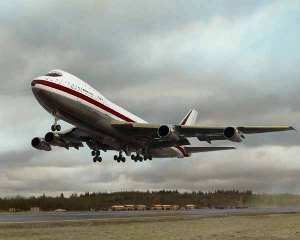
photo credit: Boeing photo
Today is the Boeing 747’s 40th Birthday. Or, at least, I count it as such since today marks 40 years since the legendary jumbo jet took its first flight.
Filed under: Airline Fleets, Airline News, Trivia by ajax
No Comments »
February 1, 2009 on 1:00 am | In Airplane Spotting | 4 Comments
I got a new Olympus SP550-UZ camera at Christmas time. With 18x optical zoom, it was a huge improvement over my previous camera, an Olympus C2100-UZ. But after testing it out at DFW at the end of December, I realized I needed just a hair more “oomph” and bought an Olympus TCON-17 1.7x teleconverter. That did it.
Plane spotting at DFW is always a bit boring for long stretches because you get to watch American Airlines’ MD-80 and B737 aircraft land all day long with very few other airlines to break things up. On this visit, I managed to catch the AA PinkRibbon Susan G. Komen Embraer RJ once more. I captured a Sun Country Airlines 737, an Airtran 717 and a Lufthansa A340 all taking off or landing on the far runway from Founder’s Plaza. Previously, they would have been a tiny spec in my camera.
I also saw a hawk standing in the field at the foot of the runway watching both us, the spotters, and the aircraft landing. It seemed like it wondered what the big deal was. One of the DFW fire trucks came by on the service road and goosed his fire pump as he went by much to my surprise. I just happened to be taking a photo of him anyway and got the water spraying out although only close up instead of from far away.
The other catch was a China Airlines Cargo B747-400. We visit a secluded area to shoot from that requires us to drive past the air cargo area on the west side of the airport. As we drove by, we saw this huge aircraft parked and pulled over to take photos. While doing so, I noticed it was buttoned up completely and running its APU and figured it would be taking off soon. It did but took nearly an hour to do so.
We also saw three corporate jets take off one after the other. You can see them HERE, HERE and HERE. Both my wife and I had the odd feeling of almost a race the way they took off and quickly turned south by southeast. About 20 minutes later, my wife guessed it. They were the wealthy taking off for Tampa and the Superbowl. I’m sure she is right. They took off so fast that I was only able to get one good photo of each.
Take a look at this PHOTO. The aircraft seems to either be coming straight at me or aimed just to the left of me. In fact, the runway was to the right of me. The crosswinds for that runway (13R-31L) must have been pretty high today.
One final observation. I’ll be sorry to see the Northwest Airlines livery fade away into Delta. Northwest has, in my opinion, one of the handsomest liveries on a US Airliner and it is a shame that Delta isn’t even retaining some small portion of the logo.
You can view all of the photos HERE.
Filed under: Airplane Spotting by ajax
4 Comments »
January 4, 2009 on 10:00 am | In Airline Fleets, Airline Service, Death Watch | No Comments
And now we come full circle back to the United States and Europe. Both have highly developed, highly competitive airline markets. Each has both LCC type carriers and legacy carriers (and Europe’s legacy carriers are the former national flag carriers in many respects.)
This won’t be a rebuilding year. To the contrary, both markets really need one large airline to be removed from the market. In the case of the United States, I firmly think that should be United Airlines but in Europe that is a harder guess. If I had to pick an large airline in Europe for the surprise of the year, it would be Lufthansa. They are, by all accounts, a great airline but I smell trouble in that group. First, they have been buying into airlines that have been unable to survive on their own. That lack of survival, in many cases, isn’t because of poor management but just a lack of market share being available to them.
Lufthansa has bought SWISS, for instance. I’m not sure why and I’m not sure if they can tell us why. They could have just as easily taken SWISS’ business and left them in a heap. Further, Lufthansa has a lot of Airbus A340 aircraft. Those airplanes just don’t compete on high capacity, long haul routes anymore. What’s more, they also have orders in for the Boeing 747-8, another large capacity, four engine aircraft. Their competitors, Air France/KLM and British Airways, have seen the light in buying more and more Boeing 777 aircraft for their long haul, high capacity routes. It costs less to operate them and they make more money as a consequence. So, going out on a limb here, I say we’ll discover that Lufthansa is nearly insolvent some time by the end of 2009.
Both markets in Europe and the US will continue to face challenges in costs (fuel and more particularly labor) and LCC competition will continue to press air fares downwards. The real solution for large legacy carriers won’t be found this year. Expect more losses (with some exceptions such as SWA and jetBlue) and more merger talk in general.
Here are a few more random predictions:
- United Airlines will ask Glenn Tilton to resign and hire an experienced airline executive. One possibility will be Doug Steenland, most recently Northwest Airlines CEO and now Vice-Chairman of Delta.
- Southwest Airlines will, for the first time, examine adding another aircraft type to their fleet. My guess is it will be the Embraer 170/190 series.
- Airbus will land a major order for aircraft from a traditional Boeing customer in the United States. My bet is that Delta orders more Airbus A330 aircraft.
- China and Japan will drop their regional jet programs or, at the least, defer them for up to 5 years.
- Bombardier will announce a major order (more than 20 aircraft) for the Q400 Turbo-Prop from a US Airline.
- If fuel prices remain steady, Airtran will seek to form a small mid-western hub.
- Last but not least, one LCC type carrier such as jetBlue or Virgin America will attempt to fly to DFW Airport (wishful thinking on my part.)
Happy New Year Everyone.
Filed under: Airline Fleets, Airline Service, Death Watch by ajax
No Comments »
December 19, 2008 on 10:00 am | In Airline News, Airline Service | No Comments
USA Today’s Today in the Sky Blog is reporting that Australian news outlets are now writing about an imminent announcement that Delta will begin flying from Los Angeles to destinations in Australia. Such destinations likely begin with Sydney and add Melbourne and/or Brisbane.
If true, this will mean that Delta will be the first airline to fly regular scheduled routes to all 6 inhabited continents in the world since Pan American Airlines. More important, it means competition for QANTAS, V Australia and United Airlines.
Currently, QANTAS is by far the main leader in that market flying Boeing 747-400 and Airbus A-380 aircraft. It has been said that about 1/5 of their net profit comes from such routes. V Australia, an international arm of Australia’s Virgin Blue, was originally scheduled to begin flying Boeing 777-300ER’s in December but had to slip the start to February 2009 due to Boeing’s labor strike this past fall. United Airlines flies the same routes regularly with 747-400 aircraft that by many accounts are worn and tired and certainly not offering the service options the other two do.
It seems that Delta, if it does fly the route, is planning to use 777-200LR aircraft that are very capable of flying the distances as well as carrying a full load of cargo while doing it. Ironically, the 777 was originally designed with QANTAS in mind although they never ordered any of the aircraft. Indeed, with optional fuel tanks and a light cargo load, it is said that the 777-200LR might be capable of flying from Atlanta to Sydney regularly although it is highly unlikely that this will happen. A more likely choice might be a late build 787-800 which Delta will be receiving as a function of purchasing Northwest Airlines.
This kind of competition is not want any legacy carriers on this route want. Delta is operating with relatively low labor costs, new aircraft that are the most efficient available for long haul routes and they have a new network (from their merger with Northwest Airlines) that will feed the aircraft to capacity loads. If Delta does launch this service, look for United Airlines to withdraw from the market. They are the airline that lacks both the service product and fresh aircraft to compete.
Filed under: Airline News, Airline Service by ajax
No Comments »
November 14, 2008 on 1:16 pm | In Airline Fleets, Airline News, Airplane Spotting, Trivia | No Comments
Using FlightAware.Com, I’ve been able to see some (but I don’t think all) of the government flights from around the world heading to Washington D.C. for the G20 Economic Summit. So far, I have identified these:
The British Prime Minister on British Airways Flight 001
The Indian Prime Minister on Air India Flight 001
The Argentinian President on Aerolineas Argentinas Flight 1001
The President of the Indonesian Republic on Garuda Indonesian Flight 001
The President of South Korea on Korean Airlines Flight 63
The Prime Minister and his government on Japanese Air Force Flights 1 and 2
The Russian President and his government is on the Russian State Transport Flight 9031 and Russian State Transport Flight 9001.
The Saudi Arabian government is flying in on Saudi Flight 1B
The Chinese government is flying in on Air China Flight 17
The President of Mexico is arrving on Mexican Air Force Flight 001.
No doubt there are others that are not being tracked inbound. The mix of aircraft will include a 777, several 747 aircraft, Airbus A330 and A340 aircraft, a 757, IL 76, IL 62 and IL 96 aircraft from Russia and even a 747-SP (Saudi Arabia).
Filed under: Airline Fleets, Airline News, Airplane Spotting, Trivia by ajax
No Comments »
November 4, 2008 on 3:12 pm | In Airline News | No Comments
The Seattle Post Intelligencer aviation reporter, James Wallace, is now reporting the possibility that Boeing’s new 787 may not make its first flight until February or March of 2009. Citing the 57 day long strike just settled by Boeing, the program is now supposed to be under review. At the beginning of the strike, Boeing’s 787 program manager had stated that it would be a day for day slip until first flight.
However, late February or early March is not a day for day slip and I think this news begins to reveal that there are indeed other problems on finalizing the 787 for its first flight. The 787 is now more than a year past its original forecast for first flight and had been definitively scheduled for a 4th quarter first flight this year. Prior to the strike, that was expected to be some time in the middle of November, 2008.
The delays to the program really should come as no surprise since this aircraft involves far more innovative engineering than probably any other commercial aircraft designed in the past 40 years including the 747 and A380. Still, another schedule slip after re-defining the program schedule and including plenty of time for more unanticipated problems begins to reveal that this is in fact a program in trouble. At this point, it is safe to say that Boeing is likely to experience a great deal of trouble getting the production ramped up to meet demand.
Filed under: Airline News by ajax
No Comments »
October 31, 2008 on 10:02 am | In Airline Fleets, Airline News, Airline Service | No Comments
Delta / Northwest is not only big with respect to the number and type of airplanes they have, they are also big for the number of hubs they are currently operating. Conventional wisdom continues to bet that some of those hubs will be closed or rationalized just as it bets that the airline fleet will be reduced.
My guess is that there really won’t be a reduction in hubs of any real significance with the exception of two. This new airline has two hubs in close proximity, Memphis and Covington/Cincinatti, and each serves similar markets. However, rather than being combined into one, I suspect that Memphis will likely be de-emphasized into a “focus” city with more connecting traffic routed through Covington/Cincinatti. The yields in each city are very good but Covington/Cincinatti is by far the city with the best yields. Memphis is likely to remain as a focus city because it is a good gateway to the central midwest section of the US.
All other hubs in the US such as Atlanta, Minneapolis / St. Paul, Detroit, and Salt Lake City have the airline as a dominant carrier and there is no reason to combine any of them with respect to the routes they serve.
Now, both airlines operate significant flights from gateway cities such as Los Angeles and New York and it is quite likely that the airline will work hard to combine some flights going to the same cities. For instance, flights from the New York area going to the same destinations in Europe will be combined to raise the load factors on the equipment being used. However, Europe presents an interesting problem because Northwest has been in a close relationship with KLM and has used Amsterdam as a “hub” to connect to other cities in Europe. Delta, on the other hand, is used to flying direct flights to a variety of cities in Europe without a hub or close partner. I suspect the relationship with KLM will be reduced so that Delta can raise the loads on its own flights to smaller European cities.
Northwest comes to the table with a hub in Tokyo, Japan and they have 5th Freedom Rights to pickup and carry traffic from Tokyo to other cities in Asia. On the surface, that would appear to be a very valuable asset. However, the value of that arrangement was far greater when the political climate in Asia was much different and the range of aircraft made it more convenient to fly to a central hub. Today, it can be much more profitable to fly direct to a variety of Asian cities using newer, long range aircraft such as the Boeing 777 and the about to be introduced 787. I have no doubt that the Tokyo hub will be retained in some form because the yields from traffic originating in Tokyo to other Asian cities is still well worth the effort but I suspect that there will be a renewed emphasis on point to point flying as things evolve in the new airline.
The thing most likely to change at Delta’s hubs will be the aircraft equipment. With a wide variety of equipment to choose from, it would be unsurprising to see a shift of long haul aircraft between the hubs in order to improve yields, load factors and even to explore new routes. That will be done slowly and carefully so that Delta doesn’t have to service too many different types of aircraft at each hub. Once again, aircraft being used at various hubs to service various areas will probably be rationalized. It would be unsurprising to see A330s shifted to longer South American and African routes with B767-400’s moved to trans-atlantic routes originating in MSP and DTW.
Los Angeles will probably see a greater concentration of 747 aircraft being used on trans-Pacific flights. New York and Atlanta will probably see 777 aircraft moved in for long range, point to point flying to destinations in India, South America and even Asia.
At present, Delta has 4 different types of long range aircraft in the 747, 777, A330 and 767 with another on the the way (787). Since Delta already operates GE powered 777-200ER/LR aircraft, they’ll likely place an order for some 777-300ER aircraft and use those to replace the aging 747 aircraft. That will reduce flying by one type. The A330 aircraft will be retained until a fleet of 787-9/10 aircraft can be purchased and then the A330 will likely be let go. Delta’s 767-400 aircraft is fairly new but it will probably suffer the same fate as the A330 in being replaced by 787 aircraft in the future. Suddenly, two basic types with 2 sub-types between them can service all the long haul routes and, at the same time, offer some harmony at each hub.
I do wonder if Northwest’s 787 orders will be switched from Rolls Royce engines to GE GEnx engines. That would permit Delta to operate two basic aircraft types that would use the same brand of engine and engines that share some basic design philosophy as well.
The tricky part of managing all of these hubs for Delta will be the domestic fleet which is comprised of Airbus A320 series, Boeing 737 series, DC-9 series and MD80/90 series aircraft. Because it is more efficient to perform maintenance on a domestic fleet that keeps the aircraft close to a maintenance center, I do wonder which hubs will get which aircraft. Both Airbus and Boeing offer good choices for domestic fleets in the A320 and 737 series. The DC-9 fleet is old and will be retired over the next couple of years so it isn’t a factor. The MD-80/90 aircraft isn’t exactly old but it does become somewhat of an orphan and they don’t offer the fuel effiency that the A320 and 737 offer. It’s quite possible that Delta will retain both the A320 and 737 series and simply order more of both until they can choose a next generation domestic fleet type from Boeing or Airbus. I do believe that the MD80/90 fleet will be selected for retirement in the next 2 years.
The exciting part of this merger will be watching the decisions that Delta makes about its new future.
Filed under: Airline Fleets, Airline News, Airline Service by ajax
No Comments »
August 23, 2008 on 10:00 pm | In Airline Fleets | 1 Comment
V Australia, a new subsidiary international airline of Virgin Blue is due to start new routes from Sydney to Los Angeles in December of 2008. They will be using new build Boeing 777-300ER aircraft configured in an economy, premium economy and business class setup. Many question the viability of successfully flying that route against the likes of QANTAS, Air New Zealand and United Airlines but I have a feeling these guys are approaching this route with more right sized equipment.
QANTAS and United Airlines both use 747-400 aircraft that typically have 343 and 374 seats respectively. V Australia’s 777-300 aircraft will have about 300 seats in their mix. However, V Australia will fly the most fuel efficient aircraft in its class and offer a brand new cabin whereas the QANTAS and United aircraft are older, less fuel efficient. In addition, with the coming fracturing of the US-Australia market, the 777 and 787 will fly those routes with lower seat costs and higher load factors than the 747 can offer.
QANTAS will be placing the A380 on that same route in the near future and while its seat costs will match the 777, the real question is whether or not they can fill the aircraft. The QANTAS A380 has 450 seats to fill every flight. The V Australia only has to fill 300. Allowing for similar departures and seat demands, the 777 makes money a lot earlier in the game.
Convetional wisdom is against V Australia and the 777. I remember that the only airline to participate in the design of the 777 and not buy it was QANTAS. There is a reason why the 777-300ER and 777-200ER have the range and efficiency that they have today. It was designed for those US-Australia routes. If V Australia keeps a good schedule and are able to manage their fuel costs well, they’ll likely succeed. Those routes could use a more economy minded competitor.
Here is the new V Australia 777 on the Microvolt / Paine Field website.
Filed under: Airline Fleets by ajax
1 Comment »
August 17, 2008 on 1:29 pm | In Airline Fleets, Airline Service, Death Watch | No Comments
United Airlines, an airline that has offered spotty-at-best service for more than 10 years, seems to have the 9 lives of a cat to most people. Unfortunately, of all the legacy airlines, it is the one that should have melted away some time ago. It emerged from bankruptcy in 2006 after spending 3 years and over $300 million reorganizaing itself to operate in a world with $50 / barrel oil without a realistic plan to deal with contingencies.
The problem is, oil was already at $60 / barrel when it started fresh. Since 2006, United has been the one airline that always manages to arrive to the party in rumpled clothes and only a $5 bill to pay the door charge. Those rumpled clothes are an aging fleet (although all of the truly old Boeing 737s are now being withdrawn from service to cut capacity) of aircraft that do not match the interior quality or service level of most of its competitors.
The management team, most importantly CEO Glenn Tilton, has spent more than 2 years maneuvering to merge this airline with another and, yet, has been rebuffed by all potential candidates such as Continental, Delta and US Airways. Indeed, they took a particularly condescending attitude towards US Airways’ offer to explore mergers when Glenn Tilton implied that he and his team would remain in place and “mentor” the US Airways management team including Doug Parker.
Say what you will about US Airways but it isn’t the company we knew in the 90’s or even 3 years ago. Doug Parker and team are really America West and they’ve been better at executing to plan than virtually any other management team at a legacy airline. If anything, Mr. Tilton would be well served by Mr. Parker’s mentorship.
Now the marriage dance in airline mergers is essentially over. Delta and Northwest are walking down the aisle, Continental has chosen to stand alone (wisely in my opinion) and American Airlines has decided to pursue trans-atlantic partnerships with British Airways and Iberia Airlines. There is no one else left for United to pursue a merger of equals and they lack the cash and operating plan to purchase a smaller airline as well. Indeed, Continental Airlines is joining the Star Alliance (of which United is a founding member) and that may benefit United but if they think they will remain the shining star in the US market for that alliance, they are sadly mistaken.
Continental’s management team is stable, smart and agile in this market. They are uniformly the choice of airline among business travelers (and that is who pays the bills) and possess a young, modern, harmonized fleet of aircraft that serve the routes efficiently. Continental has hubs that will serve that alliance well in both NYC, Houston and Cleveland and offer Star Alliance members excellent codeshare options throughout the United States.
United Airlines has a fleet of 747s that are some of the oldest -400 models and by all passenger accounts they are in desperate need of refurbishment (unplanned for 3 years and not recognized for another 2 years while United showed its legs to potential suitors). They possess a large 777 fleet which, on the surface, would imply some modernity there. However, about half of that fleet are early model “A” market 777s powered by the less powerful and efficient Pratt & Whitney engines. No lip gloss found there. The other half are 777-200ER models that would at first glance appear to be more modern intercontinental aircraft. They aren’t, really. They’re what Boeing originally referred to as “B” market 777s and, once again, they are powered by the less reliable and efficient Pratt & Whitney PW4000 series engines. I would point out that every other operator of this aircraft in the US is using the more powerful and efficient Rolls Royce Trent or GE90 engines (American Airlines, Delta Airlines and Continental Airlines.)
Their 767 fleet, a large one comprised of 767-300ER models, shows the same flaws as their 777 fleet. While some were built as recently as 2001, they are all powered, once again, by the less fuel efficient Pratt & Whitney engines. I’m sure a theme is beginning to reveal itself here.
The same also remains true for their 757 fleet in that they are powered by the lesser Pratt & Whitney engines while other airlines are utilizing the real rocket of that type, the Rolls Royce RB211 powered 757 that, with winglets, is capable of ETOPS trans-atlantic operations.
Ignoring the soon to be gone 737 fleet (which is old and dingy but not powered by Pratt & Whitney for once), the remaining aircraft are various Airbus A320 types. While they are not old by airline standard, most are more than 10 years old and some are approaching 15 year of age now.
An old airplane is not an unsafe one but, in United’s case, it is an uncomfortable one. While other airlines have paid attention to maintenance, comfort and even tuning engines, United has spent its time navigating bankruptcy and its management team has bet their golden parachutes on a merger. With no other really suitable partners, they are now faced with operating an airline that by most standards, is not competitive. What’s worse, they have lost 2 years time that could have been spent executing a service plan that might work.
If the cost pressures airlines are facing continue for another year, they (United) will be faced with another potential bankruptcy and, this time, it should be a liquidation. There is no argument for this airline continuing its operations under the present regime nor is there an argument for it continuing to operate simply to support air transportation in the United States or abroad. There are plenty of air carriers that can take up the slack and operate more coherently than United. In fact, the only part of United ceasingly to exist that I find distasteful is that it potentially offers American Airlines an even greater lock on Chicago’s O’Hare airport. Since I experience that kind of fortress here in the DFW area, I know just how expensive that can be for a consumer.
Successful airlines share a few qualities that I’ve noticed over the years. They generally possess a young, fuel efficient and harmonized fleet. They buy the airplanes configured for performance on a variety of routes. They have leadership rather than just executive management. They focus on a clean, comfortable flight experienced that is defined by the service provided by its employees. Such an airline also carefully watches its money and nurtures its finances to avoid running cash short on the wrong day. It takes care of its employees not by offering the best salaries but by offering a living wage, a hospitable workplace and with fair treatment in both hard times and good.
That is the antithesis of United Airlines and, so, they go on the Death Watch.
Filed under: Airline Fleets, Airline Service, Death Watch by ajax
No Comments »
August 16, 2008 on 2:45 pm | In Airline Fleets, Trivia | 1 Comment
In the 1970’s, Japan was experiencing fantastic economic growth and both ANA (All Nippon Airlines) and Japan Airlines needed more lift for their internal domestic routes. They approached Boeing and inquired about using the 747 for these high cycle, short duration flights. After investigating the possibilities, Boeing discovered that relatively minor changes (landing gear for instance), they could produce an aircraft that met their needs.
By eliminating 3 classes of service, galleys and other long range accomodations, the Boeing 747SR was born and able to carry as many as 525 passengers in this new domestic configuration. Later, those same aircraft were replaced with 747-400 Domestics capable of carrying over 560 passengers.
That was the first 500+ passenger commercial aircraft but now the new Airbus A380 may be capable of carrying as many as 800 passengers in a similar domestic configuration. There is some debate that such an airplane would be of use since the logistics of carrying an additional 300 passengers becomes almost unsolvable for existing airport configurations. No doubt Airbus would happily build the airplane if there is, indeed, a market for it.
Filed under: Airline Fleets, Trivia by ajax
1 Comment »
August 15, 2008 on 9:26 pm | In Trivia | No Comments
During the development of the 747, the US State Department asked Boeing to meet with a group of Soviet aircraft designers in a kind of technical exchange. Otensibly it was a technical information exchange that Boeing agreed to in order to gain some knowledge about titanium.
Boeing was working on development of the 2707 SST at the same time as the 747 and had encountered quite a few problems in working with titanium which was to be used on many of the SST skin surfaces. The original plans called for the 2707 SST to travel at nearly Mach 3 and at that speed aluminum could not be used since it grew too hot. The Concorde was speed limited to Mach 2.2 for this very reason.
Since this was at the height of the Cold War (the 1960’s), Boeing was understandably reluctant to share information but thought that if they got enough data on titanium, it might be worth it. One of the people sent to this discussion was Joe Sutter, the recognized “father” of the 747. The meeting took place on neutral territory – a restaurant in Paris, France.
The instructions from Boeing to its engineers was to not share any information until they were satisfie with what the Soviets had to share. Once the Boeing delegation was satisfied that all their questions about this heat resistant metal were answered, they instructed the engineers, including Joe Sutter, to answer their questions and to not hold back.
Surprisingly, the Soviets wanted to know why Boeing had used a “pod” type mounting of their engines on wings (with the exception of the 727) and Joe Sutter engaged them in an hour long discussion about drag, efficiency and balance. The Soviets took copious notes on napkins and even the tablecloth. When the discussion was over, the Soviets rolled up the tablecloth and departed with it and the napkins.
The next Soviet airplane to be designed for commercial (and military) use by the Soviets was the Il-76 which had podded engines, a first for the Soviets.
Source material: 747 by Joe Sutter and Jay Spenser / Legend & Legacy by Robert Serling (Rod Serling’s brother)
Filed under: Trivia by ajax
No Comments »
August 3, 2008 on 5:02 pm | In Airplane Spotting | No Comments
My wife and I went on a peace-keeping mission yesterday by visiting DFW airport to do some plane spotting. She’s actually quite enthusiastic about these trips and, I hate to admit, is better at framing a shot of an airplane than I am. Damn it.
We have 4 locations that we often visit. You can see them all on this Google Map.
Yesterday, we visited the Temporary Founders’ Plaza location for about 5 minutes to see who was on the northwest freight ramp. We were hoping to spot a China Cargo 747 that was scheduled to take off about 20 minutes after we arrived. We didn’t see that airpane but we did see a UPS 747 on the ramp (a passenger conversion of a 747-200) and a North American Airlines 757 at Terminal B (Braniff’s Old Terminal 2W).
We then went to Minter’s Chapel Cemetary located on DFW property on the southwest side of the airport. From here, you can view spectacular take-offs and the occasional aircraft taxiing by. Unfortunately, this location generally offers many different varieties of American Airlines aircraft and very little else.
There were 2 particular airplanes we wanted to try to get today. A China Cargo 747-400 and a British Airways 777-200ER that were scheduled to take off. The first was the China Cargo and it never did. I had my laptop connected to the internet via my cell phone but flight in FlightAware.com never changed its schedule and never showed itself as having taken off.
After more than hour of photographs, we were leaning against our car in the shade and suddenly my wife asked “What is that airline?” and pointed. Ummm, it was the British Airways 777 we were waiting for. By this time, I had lost the batteries in my camera so she took the photos with OK results. (It was a long, long shot for her camera.)
After getting that photo, we decided it was time to pack and leave. As we were putting together our things, I looked to the northwest and saw this rather large aircraft coming in for a landing.
Me: “Hey! That looks like a 747 coming in!”
Carolina: “Yup. We aren’t going to miss it like all the other 747s are we?”
You see, we have this history of leaving the airport, looking over our shoulders and seeing a 747 coming in for a landing. Not a good history but a history.
After landing and taxiing, we discovered it was the China Cargo 747 and was just late arriving so its takeoff clearly was going to be late too.
There is some good news. DFW is nearly finished building a NEW Founder’s Plaza (See the Google Map for the location) at a new location that is on the northwest side of the airport. It is nearly adjacent to the UPS freight facility and practically in front of runways 18R and 18L.
Here are some selected shots from both this trip and one we took about a month ago. Click Here.
Filed under: Airplane Spotting by ajax
No Comments »
July 30, 2008 on 7:24 pm | In Airline Fleets | 4 Comments
Today I found this Time Magazine story. From 1966, it describes Harding Lawrence’s 1st year of tenure as CEO of Braniff International. Now, I know I have put quite a bit of Braniff into this blog so far but that should wind down soon.
Harding Lawrence is often reviled as a man who “wrecked” Braniff. Fact says differently and this story gives a great hint or two as to his genius in operating an airline. For one, Lawrence took his experiences operating jets at Continental and severely raised the utilization rate at Braniff. Even in modern days that would be sharp.
He also introduced color and life into flying. He brought a hint of romance and a dash of allure to flying that, until that time, had not been expressed his way.
I’m in possession of annual financial reports on Braniff from 1968 to 1980. If profit is the best metric for measuring Braniff’s decisions and choices, let’s look at the facts. Since the 1968 report has a 5 year review in it going back to 1964. Harding Lawrence and his changes began in 1965.
Net income:
1965: $9.5 Million
1966: $17.8 Million
1967: $4.7 Million
1968: $10.4 Million
1969: $6.2 Million
1970: ($2.6 Million) Loss
1971: $0.46 Million
1972: $17.1 Million
1973: $23.1 Million
1974: $26.1 Million
1975: $16.0 Million
1976: $26.3 Million
1977: $36.4 Million
1978: $45.2 Million
1979: ($.04 Million) Loss
1980: ($.13 Million) Loss
I would point out that some of those numbers would be a credit to many airlines today.
Some other interesting facts are:
1) Going from #8 in ontime peformance in 1965 to #1 in 1969.
2) When Braniff (by Harding Lawrence’s decision) originally ordered the 747, they ordered 2. However, in light of the economic downturn as delivery neared, Braniff (Lawrence) took delivery of one (N601BN) and sold the second (originally N602BN and painted green). That one 747’s utilization was a highly profitable 15 hours per day.
3) Fleet composition in 1964 was 52 planes of which there were 6 different types and of which only 2 types were jets. In 1969, there were 72 airplanes of which there were 6 different types and all were jets. In 1975, There were 81 planes of which 69 were B727’s, 1 a 747 and 11 were DC-8’s.
4) The Braniff route system in 1965 was largely a north-south system with some extensions east-west. In 1975, the route system was balanced with routes traveling from east coast to west coast and from the south to the northeast, northern midwest and even the northwest.
5) In 1974 and 1975, Braniff experienced domestic traffic growth rates of 10.9% and 6.6% respectively compared to industry metrics of 2.4% and 1.5% percent. In those same years, Braniff’s fleet utilization rate exceeded the industry standard by a full hour / day.
6) Some examples of routes applied for and received by Braniff post 1978 deregulation: DFW–LAX, ATL–MIA, DFW–LAS, DFW–LGW.
7) 1979 Trans-Pac routes were instituted with some examples being Los Angeles to Guam and Seoul with follow on services to Hong Kong and Singapore.
8. 1979 Trans-Atlantic routes were instituted with some examples being DFW to London, Amsterdam, Brussels, Frankfurt and Paris and similar Boston routes to Amsterdam, Brussels, Frankfort and Paris.
Now, I realize that, unlike many opinions on Braniff decisions, I’m actually encumbered with facts. The facts I’ve given do not portray an orgy of poor decision making and egotistical fluff. They actually portray a profitable, growth oriented airline focused on service, right sized fleets and a route system that even today would be enviable.
Further, just the net income figures for Braniff serve to paint a much more fair picture of Harding Lawrence. It certainly disabuses a person of the idea that Braniff management was a bunch of huckleberries flailing around. In fact, it paints of picture of profit, growth and sound financial management for most of Lawrence’s tenure (almost 15 years) and it certainly is a credit to management and their decisions
That said, he gambled on deregulation (no more so than many others) and he lost. The odds were probably in his favor but odds aren’t a guarantee. He was definitely a man of contradictions at times and definitely was possessed of some idiosyncracies too. All told, though, I consider him the forgotten titan of the airline industry.
Filed under: Airline Fleets by ajax
4 Comments »
July 27, 2008 on 5:04 pm | In Airline Fleets | No Comments
Not you, the consumer. Oh, we know your type these days. You buy on price and frequency. Next is loyalty to your frequent flyer plan (and some of you even buy based upon gathering your FF miles ahead of price.) You aren’t going to change. You never really have and you never really will. You are the girlfriend/boyfriend who promised to change and never did.
It’s time for airlines to fly smart. No, really, it is.
Southwest Airlines pioneered the modern strategy that most airlines try to emulate in one form or another. They have a single type of aircraft (Boeing 737) and trade high load factors for high utilization of aircraft and crews. It’s a model that works for them and even for some others. Legacy airlines have adopted a modified model that included narrowing the fleet types which allows not only fewer costs in equipment but also permits airlines to use their staff across a broader range of aircraft.
But it appears (to me at least) that that strategy in the current economic climate is going to prove flawed. The truth is, the airline industry tends to have to re-invent itself every 30 years or so. That reinvention has taken the form of a revolutionary change in aircraft or, in the case of the 70’s, a new regulatory climate. Traditionally, it’s aircraft.
One of the criticisms of the proposed Delta / Northwest merger is the mish-mash of fleet types they’ll have. The CEO’s of both Delta and Northwest have responded that it in fact appears to be a big advantage in the merger because it will permit them to “right-size” each city pair with the proper aircraft. What this means is that with different fleet types comprimised of aircraft capable of varying efficiencies and loads allows them to fit the right aircraft to the right flight.
For example, a flight from Atlanta to Nashville might typically carry an average of 90 passengers per flight and Delta might be using a Boeing 737 for the flight segment that carries about 130 passengers. That means their using a new (high capitol costs but more fuel efficient) airplane to fly the route with an average load factor of 69%. It’s a short flight segment so the fuel efficient engines of the 737 don’t play as big a role in savings as they would on a longer flight. Post Merger, Delta may put a Northwest DC-9-40 on the segment that carries about 110 passengers. Suddenly the capital costs are extremely low (the airplanes were paid for years and years ago and the costs to operate it are maintenance and periodic refurbishment), the load factor is now 81% and flight has about similar fuel and labor costs. What’s more, that 737 can now fly on flight segments with average loads that are much closer to its capacity and which provide greater revenue yields as well.
More airlines in the US need to re-examine their fleet strategies. Almost all flights being flown by regional jets of 50 seats or less *lose* money now. Particularly when they are used for “long and thin” routes such as DFW / CLE (Cleveland). An airline of real size (US Legacy carriers but also LCC carriers such as SWA, Jet Blue and Airtran) can benefit from a diversified fleet.
There are countless “shuttle” type routes that could yield far more profit by using new, advanced turbo-prop aircraft such as the Bombardier Q400 and ATR-72. There is no rational justification to use regional jets on short segment routes when compared to these advanced turbo-props for instance.
An airline could, for instance, fly a Q400 on flights between Dallas and Austin offering 70 seats per flight and make money by filling only half of them per flight. Time flying between cities would be virtually the same as Southwest Airlines’ Boeing 737 and seating would be about as comfortable. The capital costs, maintenance, fuel and labor costs for that aircraft are all significiantly less than the 737 but offer about the same comfort and convenience.
Reduced fleet types made sense in the 80’s and 90’s because airlines were focused on the hub and spoke model. It allowed an airline to use aircraft interchangeably and since fuel costs were extraordinarily low, load factors could be as low as 60% and an airline could still make money.
Today, airlines need aircraft that are more pin-point appropriate for their routes. Short segment shuttles should be flown by Q400’s while longer segments with greater density should be handled by 737s and A320s. Large trunk routes should be served by Boeing 757s, Airbus A320/321s and even smaller widebody aircraft such as the Boeing 767 and Airbus A330. Longer, thin routes should be served by the upcoming Boeing 787 and A350-900 aircraft while long, high density routes will be better served by the Boeing 777, Airbus A350-1000, Boeing 747-800 and Airbus A380.
There will be increased demand for a new kind of aircraft. One that is a re-birth of the original DC-9 and Boeing 737. A 100 to 120 seat aircraft that can fly 25% more efficiently over route segments of 500 to 1000 nautical miles. Bombardier (Canada), Embraer (Brazil), Mitsubishi (Japan), AVIC (China) and Sukhoi (Russia) are all working on such aircraft or already have such aircraft available for order. Boeing and Airbus don’t.
The days of flying a regional jet such as an Embraer ERJ-145 or Bombardier CRJ-200 are over. They cannot fly profitably short or long, thin routes anymore as they offer, at best, only 50 seats and a product that is quite unpleasant for trip durations over 1 hour.
Legacy airlines no longer can afford to “sit” on routes to protect them for use at later date. All of the capacity cuts made so far are squarely aimed at routes that do not generate sufficient revenue to justify their existence. To serve those routes in the future, they’ll require an aircraft whose economics ENSURE profit.
That means airlines will seek to merge and become bigger because size permits greater fleet diversity and fleet diversity means more revenue per passenger. Even airlines such as Southwest, Airtran and Frontier will have to begin considering the value of “right sizing” their fleet to their customers. To some degree, Airtran does that with their mixed fleet of Boeing 717/737 aircraft.
Greg
Filed under: Airline Fleets by ajax
No Comments »
July 27, 2008 on 2:38 pm | In Uncategorized | 1 Comment
Right now, I’m not entirely certain which direction this blog will go. Being an avid fan of the airline business and someone who follows the business daily, I found myself having some opinions. Being pretty certain that my family no longer wants to hear them, I thought I could write them here. We’ll see what happens.
I said I was an airline business fan which means I’m not an old aircraft fan or a warbird fan. Mostly I’m a fan of the business and my interest in commercial aircraft comes second to that. As you can imagine, this is not a hobby that impresses dates.
On the header of this blog there are 5 different photographs depicting Braniff International aircraft. Interestingly enough, 3 of those 5 never served Braniff. One of those that did never served in Braniff livery. The one on the far left is a photograph of a Braniff DC-10-10 model and working from left to right the remaining aircraft are a concept of the Boeing 2707 SST in Braniff colors, a model of a Braniff L1011, the Concorde in Braniff livery and, finally, the Alexander Calder Braniff DC-8.
The DC-10, L1011 and B2707 SST never served Braniff. (Indeed, the B2707 SST never got beyond full size model mockups). Braniff did operate the Concorde, for a short time, by “sharing” the Concorde with both British Airways and Air France. The services operated from London and Paris to Dulles Airport (Washington D.C.) and then Braniff flew them with their crews to Dallas. By the end of the service, tickets on the Concorde from Dallas to Washington D.C. cost a $10 premium over standard first class fares.
The Calder DC-8 is my favorite Braniff aircraft. Designed by Alexander Calder, this DC-8 served Latin American routes through the 70’s. It was only very rarely seen in Dallas and I can only recall seeing it once myself when, I believe, it was substituted onto the DFW-HNL (Honolulu) service in place of the regular 747-100 (N601BN). I last knew of its fate about 4 or 5 years ago when I discovered it was serving an air cargo airline out of Miami.
If anyone finds this blog outside of my family, I’ll be impressed. If you do and you like it, please leave a comment.
Greg
Filed under: Uncategorized by ajax
1 Comment »
|
|
|




