ANA airlines of Japan has upped its order for the 787 by 11 more aircraft. The airline has exercised options for 11 more 787-9 aircraft based on its operational experience with the airliner to date.
Great news for Boeing as it is, I believe the first “top up” from an airline operating the 787 and given that it is ANA, it’s a great blessing for the aircraft.
I expect that we’ll see more airlines asking for more aircraft over the next 12 months with a strong focus on the 787-9 and a strong demand for an announced 787-10 (with appropriate range.)
QANTAS has shown a loss for its 2nd Quarter results and in the process announced a cancellation of its orders for the 787-9. Nominally, the basis for this is to reduce spending and QANTAS has already deferred some A380 deliveries for the same reason.
Reasons for QANTAS’ losses are in its international division and include very high fuel costs in that region. This begs the question as to why QANTAS would want to give up aircraft that would improve its position on fuel costs considerably. The international division relies upon a lot of 4-engine airliners presently and older Boeing 767 aircraft as well. While it has reduced its average fleet age, that has come about primarily through purchases of a few A330 aircraft and new Boeing 737-800 aircraft.
It’s notable that the 737-800 becomes less than desirable with the 737-8MAX on the horizon.
I would think that by now QANTAS would have come up with a rational fleet approach for its international long haul flying. While it has some critical mass on the A380, it still is operating an ever aging 747-400 fleet with some of those aircraft not due for retirement until 2018. The 767s can be improved upon massively with the 787 and that would help considerably.
The age of 4-engine airliners for even QANTAS’ trans-Pacific flying is ending in many respects. Virgin Australia is using the 777-300ER for similar routes to the US West Coast now and likely seeing far better CASM than what QANTAS experiences with the 747-400.
In a tiered approach, one would expect the 787-8 to replace about half of the 767 aircraft. The 787-9 could replace another 1/4 to 1/3 of that 767 fleet. The 777-200/300 could replace the remaining 767/747 flying easily and that leaves the A380 for high demand, trunk routes. With a 787/777 fleet, QANTAS would also experience better flexibility in its pilot group since a pilot can transition between either aircraft in just a handful of days.
It’s possible that if Boeing got off its delay in offering the 787-10, this aircraft could provide QANTAS with a nice fleet for medium to long haul travel at a fuel cost that would not be beat by any other airline.
A part of me sees QANTAS becoming a smaller and smaller player in the international domain. It lacks good partnerships with other airlines and the partnerships it does have sees those partners leaning heavily on QANTAS to do much of the expensive flying. It needs partnerships that are more equal in scope and which allow the airline to perform successfully on routes it can fly while offering customers options on routes it cannot fly.
It feels as if QANTAS and its leadership are simply managing the airline to mediocrity and you quickly become irrelevant in the marketplace that way.
Air India and Boeing have come to an agreement on compensation for 787 delays allowing first delivery of a 787 to proceed to Air India. Air India has been making noise about compensation since 2008 and has often floated a number approaching $1 Billion.
The big driver in Air India’s push for compensation is its own horrific management. One could do 4 or 5 blog posts on that alone. The Indian government hasn’t pushed for a rational operation and the integration of the two airlines, Air India and Indian Airlines. Right now, the airline has a too many constituent groups fighting for the work and the entire company is overstaffed by the tens of thousands. No one in India wants to anger constituent groups such as pilots unions as the political implications stretch far beyond just the airline itself.
Furthermore, the Indian government has pursued trade policies that are hostile towards foreign companies in an attempt to gain all the economic benefit it can from these companies and often in an internationally unfair manner.
Playing hardball with Boeing was a mistake, however. The aircraft that Air India ordered are too easily sold to others clamoring for the 787. Ironically, Boeing could probably sell these aircraft for more than the sale price to Air India. Boeing could afford to take the long view despite the problems that it has experienced with the 787 and production.
Air India needs these aircraft. They will serve routes in a fuel efficient manner and help “right size” the company. It inevitably was going to have to figure out how to pay for these aircraft and get them into service. They are not, however, the magic bullet for Air India’s problems. We’ll talk about that in another blog post in the future.
Boeing’s Charleston 787 assembly line rolled out its first 787 a few weeks ago and it took flight for the first time on May 23 for a “B1” flight test. 3 more 787s will be built at Charleston this year and all 4 are for delivery to Air India (which can ill afford these right now but that’s another blog post.)
Am I the only one struck by how relatively smoothly the Charleston site got built, staffed and its first airplane assembled? Obviously there was some learning curve alleviated as aircraft were assembled in Seattle. However, this is the first commercial aircraft assembled at that site and there was just no real muss or fuss about it.
I suspect the Charleston site not only is going to reduce risk for Boeing over the next few years when it comes to the 787 but I also think that this effort is going to cause Boeing to look at other areas for manufacturing when it comes to other aircraft.
Seattle will remain Boeing Central for aircraft manufacturing but I think we just witnessed an excellent argument for Boeing not scaling production higher and higher for an aircraft in Seattle but to decentralize assembly of aircraft to other areas when large quantities are demanded for an airframe.
I really don’t think Boeing took nearly as much of a victory lap over their Charleston achievement that they could have.
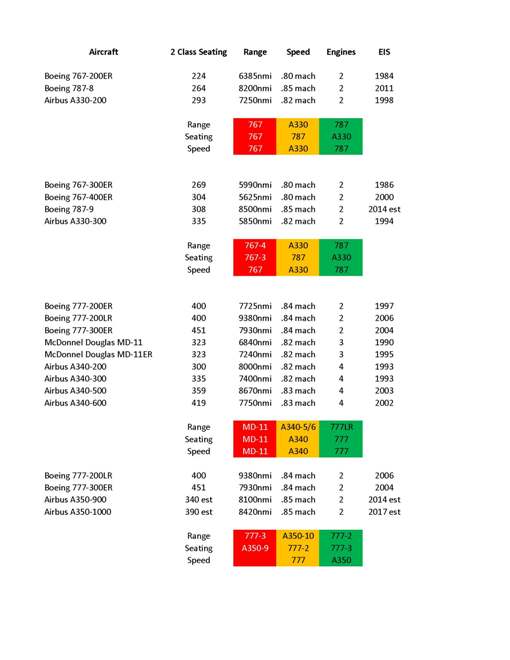
We could spend tens of posts evangelizing for one manufacturer over another in the Airbus vs Boeing wars. I spent some time wondering how it is each overcame the other at various times and decided to chart their respective aircraft on seating, range, speed and engine count. It’s not hard to see why the 767 got trumped by the A330. The A330 was the logical growth aircraft. It had the right seating, range and speed.
Similarly, it’s not hard to see how the 787 is trumping the A330 and 767. It hits the sweet spot in seating (not too large, not too small) while killing competitors on range and speed. The same is true between the 777 and the A340 (and I’ve thrown in the MD-11 for comparison). Again, the 777 trumps its competitors soundly in all three categories.
But most remarkable of all is seeing just how the 777 stacks up in present form against the A350. Now I understand why Boeing continues to be the preferred aircraft so far. The A350 competes and even competes reasonably well but it still doesn’t really trump the 777 and in some cases, it doesn’t get close to beating the 777.
Emirates CEO Tim Clark has decided to beat the drum of wanting a new, upgraded and revised 777 and he would like Boeing to announce it pronto. Emirates has a very large fleet of 777 aircraft and likes to retire its aircraft from the fleet after about 12 years. They also have the A350-1000 on order (20 orders) and have behaved very cool towards Airbus over that aircraft’s delays and its inability to be a real game changer against the 777.
Boeing probably has done a fair bit of definition for the 777-8X/9X aircraft and its likely they’ve held substantial conversations with customers to get a better feel for what should be offered. I’m not entirely sure that what is offered is going to make Tim Clark happy as he generally wants more, More, MORE range in an aircraft. Sadly, most airlines don’t need ultra-long range capability nearly as much as they want excellent fuel efficiency and very low seat mile costs.
The 777-8X is likely to be somewhat satisfying to Emirates but I suspect the -9X won’t be quite what they want. Remember that Emirates wanted to see a 747-8i that had a few hundred more nautical miles range and Boeing wouldn’t give that to them.
It’s a tough position to be in at Boeing. Emirates could act as a launch customer for a very successful upgrade of the 777. On the other hand, Emirates will be the toughest critic possible of the aircraft all through development.
Boeing has quite a handful of things going on right now, too. The 787 program is getting better and better but still requires quite a bit of care and feeding in order to develop the 787-9 and 787-10 over the next few years. The 737-MAX program will keep a large portion of engineers busy for the next 5 to 6 years and that leaves very little engineering capability left over for the 777 development.
I think we’ll see some sort of firm definition get announced early next year and I think that an authorization to offer the aircraft will only come after Boeing sees customers signal their willingness (and even eagerness) to buy the aircraft from around the world and not just from the Middle East. That is going to take a while.
The current and future product lineup for both the 777 and 787 is now becoming more clear for the next 15 years or more. The 787 line is expected to be pumping out more and more 787-8 aircraft for current customers and the 787-9 is expected to fly in 2013 with deliveries taking place shortly thereafter. Those two aircraft slot themselves just under the current 777-200ER/LR which is still an attractive aircraft to many airlines.
The 787-10 is conceptual but, I think, a near certainty to arrive as a replacement for the current 777-200ER/LR. Range will be the factor on this but Boeing should be able to provide with with similar range and capacity (passengers and cargo) as the 777-200ER with improved efficiency. Suddenly, we have a 787 lineup with 3 aircraft capable of meeting the needs of airlines from the 767 range to the original 777 range and which also covers the current A330 lineup as well. It also allows airlines to operate a mixed fleet to rightsize aircraft to routes using the same aircrew for each.
Additionally, the 777-X lineups move upwards with the 777-200 and 777-300 getting about 50 seats more capacity each with similar range as today. These new variants will benefit from a larger, lighter composite wing and new generation GE90 engines that benefit from GENx technology. The expectation is that such aircraft can also deliver from 15 to 20 percent improvement in efficiency as well.
Now you have 5 aircraft derivatives from two models covering 98% of all widebody needs with class leading efficiency that brackets Airbus’ offerings in the A330/A350 models. That’s a powerful sales tool when you consider that the current 777 pilot can transition to the 787 (and vice versa) in about 8 days of differences training. I would expect that the new 777 variants may well be designed with flight decks that take that transition time down further or which may well make it possible for a pilot to be flexible across the entire 787/777-X line.
This will be attractive to airlines around the world. One airline can buy 5 variants that will seat a range of passengers from 242 seats (Boeing 3-Class Configuration) to 410 seats (Boeing 3 Class Configuration) with increments from the 787-8 forward being about 30 seats per aircraft, just where airlines like to see things.
I would expect that airlines would likely operate “skips” in their choices. A 787-8 operator might also own the 787-10 and 777-9X, for instance. A 787-9 operator might also own the 777-8X, as another example.
Flexibility and range are the key weapons here and they become very, very attractive to airlines both in the United States as well as abroad. These won’t be airliners designed to the demands of middle eastern airlines such as Emirates (who always want more range and capacity) but, rather, to the airlines that comprise the rest of the world.
I think we’ll also see range in excess of 8000 to 8500nm as being not necessary either. In other words, I don’t expect airlines to continue to try to build variants with more and more range. Yes, it would be nice to offer an airliner that can fly from London to Sydney and earn money and that may even be possible with the next generation 777 aircraft. However, it’s virtually the only market left that cannot be served by airliner and that makes it a pretty small one for aicraft. As such, I would expect that their might be a high performance 777-8X offered to those airlines capable of doing the mission profitably but that will come later rather than sooner unless it is deamed necessary to selling aircraft to the airline.
It’s 2012 and the Boeing 787 Dreamliner has delivered but only 3 aircraft so far. There are tens of aircraft in Seattle and San Antonio requiring rework and change incorporation and the assembly line in South Carolina hasn’t cranked up yet either.
By all reports, the 787 is exactly what airlines expected. Note that I said “airlines” and not “airline passengers”. For those of you that expected a transformational experience with the 787: surprise. This airliner was built for airlines, not you. It was sold on its exceptional features for passengers, yes. However, at the end of the day, it’s really a highly economical airliner for airlines. In other words: seat pitch isn’t going to change and the bigger windows, higher humidity and lower cabin pressure don’t really add up to a shocking experience. It’s better, no doubt. However, I’ll bet that most don’t really notice a big difference except, perhaps, for the windows.
So, we’ve got a great airliner that should be transformational for airlines and there is just one problem: Nobody has really gotten their 787s yet. Airlines seem to have gone into a funk and accept that they’ll get theirs when they get theirs. I’m not suggesting they have a choice at this point but I do wonder at why Boeing isn’t bearing brunt of at least a little more ire at the delays.
My prediction: Boeing will deliver no more than about 35 of these airliners by the end of the year. There are still too many signs of Boeing not quite “getting it” when it comes to the need to push these airliners out the door.
Aspire Aviation has revealed that Boeing has issued an RFP to GE and Rolls-Royce (with speculation that Pratt & Whitney got included) for a next generation engine for the 777-8X/9X development. The target appears to be about 100,000lbs of thrust (and I’m sure Boeing would like to hear about a growth path to that as well.)
With the combination of new technologies for the fuselage, composite wings that are likely a bit larger and a lower fuel consumption, these new aircraft would definitely be A350 beaters in every category. The current 777 lineup performs well against the performance definitions for the A350-900 and based on comments from A350-1000 customers, the 777-300ER probably isn’t equaled on long haul routes.
A revised 777 that upgrades the -200LR with more seats and as much range, capacity and cargo capacity would clearly be of interest to many airlines. A -300ER that also increases its capacity with equal or better range would also be of great interest to many. Boeing has rightly identified that its the -300ER that is likely the sweet spot in size (or a little larger) for most airlines requiring a high capacity/long range airliners for routes.
The A380 will be around for a long time. It won’t be a big seller over the next decade and will only ever be a success if there is enough growth on long haul trunk routes to require that aircraft. The 747-8i remains an interim solution from Boeing and it still hasn’t garnered much interest from airines. In fact, many airlines have downsized from the 747-400 in favor of the 777-300ER.
Trunk routes will remain but there will be fewer of real importance and requiring a VLA. The 787, A350 and 777 all permit airlines to fly more point to point routes and earn profits. Ultra long haul flights are likely to remain more in the style of “long and thin” than “long and fat”. After all, just how many people are likely to fly from Houston to Auckland, New Zealand even with network feed? Answer: Not enough to require a 777 or 747 for quite some time.
I do think Boeing has the right idea in offering a revised 777 instead of an all new design in this category. The 777 still incorporates some fairly cutting edge technology and with a revised composite wing alone could probably continue as a category winner.
2011 wasn’t the worst year for airlines and 2012 won’t be either. Instead, I think we’ll see more of the same in most respects.
Airlines will continue to constrain their capacity and that will show more discipine than I thought they had 3 years ago. They’ve proven me wrong and I think the results are too good for them to not to continue over the next 12 months.
Fuel costs will continue to be a difficult thing for airlines to manage. There will continue to be volatility but I don’t think we’ll see anything like 2008/2009. The financial crisis in Europe will reduce some demand on oil but I see no real economic growth in any part of the world that will drive demand either. The truth is that the emerging economies are largely dependent upon demand from both Europe and North America and neither of those economies will see high growth in 2012.
Airlines will continue to make large orders for more fuel efficient narrow body aircraft. This only makes sense as the gains are more than enough to justify the purchases and now is the time to gain an advantage in bargaining with both Boeing and Airbus. Furthermore, airlines need to hedge against their labor costs which will only grow over time.
Aircraft manufacturers have a much more sure path for the next 10 years now. Boeing will be biding its time on improvements to the 777 until it sees more definition of the A350-1000 and it will throw its resources into ramping up 787 production, 787-9 development and 737MAX development. It’s possible that we’ll see a real 787-10 announcement in 2012 but, if so, probably not until the latter part of the year.
Airbus has to get its act together on the A350 and try very, very hard to prevent too much schedule slip. Despite its efforts, I think we’ll see more schedule slip and it won’t reveal the entire picture as that unfolds. While I don’t expect quite the same delay as the 787 saw, it will be a significant delay and it will impact Airbus. They’ll also try to flog the A380 as much as possible and may even succeed with small orders in parts of the world it hasn’t penetrated much to date. I do not see any US based orders for the A380. Furthermore, Airbus made some big promises for the A320NEO and it’s got to work hard to deliver on those. They’ve made it out like the A320NEO is a no-brainer for development and while it is an incremental improvement, the engineering to deliver is non-trivial.
Bombardier will work its tail off to sell more of the CSeries and I think it may even succeed. The sweet spot its lineup offers will become more attractive to airlines once they see Bombardier actually perform in the development and test of this aircraft. The CS100 isn’t the attractive aircraft but its the one that will fly and deliver first. Once the performance of that aircraft is established, I think we’ll see orders from US and European airlines come in large numbers.
Embraer has got a nice grip on the regional airliner business but it also has a problem in that, right now, there is no growth path into a larger plane for purchasers. It has plans to work on re-engining the E-Series but I think they’ll concede the need to develop a larger airliner as well. The Bombardier CSeries presents just a touch too much threat in the future.
I don’t think we’ll see much from the other regional airliners being developed. The Mitsubishi MRJ doesn’t feel quite right for airlines to me and doesn’t offer a growth path into a larger airliner. The orders its racked up so far are fairly paltry and at risk, in my opinion.
The Sukhoi SuperJet, on the other hand, has a real chance, I think. It’s Westernized, it’s flying and it does feel like its the right size. The real challenge in this aircraft is ensuring support and with Boeing as a consultant, it may well have some help in that arena. If it does succeed, that success will begin in Europe as well as for airlines of lesser developed areas such as the Middle East, India and the Far East. If any orders come from the US, it will be years in the making.
If anything stirs in the US airline industry, I think it will be in the LCC arena and I think it will be small(ish) if anything. I do not think we’ll see any legacy consolidation despite wishful thinkers for a US Airways / AA merger. Something like that becomes much more likely in 2013.
I think American Airlines will plod through its bankruptcy in 2012 with a bit of scandal here and there. I think its labor force is about to take a beating on wages and benefits and I think the resulting bitterness will last for years. I also think that United and Delta will be growing a bit more concerned about AA late in 2012 once they have a picture of what AA’s cost structures are likely to be.
2011 was largely a “rebuilding” year for the airline industry. 2012 will be largely so as well. Until the world economies recover, the best the industry can hope to do is manage its problems and earn a bit of money. That’s eminently possible for them to do.
I’m not sure we’ll see much in this territory for SkyTeam or Star Alliance. They’ll continue to succeed and be smart in their attempts to gain more dominance in more parts of the world. I think Oneworld is going to be smarting through this next year as a function of health problems at founding members American Airlines and QANTAS. I also think that gaining the LATAM membership is not nearly as “sure” as they think it is.
The Middle East
After ordering an insane amount of widebodies in 2011, Emirates will order another insane amount of widebody aircraft and beat up on Boeing about its 747-8i. This has begun to feel like an addiction problem.
India
The airline industry in India has imploded and we’re just watching the mushroom cloud of debris settle. For 2012, more explosions and more governmental heads will push even deeper into the sand. Air India has already become the new Alitalia.
The Far East
Chinese airlines will order more aircraft and I expect we’ll see orders from them for 777s and A380s and possibly some A350s. Not unlike 2011. I don’t think we’ll hear about any stunning orders from that part of the world, however.
China will tout its COMAC C919 even harder and most of us will try desperately to keep from laughing even harder. Ryanair will back away from this aircraft quietly, I think.
Japan will find ANA deploying more and more 787s on more and more routes with more and more success with that aircraft. JAL will take delivery of its 787s and find that they not only work well for JALs needs but actually exceed expectations. I think we’ll see an order for some more Boeing aircraft from JAL this year and I think it will be the 737MAX and 777-300ER. No huge numbers but large enough to make a splash.
South America
LATAM got its approval from Brazilian and Chilean authorities (barely) and LATAM will begin consolidating its operations to make more money. I think we’ll see a largish order from LATAM and it will be for an airliner to replace aircraft on both the Brazilian and Chilean side of the airline. The aircraft of choice will be, I think, the Airbus A320NEO and I think they’ll bump up orders for the 787 and 777 as well. TAM has 27 A350-900s ordered and I think that order *might* be at risk. The strategy of using Airbus for narrow bodies and Boeing for wide bodies seems to be a smart one for airlines in that region.
I don’t think we’ll see more consolidation in South America but I do see South America becoming a bit of a battle ground between airline alliances. Most see LATAM going with Oneworld and while I can’t disagree with the arguments, I think that SkyTeam and/or Star Alliance might just swoop in with one hell of a package that may be too hard to resist. If this happens, Oneworld and American Airlines gets kicked in the groin in South America.
Aerolineas Argentinas? The Alitalia of South America in 2011 and the same in 2012. Enough said.
Europe:
British Airways managed to get through 2011 without any huge problems and saw Willie Walsh move up to the CEO position of International Airlines Group which means Willie’s still in charge. Iberia, British Airways’ sister airline, saw Willie stirring things up with plans for a LCC subsidiary. Iberia pilots decided to strike because shooting onself in the foot can’t be just an Indian thing. IAG also managed to get a tentative deal to buy BMI from Lufthansa and become the Emperor of slots at London Heathrow . . . maybe.
Virgin Atlantic didn’t die, didn’t find new partners and didn’t extricate itself from the chokehold that Singapore Airlines has on it. Richard Branson actually didn’t make the news very often except to shout, stamp his feet and act insulted that Virgin Atlantic wasn’t able to do a deal to win BMI. Expect Virgin Atlantic aircraft to start carrying some message against the IAG deal for BMI. I actually think that Virgin Atlantic will have to find an airline alliance to join and if I’m right, I would lay very heavy odds on it being the Star Alliance.
Lufthansa did itself a favor and got rid of BMI and I expect they’ll continue their very conservative mangement of the airline and the subsidiary airlines. I do wonder how much longer Lufthansa can rely upon its A340 aircraft and somewhat expect Lufthansa to bite the bullet and buy the 777.
KLM/Air France: I see nothing here at all. Not in 2012. I don’t expect a large widebody order nor a narrowbody order.
I do expect Ryanair to make an order and I do think it will be the 737MAX. In fact, I think it may well end up being the 737MAX-9 instead of the 737MAX-8. Instead of repudiating the C919, Michael O’Leary will just quit talking about it. Instead, he’ll suggest stripper poles could be installed on Ryanair aircraft.
All in all, I think it will be a tough year for European airlines. The financial crisis on that continent will make it very hard to earn an honest profit and Middle Eastern airlines will continue to erode the long haul traffic that European airlines have enjoyed for decades.
Tomorrow, a summary of what I see for 2012 and the world airline industry.
I got asked what I thought of the A340 last week by a reader of FlyingColors and decided to give some thought to that subject and write a post.
The truth is, the A340 was probably the first Airbus aircraft that I really liked visually. I liked the slender appearance of the widebody fuselage and I liked the four engines and how they were hung on the wing in a proportion that just seemed a bit sexier than other 4 engine aircraft.
I liked Airbus’ approach to the A340/A330, too. I’ve always been fond of the parts bin approach to creating value for a customer and the A330/A340 development was certainly that.
A fuselage that got borrowed from its first twin-aisle aircraft and CFM engines that were derived from the A320 aircraft. Need a medium range hauler? Use our A330. Need a long range widebody? Try our A340. Going trans-Atlantic? Use our A330 and if you’ve got trans-Pacific routes, we have this lovely 4 engine aircraft for you.
And you got to have pilots that could fly both.
It was a beautiful approach and a real answer to what was needed at the time. It was way better than McDonnell Douglas’s offering in the MD-11 and Boeing really didn’t have an aircraft that even fit the needs at all.
ETOPS was changing the game at the same time, however. So was engine development.
The MD-11 was a bit flawed in that it really needed a truly new wing and better engines to achieve its mission. But the ever frugal derivative player, McDonnell Douglas, played things just a bit too frugal.
The 747 was simply a different class of aircraft. The 767 was too small and too short ranged to fit the gap.
Airbus did a great job with those aircraft in offering a sweet spot solution for both capacity and range and then made a strong business case for both of them by making them as common as possible. You cannot blame any airline who went that route. It was, in the context of the times, the perfect solution.
What we didn’t really count on was engine manufacturers being willing to truly make game changer engines and ETOPS going far past anything anyone could envision. The 777 was born and it was an even bigger game changer. First an aircraft that solved the A330 problem just a little bit better. Not fantastically better but it offered just a touch more capacity and bit more cargo capacity and it did it with engines that were more revolution than evolution.
The A330 has survived because of its improved derivatives and any airline using them makes great money.
The A340 got hampered by a few things. It needed a bit better wing and better engines (and finally got both in the A340-500/600). The CFM engines were a great choice going in but the Rolls Royce Trents were the answer to a question that got asked a bit too late.
Airbus bet on 4 engines being preferred for long haul, trans-oceanic routes and given the dominance of the 747 in that market, it wasn’t a bad bet. Their mistake was in underestimating Boeing’s ability to look forward. Boeing saw the possibilities in ETOPS and extra high by-pass engines that were more reliable than anyone could have conceived of a generation earlier. And it should have given its customer base at the time.
Airbus was hampered by a bit of McD disease and by multi-government ownership at the time. It didn’t have enough capital to go “all in” on designs and knew it had to make its business case on flexibility which meant derivatives. In fact, it often only got capital for new investment if that investment benefitted its owners in the form of jobs programs for their citizens.
While thinking about this post, it occured to me that Airbus even produced a 747-SP. The A340-500 derivative. It could fly fantastic distances but without enough passengers to make it cost effective. Then the 777-200LR came along and was capable of doing *that* mission better and cheaper.
The 777-200ER and 777-300ER killed the A340 in all forms (And EADS CFO just admitted it in the press). It could haul more passengers and cargo for the same or longer distances for less money. It was that simple. Boeing made the business case on trip costs and won.
Even if hindsight is 20/20, you can’t say that Airbus made a mistake with the A340. The A340 killed the MD-11 and exposed the weaknesses of owning 747s. It did its job very well but it arrived just a little bit too late to enjoy its success for very long. Timing is everything.
I would criticize Airbus for the A380. Yes, it has made a few airlines some good money. It also ignores the model(s) for long haul travel over the broad spectrum in favor of trunk routes. It will never enjoy the numbers or prevalence of the 747. On the other hand, neither will the 747-8i.
I’m not sure the A350 is the answer either. I don’t think it fits long, thin routes as well as the 787 and its planned derivatives. I don’t think it fits the long, large capacity routes quite as well as the 777 either. Its smallest derivative is an A330 replacement at best and I question whether or not it will ever get built. Its largest derivative so far doesn’t respond to the 777-300 as a game changer either. They are free to prove me wrong.
It’s not that I think the A350 won’t sell. It will. But I think it’s destined to be a player among a fairly small core group of airlines. Much as the A380 is and will be. Boeing took a page from the Airbus playbook and built the 787 to fit a nice, broad piece of medium and long haul routes and positioned itself to answer the largest A350 with a next gen 777 or next gen new build large capacity, widebody aircraft.
Boeing one ups Airbus over the next 20 years with its product line up and does it in a way that has the gaps covered in distance, capacity and service.
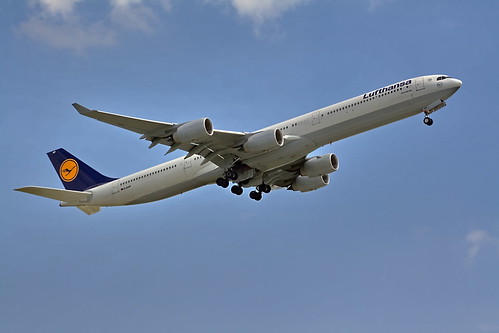
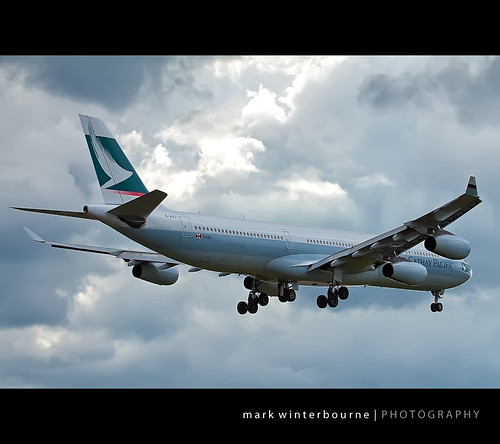
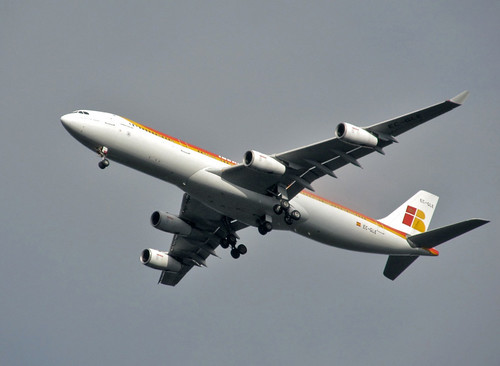
With all of that said, I still think the A340 is one hell of an elegant and pretty airliner. It lends itself to the great airliner liveries of the world. Just look at these:
(All images from Flickr under their Creative Commons License)
First, my apologies for going dark for such a long time. My day job became suddenly very busy and required my full attention.
And now to take note that the 787 has been delivered to ANA and it is winging its way to Japan as I write this. It’s a good moment for the 787 and Boeing and I’m glad to see this delivery take place. It’s long overdue and all parties suffered a great deal of pain getting to this point.
But even though it is a moment of celebration, I think it’s important to remember a few things going forward.
First, this is the first delivery and a better indicator of the state of the program will be how many more are delivered by the end of the year. If this turns out to be a small handful, I think we’re looking at a program with production problems still. (The latest indicator about this was Boeing’s last production halt to allow work to catch up just a few months ago.) If Boeing manages to deliver more aircraft than expectations and I would have to say that this would need to be 12 or more deliveries, we might be able to relax and feel more confident that Boeing has the production issues well managed.
Second, this is a great aircraft but the one many more airlines want is the 787-9 and quite a few want to see what a 787-10 will look like. The 787-9 isn’t due for another 2 years and it is dependent upon Boeing having its production ramped up completely. My fear on the 787-10 is that Boeing will compromise the design into a derivative that is unsatisfying for customers. My prime concern is that they’ll accept a range that doesn’t completely allow customers to use it in 777-200LR missions and I think airlines want that capability. There will be more McBoeing cracks if the -10 ends up being that kind of disappointment.
Finally, there is the question of “what’s next?” for 787 technologies. Boeing has spent a massive amount of money developing this aircraft and it not only has amazing promise, it’s already realized amazing gains. Now they own a tremendous body of knowledge and . . . there is no other program to apply these to. There is no replacement for the 737 being worked on and that is deferred for probably 10 years or more at this point. There is no announced program for enhancing or replacing the 777 and there likely won’t be for some time to come.
If you don’t use such knowledge, it creeps away from you. At this point, there could be a 5 or 8 year gap between applying these technologies and given how technology rapidly evolves today, I think that’s a shame. I continue to believe that the argument for a 737 re engine was justified by low capital costs alone and didn’t adequately consider just how devestating a full new aircraft would be to Airbus. To not want to do that aircraft because you had not fully figured out how to scale production to 60 aircraft a month is . . . suspcicious. I want to throw the McBoeing label out there when I consider this.
I know one thing . . . a 737 re-engine would have never gained traction with Alan Mullaly at the helm.
So, here is some interesting news. According to the Sydney Morning Herald (Australia), QANTAS is finding its 4 times a week flights to the DFW area using a 747-400ER as both successful and profitable. The airline began the flights just 3 months ago and is already seeing load factors in the 90% range (with about 80% of that load being leisure and 20% corporate/business.)
There have been a few diversions to South Pacific locations for refueling due to adverse headwinds but none recently. There have also been a few complaints about luggage being delayed due to load limitations. Both because the route is on the outer limits of the range offered by the 747-400ER.
If the success is as good as claimed by Qantas NSW regional general manager Peter Collins says it is, I wouldn’t be surprised if QANTAS either changed the service to an A380 in the future or if it added 6 or 7 times a week frequencies. QANTAS has already said that when its 787s become available, they’ll likely service the route with multiple daily frequencies.
QANTAS has both 787-8 and 787-9 aircraft on order but I would expect that the aircraft they’ll want to use is the 787-9 (provided the range promised is delivered) and that means a long time from now. In the meantime, the A380 can offer as much range with greater capacity as the 747-400ER for this flight when it can operate its aircraft with the uprated Rolls Royce Trent engines at full thrust again.
In any case, it’s good to see QANTAS succeed with this route and I look forward to seeing it developed even more as time goes by.
Boeing is going to pause its 787 production line in Seattle for 1 month . . . again. Swirling theories have it that its necessary for parts to catch up and change incorporation to take place. This line hold takes place for the first time this year but after 4 such holds in 2010.
One wonders how Boeing will increase production to 2.5 aircraft per month this summer and increase it up to 10 in 2013 given the holds that continue to happen. In addition, if various needed assembly pieces are experiencing shortages, how does Boeing supply its soon to be open South Carolina production line for the 787?
And why do we care? Because for no other reason than the 787 really is a test of new production supply chains and the failure of those supply chains may well call into question the rather stunning production rates being talked about for both current Boeing 737 and Airbus A320 lines as well as future new aircraft.
Typically, supply chains can keep up once the real demand is known. I don’t doubt that the supply chain will eventually find its rhythm. However, it could still take a few years for that to happen and only after Boeing makes further changes to its supplier structure. In the meantime, failure to deliver 787s impacts Boeing’s bottom line and its ability to move on to other new aircraft.
Airbus has announced its plans for the A350-1000 and airlines have responded with yawns or, in the case of one airline, a bit of outrage. Airbus can still change their minds about the final definition of this airliner but not without more delay or a commitment from an engine maker that would be pretty unrealistic. So we know what the A350-1000 will look like, more or less.
And what is Boeing’s best response? I’m not sure the timing is right for an all new widebody large capacity airliners to sit just above the 777-200ER to just below the 747-8i. But I do think the timing is right to greatly improve the 777. Imagine the pain Airbus feels with a 777 update that provides a better wing constructed of composites, a fuselage that is slightly lighter due to some composite use and engines that are bit more fuel efficient as a function of incorporating GEnx engine technology. What if Boeing can offer a 777-250/777-350 that offers more seats, 500 to 1000nm range improvement and/or a slight upgrade in payload capacity?
That little squeak you heard is Airbus salesmen contemplating that scenario. I can see a strong business case for such aircraft and I think you would hear a lot of airlines bark out loud “sold!” if it was announced. Does it get announced this year? No. Boeing has got to figure out the 737 replacement family, finalize the 787-9 production, get the 787-10 kicked off and then contemplate the 777’s future. I wouldn’t expect anything developing on the 777 until 2014.
Take a look at this video of the 787 landing in Paris for the airshow. It was shot with a FLIR (Forward Looking InfraRed) camera and at various points it switches to infrared. At the very end, while taxiing, you can see just how hot the wheels and brakes are compared to the rest of the airframe. Only the engines are hotter.
French parliamentarians went a bit crazy and became furious with Air France’s decision to accept bids from both Boeing and Airbus for 100 mid-sized widebody jets.
Boeing’s 787 and Airbus’ A350 are in the running and Air France officials have said that it is likely to be a split purchase.
France continues to own a stake in Air France and is also one of two major stakeholders in Airbus.
I find this ironic since Air France has found it very economical to use Boeing’s 777-200/300 aircraft and owns 60 at present. The 787 fits nicely into their plans since the transition from a 777 to a 787 is short and easily accomplished. The transition from an A340/330 aircraft to the A350 is sure to be similarly easy.
Politics in the airline world inside France is always nationalistic but this move is just a bit too overt for our taste.
Delta Airlines and Virgin Australia have gotten their approvals for an anti-trust immunity agreement to cooperate across the Pacific between the United States and Australia. They did so, in part, by promising to keep up frequencies between the two countries.
This doesn’t mean that routes won’t be rationalized. The frequencies will stay the same, the routes won’t. These two airlines will deploy their 777 aircraft on routes that are complimentary rather than competitive. Expect V Australia 777s to start arriving in San Francisco to replace QANTAS’ recently withdrawn flights.
Delta’s 777-200LR aircraft can potentially make the flight between Atlanta and Sydney (although with a touch of payload restriction) and provide competition to QANTAS’ new 747-400ER flights to Dallas/Fort Worth.
And for the first time, there is real competition for the QANTAS/British Airway/American Airlines Oneworld consortium. Virgin Australia can provide domestic connections to Delta in Australia and Delta can provide domestic connections to Virgin Australia in the United States.
John Borghetti, CEO of Virgin Australia (and formerly an executive with QANTAS) has made it clear that he intends that Virgin Australia be a strong competitor with QANTAS rather than an constant underdog and he has experience with building networks as a result of working for QANTAS for many years.
Look for quite a bit of new competition on routes between the United States and Australia and I think United is going to be the airline to take the hit. United has pretty old aircraft with a pretty old service product and no partners in Australia to assist with feed. They also have no new large widebody aircraft to carry passengers with either although they will have the 787-8 with which they can start direct flights to New Zealand and Australia from cities in the United States that have never traditionally seen direct flights.