In what is almost certainly a politically motivated move, the country of Iran is requiring that all foreign airlines traveling to and from Iran must show the name of the Persian Gulf as “Persian Gulf” on their moving flight displays instead of “Arabian Gulf” as some apparently do. Failure to do so may result in aircraft being impounded and flight privileges to Iran being suspended.
The correct, United Nations confirmed, name is Persian Gulf but several countries (Qatar, Saudi Arabia and Kuwait to name a few) on the Arabian peninsula have apparently persisted in calling it the Arabian Gulf.
And you thought Islamic nations in the middle east were unified. You can read more from Reuters HERE.
I received an email pointing me to this video about the US Airways A320 recovery in the Hudson river. It’s a time lapse film of the A320 being pulled up from the river and it’s both well done and even a bit dramatic. Here it is:
British Airways cabin crew (aka “the flight attendants”) were going to go on strike this holiday season believing it best for everyone concerned that they get their way on everything. The British courts nixed that idea.
HERE is an entertaining essay by Jeremy Clarkson of Top Gear television fame on Christmas Travel.
It seems to me that our government and Congress in particular has far bigger pressing problems to deal with than attempting to swat at airlines over frequent flier miles.
Levying fines on Continental, ExpressJet and Mesaba for the Rochester, Minnesota incident is surprising everyone because it lays blame on everyone we, ourselves, would blame.
Voting Midwest as a best airline (Zagat) is just strange given that it really isn’t an airline so much as a brand now.
Nothing sells an aircraft like the head of state for the manufacturer.
I found a fun quiz on world airlines on another blog this morning. It’s timed and does include a lot of different world airlines. You match the city it is headquartered in with the airline. You can find it HERE.
Air France just received their first A-380 and Lufthansa is right behind them. Lufthansa is unusual in that it has orders for both a considerable number of A-380 aircraft as well as the new Boeing 747-8i.
You can view a rather great video on Lufthansa’s new A-380 HERE. It’s actually one of the better videos of an A-380 that I’ve seen.
American Airlines announced that they will be closing the Kansas City Maintenance Base in about a year. The maintenance base was begun by TWA and has existed for oer 50 years servicing aircraft that include the Lockheed Constellation, the Boeing 747 and the McDonnel Douglas MD-80. The Kansas City newspaper has a photo gallery of this base HERE.
If you are ever at an airport and see an aircraft with the company name Capital Airways, you’ve just seen the US Justice Department’s own little airline for transporting prisoners.
It’s still slow in the news of airlines but I have some ideas for articles to come soon.
In the meantime, I thought I would post THIS link to a Boeing 707. The aircraft is in a park in Ho Chi Minh (ex-Saigon) and somewhat near the airport. It’s supposed to be an aircraft originally owned and operated by South African Airways that was later sold to Vietnam Airlines.
Passur, a company that does aircraft and airport real time tracking, has created a simulation of US Airways Flight 1549. It really is stunning. You can see it HERE.
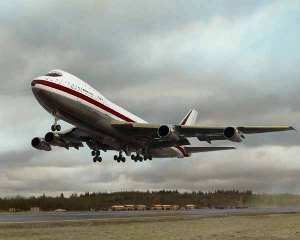
Today is the Boeing 747’s 40th Birthday. Or, at least, I count it as such since today marks 40 years since the legendary jumbo jet took its first flight.
Lots of time gets spent reminiscing over the DC-9 and the 727. Both were the first examples of a short to medium range jetliner for the United States and even the British BAC-111 and Hawker Siddley Trident get remembered for some good. But the first real twin engined, short to medium range jet was actually the French Sud Aviation Caravelle.
The prototype was first rolled out in 1955 and just one year after the Boeing 367-80 prototype that was later evolved into the Boeing 707. The first Caravelle was powered by a Rolls-Royce Avon jet on either side of the fuselage at the rear. Because of the rear engine placement, the horizontal stabilizer was moved half way up the tail in what might best be described as a semi-T-tail.
One other little known fact about the Caravelle is that it had the same nose section as the DeHaviland Comet and Sud paid a royalty to DeHaviland for each one. Somehow that nose looked just a bit more sporty on the Caravelle.
The Caravelle was also the first aircraft to have spoilers and thrust reversers which allowed Sud to do away with the parachute braking they employed on the first 4 iterations of the aircraft. It was expensive and time consuming to repack parachutes for the aircraft but necessary given the rather short runways at some of Europe’s airports.
United Airlines was the only U.S. based airline to buy the Caravelle. They favored the Caravelle VI-R (R for reverse) that now sported jet engines capable of over 12,000 lbs of thrust. It was used on New York City to Chicago routes and some were actually outfitted as men’s only flights that operated more as flying lounges than commuter aircraft.
The first Caravelles carried a maximum of 80 passengers for a maximum stage length of about 1000 nautical miles. The first stretch offered passenger capacity of about 95 and the second had a maximum of 105 passengers. The last models were capable of 140 passengers in an all economy (for the time) configuration.
Not only did the Caravelle parallel the DC-9 in capacity in various guises (the original DC-9-10 carried about the same number of passengers, was about the same length and used engines of similar thrust from Pratt & Whitney), it was also very nearly built by the Douglas Aircraft Company. Douglas did spend some time marketing the Caravelle in the United States but later chose to develop their own DC-9 based largely on the configuration(s) they marketed for Sud Aviation and their Caravelle.
The Caravelle was purchased by GE and engined with the infamous GE CJ-805 engines that were also used on the Convair 880 and which were responsible for great gasping clouds of smoke on take-off. This made an order by TWA possible for 20 aircraft since TWA also had ordered the Convair. An order that was later canceled due to financial problems. When TWA was capable of making another order, the DC-9 was available and the Convair had already begun to fall into disrepute.
The final models were powered by the Pratt & Whitney JT8D engines rated at more than 14,000 lbs of thrust. The same engines that would power both the DC-9 and Boeing 727 for production runs that would last decades.
The last Caravelle, the Super Caravelle 12 saw only 12 examples built for the charter market but were seen flying in Europe as late as 1996. Ultimately they fell out of favor with the institution of Stage III noise regulations.
With speeds in excess of 525mph, passenger capabilities that matched anything offered in the United States and engines that are still known today for reliability and power, it is remarkably surprising that only 282 examples were built and that the only US Airline to use them was United Airlines. It was an aircraft that matched its competitors in every way.
As I suspected, the new focus on airline safety is all about bird strikes. The Middle Seat Terminal Blog (a Wall Street Journal blog) has THIS post. After the US Airways Flight 1549 ditching, I suspected that there would be lots of chatter about preventing bird strikes and there has been.
Some of this chatter is about putting screens in front of the engines, for instance. No one stops to think just how strong and well engineered a screen would have to be to withstand the force of an 8 pound bird and well as how fine it would have to be to keep debris from entering the engine. Nor does anyone consider that by putting such a screen in front of an engine, you are effectively disrupting the air flow into the engine and that will, at the least, reduce engine efficiency if not keep it from operating as designed.
Consider a goose that weighs about 4 kilograms being struck by an aircraft going about 250mph. That is just about the exact scenario for Flight 1549. Such an impact represents over 27,000 joules of energy. In very rough terms, that is enough energy to move more than 3 tons of weight about 1 yard. By the time you engineer a screen for that jet engine, you need a better, more powerful jet engine to carry all that extra weight.
The truth is that bird strikes are not uncommon and almost always result in non-event. In fact, engines and other parts of aircraft structure have to be engineered to withstand most bird strikes likely to be encountered. Jet engine makers have to prove their engine can take a strike and not furiously disassemble itself and damage a wing or fuselage. Cockpit windows have to be able to take a punch too.
The truth is that commercial aircraft handle these events very well and what happened to that Airbus A320 was actually a statistical anomaly. It is so rare for a commercial jet to encounter birds and lose both engines to the point that the aircraft cannot return to an airport that in my research, I cannot find another instance. Oh, it may well have happened but it is exceedingly rare.
Put another way, you have a far greater likelihood of experiencing an “incident” from turbulence than you do from a bird strike. That doesn’t keep you from flying does it? From my perspective, this incident proves that nothing more does need to be done to mitigate problems from bird strikes.
First, it is rare for them to disable an engine but it does happen. A jetBlue Airbus encountered a bird strike this past weekend and rejected its take off. After returning to the terminal, evidence of a bird strike was found. Any other week, this would not have made national news. For birds to disable both engines is virtually unheard of and that is a good thing. Any modern two-engine airliner is capable of taking off, losing an engine and maintaining climb power to go around and return to an airport.
Airports do their part to prevent this problem. Unfortunately, airports happen to be places that attract birds because of the wide, open areas that are flat and which generally contain a lot of what birds want. Airports scare them away and do their best to make flight areas a very unattractive place for them to flock to. And they are very successful at that in general.
One of the other points that I think escapes what happened to US Airways is the altitude that they encountered these birds at. It was at about 3000′ above the ground and how common do you think it is to find birds at that altitude? Very rare.
The traveling public is quite safe when it comes to bird strikes. This was an anomaly and you are just only now hearing about this “problem” because it just rarely happens to ever truly affect a flight.
IN 1968, a JAL DC-8 was essentially “landed” into the San Francisco Bay in error and about 2.5 miles from the runway it was supposed to land on. There was no declared emergency and there was no other reason to do this except that it was an accident. Everyone survived and the DC-8 was actually returned to service eventually (although I’d wager that it wouldn’t be today). The biggest difference between this incident and the US Airways incident is that the DC-8 wasn’t fully loaded and didn’t have a nearly full fuel load. Weight makes a big difference.
What particularly impresses me is the Captain’s explanation for this act when he testified in the investigation. You can read that HERE. I didn’t know about this statement until I was reminded of the ditching when reading an aviation forum last night.
This incident with US Airways Flight 1549 has made me realize that we now have two incidences (at the least) on record where a superb landing was made in an emergency situation and was done so during moments that call for graceful aircraft handling.
I feel certain that this US Airways incident is one. It does take grace and experience to land an Airbus A320 gently enough in the Hudson River so as to avoid any breakup of the aircraft. A fully loaded, fully fueled airplane is not easy to handle and keeping it from over-stressing itself and breaking apart is a genuine feat. The pilot, Chesley Sullenberger, is a certified glider instructor.
Another incident that many airliner fans certainly know about is the Gimli Glider episode. An Air Canada Boeing 767 ran out of fuel and was glided to a safe landing at a decommissioned air force base. A fueling mistake had been made at its last stop and both pilots found themselves woefully out of fuel in the middle of a transcontinental flight. The Captain of that flight, Bob Pearson, was also an experienced glider pilot and used some flight techniques from that experience to make a safe landing at Gimli. You can read all about that incident HERE. (It’s well worth the time.)
What strikes me about this incident, so far, is that the pilots had very little time to execute a plan and manage their situation when it happened. The bird strike occured somewhere near or over the Bronx Zoo (based on the observed flight track from Passur.Com). From that moment, they had just a hair over 3000 feet in altitude, two failing engines and a highly populated area underneath them. With engines providing some forward thrust, they maintained control of the aircraft, executed a tight turn just north of Manhattan and made contact with air traffic control.
While attempting to manage the aircraft for an emergency landing at New Jersey’s Teterboro Airport, the pilots had enoug presence of mind to realize, quickly enough, that they had not enough altitude nor forward airspeed to make it there and quickly lined up on the Hudson River instead. Gently landing an A320 that likely weighed in excess of 150,000 lbs and which had little airspeed to maneuver with is a nightmare scenario for any pilot. Captain Sullenberger managed to line the aircraft up with the river, lower it to just above the water’s surface and then stalled the aircraft just right so that it essentially dropped into the water with almost no forward motion. He did it so good, most passengers have described the impact as no worse than a minor rear end car accident.
A very well done job for all the flight crew and it was a genuine touch of class that Captain Sullenberger was able to walk the aircraft and ensure all his passengers were off and manage to be the “last one off the ship” as well. For a really bad situation, it was the best of all outcomes.
This was written earlier today by my friend, Dave “Rigger” Vick, who is currently touring with the musical, A Chorus Line. He reads this blog and since he has been experiencing a variety of travel scenarios for the past several months, we talk often about the challenges in aircraft, airports and airlines.
So here’s some wacky fun…
When you fly out of Lester Pearson International Airport in Toronto to a destination in the USA, once you’ve checked in and collected your
boarding pass you have to go through US Customs & Immigration
Pre-Screening, inside the airport, which you might think is still
inside the City of Toronto in the Province of Ontario in the nation of
Canada…
But you’d be wrong. Very wrong…
The line to get up to the pre-screening agents is in fact Canada, and
you can enter and leave the line as much as you wish – and they tell
you that, too – *until* you have passed through the pre-screening and
been cleared by the USCI agent there. Now you are *technically* no
longer in Canada, and if you need to return to the terminal for any
reason, you are required to go through Canadian Customs &
Immigration…
However, the next stop after the pre-screen, on the way to your gate,
is the Canadian equivalent of the TSA security screening checkpoint,
which is *not* run by US-TSA agents, but by their Canadian
counterparts, and since the USA does not permit foreign nationals to
run its securty apparatus, ergo, you are *technically* not on US
territory, either.
You’re not in Canada… You’re not in the US… You’re in No-Man’s Land.
So what happens when you happen to be, say for the sake of discussion,
the assistant carpenter-slash-rigger of a touring Broadway show,
leaving Canada after 35 days to return to the US for your next
itinerary stop, with your knapsack full of necessary tools; say for
instance two Motorola walkie-talkies, a PLS laser, a Leica Disto laser
rangefinder, a roll of 3″ wide gaffer’s tape, a roll of 2″ wide clear
Jalar tape, an assortment of measuring tapes, a soapstone marker in
its holder, a Pentel paint marker, a laptop computer, and a 9v-powered
Screamin’ Meanie, and consequently the security agent manning the
X-ray machine sends up all sorts of red flags and bells and whistles?
You sweat, my friend… You sweat, is what you do.
That was about the most nerve-wracking thirty minutes of my life,
trying to explain to a very flint-eyed Canadian woman exactly why I
was carrying all of that drek through from YYZ to BWI at 6:30am this
past Monday. She wasn’t having it, but there was apparently nothing
she point to that was blatantly enough evidence to get me into
rubber-glove-up-the-butt screening, so she had to settle for making me
squirm.