A good month, a good quarter

July 20, 2013 on 1:00 am | In Airline News | No Comments

American Airlines had the exceptionally rare privilege of announcing a $220 million net profit for the 2nd quarter (American is calling it a $357 million profit excluding bankrtupcy costs.)

This is exceptional and it reflects all of the cost savings achieved through bankruptcy to date.  This number should even improve incrementally from a cost perspective for several years to come as the airline’s fleet is renewed more and capacity is grown with additional seats.

Is there  a “but”?  Yes, there is.

This is all due to cost savings, not revenue growth.  In fact, year over year, revenues for Q2 dropped ever so slightly.  While costs can drive this airline to profit, it will be revenue growth that drives this airline to real success.

Revenue growth will take from 1 to 4 years to really be perceived and I don’t expect this focus to take place until Parker & Company are officially in charge.

The Leadership at American Airlines Group

July 19, 2013 on 1:00 am | In Mergers and Bankruptcy | No Comments

With more and more leadership announcements going on with respect to those who will have a position in the new American Airlines Group when US Airways and American Airlines merge, I see a pattern.

That pattern is that US Airways leadership is being used to provide cohesive leadership structure and certainly leave no doubt as to who is in charge of this merged company:  Doug Parker.  I’ll admit that my fears that Chairman Tom Horton will attempt to interfere are unchanged.  I think that there will be a number of attempts to direct the merged company.

Now I think they will fail.  Doug Parker is building a leadership team that clearly has its loyalties in the right place.  American Airlines leaders are being used to fill functional roles whereas US Airways leaders are being used to fill leadership roles.  There is nothing wrong with this approach.  I like it.

This is a group of leaders who will have incentive to work together and to succeed (or fail) together.  I see little opportunity to breed divisions in these ranks and I think that will only benefit the airline.  The right, successful people are in charge.  The ones who comes from a company with a winning and profitable track record will be the leaders and that is only right.

I would contrast this with the Continental United merger where it seems that Jeff Smisek willing took on way too many United loyalists.  That ship has been slow to change and correct directions when necessary and I still don’t see a cohesive team in place at United.

So, well done Mr. Parker.  This is looking like a merger with the potential to meet or exceed expectations on all fronts at this time.


Fly Braniff Free: Part 2

July 18, 2013 on 1:00 am | In Airline History, Trivia | No Comments

Fly Braniff Free:  The Braniff Travel Bonus Bonanza Program (Part 2)


The Flying Colors of South America

Gemini Jets 1:400 Scale DC-8-62 Model: The Flying Colors of South America


After Harding Lawrence’s departure from Braniff International in December of 1980, John Casey, brother of Albert Casey (Chairman and CEO of American Airlines) was elevated to the positions of President & CEO at Braniff and Neal Robinson became Executive Vice President – Marketing.  When strategizing with Vice President of Sales, Jeff Krida, Robinson told Krida about the Braniff Fast Buck program that lasted about 6 months a decade earlier.

The Fast Buck program awarded passengers a plastic token good for their next trip on Braniff if their flight was late.  This encouraged good will among passengers and tied them to Braniff for their next flight at the same time.  Robinson wanted a program that tied people’s travel decisions to Braniff.  That was when the subject of S&H Green Stamps came up in the Robinson – Krida strategizing as Robinson remembered having to lick and past stamps into books when he was child.

On a more personal note, I can remember that there was a small store near our home at that time that was one of the last stores around in the area to aggressively market the fact that they issued S&H Green Stamps and I remember people demanding Green Stamps when they filled their car fuel tanks with gasoline during the gas crisis of 1979.  Those stamps tied loyalty to that store very tightly during that energy crisis.

Robinson, who had spent a great deal of his career tied to the reservations and financial systems of the airline, hoped that they could tie the program into the Braniff “Cowboy” reservations system so that they could identify the passengers travel with the passenger and offer a benefit to the passenger rather than the company paying for the ticket or the travel agency procuring the ticket.  The passenger would reap a reward that came at no cost to him and the program worked very well.

Flying Colors of The United States

Gemini Jets 1:400 Boeing 727-200 Calder Flying Colors of The United States


There are plenty out there who would tell a different story.  Some would tell the AAdvantage story and some would tell the Western Airlines story.  The truth is that like quite a few developments in marketing, there were a number of people who were exploring the idea of a loyalty program.  Men like my father, Robert Crandall, Tom Plaskett, Jeff Krida and others were all of a similar generation who were doing similar things.  They had the benefit of being of the same generation and the same experiences that came with that generation.

From a personal viewpoint, I still remember very strongly the day that American Airlines announced its own program.  My brother and I both reacted strongly and exclaimed “Hey, they stole that from Braniff!”  We were proud and defensive of our father.

It’s also notable that the Braniff campaign was to be good through May 31st  1982.  The airline filed for bankruptcy just 2 weeks before that date and my father had been gone from the airline for many months by that point.  That final element in what needed to happen to support Braniff’s survival was never done by the remaining executive leadership.

Delta Airlines accepted the points earned by former Braniff customers starting about one month after Braniff’s bankruptcy filing.   Delta had just begun their own program and wanted to earn their way into Dallas / Fort Worth in particular.

He who wins, gets to write history and American Airlines won.  The AAdvantage Program won and it is entitled to write some history.  The truth is that I do not believe that American Airlines “stole” the idea.  I strongly suspect they were working hard to figure out solutions to problems just as most airlines were and decided to try something that had worked in other forms and in other decades.

Airline loyalty eroded heavily after deregulation.  Prior to deregulation, you did not choose your airline on price.  The fare was determined by the government.  You chose your airline based on the schedule available and the service style you wanted.  Airlines drove their loyalty with that service.

Post deregulation, fares drove those decisions and particularly so among the public.  Fares were the democracy that the airline industry had never before seen and it was shocking to many just how quickly even the most loyal customers could leave based on fare that was a few dollars cheaper than the next guy.

Airlines knew how to work with loyalty and they craved a way to re-establish it.  So it makes sense that many at many airlines would be working on loyalty programs.

That brings me to an irony in closing this article:  My father was at least a father of airline frequent flier programs if not the father of such and it was a program that worked well for Braniff.  As an airline industry commentator and someone who has been observing the industry for about 20 years now, I loathe frequent flier programs.  I believe they skew the industry in ways that cause service to suffer madly and which allow bad airlines to survive years past what they should be able to do.

And when you think about it, that is a great definition for the success of such a program.


View a low resolution copy (courtesy of Braniff Flying Colors Collection, Dallas, Texas) of the original brochure:  Braniff Travel Bonus Bonanza Brochure

For additional images and perspectives, visit the Braniff Flying Colors Facebook Page


Fly Braniff Free: Part 1

July 17, 2013 on 1:00 am | In Airline History, Trivia | No Comments

Fly Braniff Free:  The Braniff Travel Bonus Bonanza Program

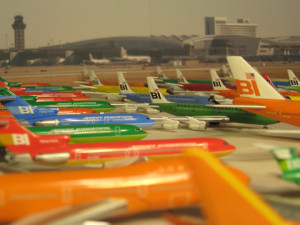
Photograph of Braniff International aircraft

The Braniff Fleet owned by the author

For the very few that remember this program, it could be argued that this really was the first modern, points based airline loyalty program to be instituted.  And some would argue that it was American Airlines who did this.  Before I go further, I should mention  that I am not entirely an unbiased observer in this story because it was my father, Neal J. Robinson, who I would argue is one of the originators of these programs.

The story about what drove Braniff to adopt such a program has its start in the 1978 Airline Deregulation Act just like so many other modern airline stories.  It was the opinion of many in the airline industry at that time that airlines would have to grab all the routes that they could when deregulation began so that they could hold these routes when the airline industry was re-regulated, as so many thought.  Harding Lawrence, Chairman and CEO of Braniff International certainly thought so at the time.

There was a belief among many airline executives that deregulation would last only a few months because no one believed the government and the public would have much tolerance of the chaos they believed would ensue.  In hindsight, this seems silly but in the context of the 1970’s and the history of the airline industry, it wasn’t entirely impossible either.

Deregulation only liberated the revenue and service side of the airline industry while the cost side, especially labor, remained regulated in the form of unions, union contracts and the Railway Labor Act. Many of those involved in the accounting and finance domains of airlines became acutely aware of the risk that their airlines were about to endure as prices dropped and costs remained the same.  My father was one of those men as he sat as Vice President – Finance & Control for Braniff.

By late 1979, Braniff was under significant financial pressure by having taken on too many new routes and by having ordered too many airframes and engines to serve those routes.  The company was under increasing pressure from its lenders and that fact became a matter of speculation within the travel industry and, to a lesser extent, among the general public.

The impact on Braniff as a result of that financial pressure and the attendant speculation was estimated to be that the airline was possibly losing from 5 to 10 percent in load factor on a daily basis as a result.  The airline was suffering for passengers badly just when it needed them the most.  In the pre-deregulation era, it was commonly accepted that airlines would aim for load factors of approximately 60 to 65 percent which contrasts greatly with the 80 to 90 percent load factors airlines want today.

With air fares suddenly dropping like rocks, airlines could not afford to suffer any drop in load factor whatsoever and certainly not a massive drop such as 5 percent or more.

According to Neal Robinson, his calculation (an educated guess really) was that in 1979, travel agents who were selling to the general public and to the corporate travel departments constituted approximately 65% of all Braniff ticket sales and he was certain that this percentage was dropping quickly.  The decline also roughly correlated with the level of news and speculation about Braniff within the industry.  In short, the speculation was fueling a self-fulfilling prophecy.

Mr. Robinson describes the problem here:

 I concluded the reason for that decline was the basic math of travel agent ticket sales.  Travel agents typically received a commission equal to 10% of the ticket price, e.g., for a $500 ticket, $50.  In the event of an airline failure where the ticket became essentially worthless except to the extent another carrier might honor it, sometimes on standby, the entire ticket purchase price would be lost, e.g., $500.  In that event, the travel agent would be under great pressure to refund the entire ticket price.  Thus, where the travel agent had the potential to benefit in the amount of $50 for selling the ticket, it had a corresponding opportunity to lose $500—or ten times the amount the agent had to gain if the carrier ceased operations.  I believe that made travel agents and corporate travel departments shy away from using Braniff—that in addition to the inconvenience that would result to the passengers, their “customers,” in the event the airline failed. 

 Travel agents were doing what smart business owners do:  limiting their exposure to risk.

When Neal Robinson was elevated to the post of Executive Vice President – Marketing, he concluded that three things had to happen fairly quickly.  First, Braniff needed to create the image that they were fighting their way back.  This was initiated with the Glen Geddis (designer of the Braniff Two Tone Livery in the early 1970’s) developed campaign titled Braniff Strikes Back which was thematically inspired by the Star Wars movie, The Empire Strikes Back.

Glen Geddis Two Tone Red Flying Colors Aircraft

Jet-X 1:400 Boeing 727-127 Glen Geddis Two Tone Red

The second thing needed was a way to take the airline choice decision out of the hands of travel agents and corporate travel departments and get it into the hands of the passengers.  Mr. Robinson and his team believed that travelers liked the Braniff experience and even preferred it despite the fact that the airline’s relationship with passengers had recently been strained by operational problems incurred with the rapid route expansion.

The final action was to put together a business plan that made sense to banks and insurance companies who were largely Braniff’s creditors at the time and who the airline needed to reduce the constant pressure and industry speculation that drove falling load factors.

In the next post, I will talk about the program used to drive that passenger loyalty:  The Braniff Travel Bonus Bonanza

For additional images and perspectives, visit the Braniff Flying Colors Facebook Page

The Big “What If”

July 16, 2013 on 10:54 am | In Deregulation | No Comments

There are many fans in the airline world who freely speculate on what would have happened if someone or something were different when it comes to their favorite airline.  I see this a great deal in the Braniff International world.

There are schools who believe that Braniff’s CEO Harding L. Lawrence ran that company into the ground singlehandedly.  Some believe that deregulation did the company in, some think it was American Airlines who struck at Braniff and some think that if Braniff had continued to be managed by its CEO Chuck Beard, it would be here today.

The big “What If” isn’t just with Braniff.  It’s with virtually every beloved airline that has disappeared.  What if the unions at Eastern had not gone nuclear with Frank Borman?  What if Pan Am hadn’t suffered an image problem from the Lockerbie 747 crash?

I want to talk about deregulation.  What if deregulation hadn’t happened?

Well, the truth is that that was never an option.  We think it might have been but it really wasn’t.  Regulation of the airline industry was inhibiting economic growth.  If it was not deregulated, you would have seen the United States a highly regulated environment playing against a highly deregulated environment that would exist in the rest of the world.  Want to know how ugly that would get?

Alitalia, Air India, Aerolineas Argentinas are 3 great examples of what the US airline industry would look like as a protected, regulated industry operating against deregulated airlines.

This country nor its airlines are in control of the changes that occur naturally throughout the world.  There is no altering the dynamic forces of change to fit the needs of an airline.

The truth is that deregulation hurt all US airlines.  Not a single US airline was prepared for deregulation.  Most airlines were led by people who had no concept of how to cope with deregulation.

Successful airline industry titans either left as the writing showed up on the wall or were violently ripped from their companies as they held on too long.   In Braniff International, Harding Lawrence bet heavily on deregulation being reversed and lost badly.  Continental’s Bob Six lost his entire airline because his company was poorly equipped in leadership for deregulation.  American Airlines’ Albert Casey made an orderly departure but only because he did have a leader equipped to deal with deregulation:  Robert Crandall.

Lest you believe that only legacy airlines were affected by this, let’s take a look at airlines such as the original LCC carriers.  People Express died being started and run by people who still thought that marketshare was king.  Air Florida:  Same thing.

There is just one major airline who survived deregulation and thrived ever since:  Southwest Airlines

Arguably the best prepared airline for deregulation since it started in a threatening and competitive environment and had to fight for its existence for the first 20 years of its life.  It started in an deregulated, intra-state environment and learned how to fight before moving out of state.

What if the leaders of legacy airlines were right and deregulation didn’t happen?  It’s a question premised on the idea that deregulation might not have happened.  That’s a false premise.  It did happen, it would have happened no matter what and timing was the only issue at hand and even that was somewhat predetermined to happen within 10 years or so of when it did happen.


Calling all former Braniff employees

July 15, 2013 on 1:15 pm | In Airline History | 6 Comments

An extremely nice and talented duo, Abra Schnur and Jacob Flores, are engaged on doing an oral history about Braniff.  They are doing voice interviews with former employees and family members of Braniff and then transcribing and archiving these interviews with the University of North Texas.

I’ve written about their project before.

They need subjects to interview.  I believe they have had no problem in getting numerous interviews with pilots and flight attendants but they need interviews with people who worked or interacted with the airline in other areas.  That means people such as accountants, baggage handlers, managers, salesmen, mechanics and others.

It’s a worthy cause and it costs you nothing to participate but a small amount of time.

I’ve done an interview with them and found it be a terrific experience and it surprised me how much I had to say.

Why should you do this?  Because the history of Braniff is unlikely to ever be documented in an authoritative book.  The authors who did such writing are largely gone and the acknowledged king of airline histories, Robert Serling, has passed away.  (Serling produced authoritative histories of airlines including Eastern Airlines, TWA and American Airlines.)

More importantly, if this history is not captured now, it may never be captured.  The truth is that people from Braniff are aging and there is probably a 5 to 10 year window to capture this history at best and, frankly, I fear we may have already lost some in the deaths of certain Braniff icons.

What can you do?  Contact FlyingVoices on their Webpage or their Facebook page and offer to do an interview.

Go ahead, do it now.  We’ll wait patiently while you do so.

Do you think you don’t know a former Braniff employee?  Maybe you don’t.  But forward this blog post on to others and try to spread the word anyway.

Do you have questions or wonder about the legitimacy of this?  Contact me by commenting on this blog post and I will answer whatever concerns you have.

A project being executed objectively and without agendas is rare and FlyingVoices is trying very hard to get it right.  Without participation and even sponsorship (they need money!), these kinds of projects fail and history is lost.

So go save some history and participate in FlyingVoices.


Lost Luggage

July 10, 2013 on 1:00 am | In Airline Service | 2 Comments

So, Southwest lost my luggage.  Actually, I believe they got lazy with my luggage.   My flight into Love Field arrived a few minutes before midnight and we all trudged through the old section of the terminal to get to the makeshift baggage claim where we all waited for our bags.

Until several of us discovered our bags weren’t there.  Curiously, it appeared that among us, most missing bags had come from the East Coast.

There was a section of baggage being supervised by SWA staff between the two makeshift baggage claims.  I went over there to check on the location of my bag because I thought there might be a chance my bag went ahead of me.  You see, when I got to St. Louis that night, I noticed that an earlier flight to Dallas (Flight 110) was leaving late and I wondered if the bright purple transfer tag with DAL on it wouldn’t have caused my bag to transfer quicker than myself.

But when I handed my claim ticket over and asked the staffer to check around for my bag, I got “You need to go to the office and file a claim.  That bag ain’t here.”

I was fascinated by the fact that she knew this despite there being 100 bags give or take in the area.  This woman had all the bag claim checks memorized for those bags.

Next I went to the bag claim office and when it was my turn, I was asked what they could do for me.  Again, I handed over my claim ticket and asked that they find my bag.  This staffer, without saying anything else just started typing.  Then she asked for my driver’s license.  Now, I’m kind of weird about handing over stuff just because someone asks for it.  Particularly identification and credit cards.

“Why do you need my license?”  I asked.

“Do you want us to find your bags?”  She responded harshly.

So, I don’t do snippy very well when I am  overtired and I have been patient for the day.   I explained (firmly) to the staffer that I did want my bags found and that my question as to her purpose for my driver’s license was not inappropriate whatsoever.  She responded that she wanted to get my information for getting the bag back to me in slightly less snippy tones and I gave it to her.

Then I asked:  “So, is my bag lost?”

She looked at me blankly and I repeated:  “Is my bag lost?  Does Southwest not know the location of my bag?”

“Yes, it’s lost”, she replied.

“Then tell me it’s lost before acting as if I should just blindly follow your lead.  It would also be nice to hear an apology for misplacing it.”  I stated.

“Do you even want me to find your bag sir?” said the staffer.

I really don’t do snippy well when your company has lost my bag and then behaves as if I am the inconvenience.  That’s when I asked for her supervisor.  Her supervisor sent her to get a can of water and curiously 2 police officers showed up.  As soon as they did, I hit “record” on my iPhone.

Before any of you attempt to lecture me on privacy laws, recording that conversation is absolutely legal in the state of Texas and most anywhere else.  It’s a public conversation.  However, Texas also has one party consent.  It was legal so don’t send me messages about this.

The agent finished her work on getting my info, printed a one page form and then kind of blew me off.  At this point, it’s worth explaining something:  I was not upset in the least about my bag having got lost.  Well, maybe a tiny bit but not really much at all.  Bags get lost.  In almost all situations, they are returned in a very timely manner.  There was nothing in mine that was essential or valuable.  I was highly confident that it would be found early the next day at the worst.

But I do not like to be treated as an inconvenience when an airline has made the mistake.  There is a culture among airlines that has them pushing off the problems created by the airline onto customers.  I don’t buy into that and I very much do hold the airline responsible for its part.  They are getting paid hundreds of dollars for a service.  Airlines have a particularly bad habit of turning lost baggage customers into ugly stepchildren in the process.

I was really not worried about this issue at first because it was, after all, Southwest Airlines.  A business that is, first and foremost, customer centered.

Except when they lose a bag these days.  In that case, they are a defensive legacy airline acting hostile towards its customer.

I waited to speak to the agent’s supervisor and I explained that I was disappointed about how I was treated but that I was not particularly concerned about the bag.  I told her that it is very important to simply say “We lost your bag and we’re very sorry about that.  We will do all that we can to reunite it with you as soon as possible.”

They say the first step to fixing things is admitting you have a problem.

In the supervisor’s case, she wasn’t quite ready to admit a problem.  I find it disappointing that at the end of a long day, my chosen airline had staff acting like American Airlines instead of Southwest.  It does point to a trend I’ve seen with Southwest over the past 2 years and I do wonder if Southwest is losing its customer-centric culture.

Now, I did get a phone call at 8:10am the next morning from Southwest saying they had my bag in Dallas and offering to deliver it immediately or in the evening.  That person was acting like she was all over the problem and very motivated to make something happen.  And she did.  My bag was delivered that night by 9pm by my choice and I was plenty happy.

My bag did not even get on my plane in Newark.  I find that particularly sad since I arrived at the Newark airport about 90 minutes before my scheduled departure and checked it at the curb when I arrived at the airport.  Southwest had about 85 minutes to get that bag on the aircraft and by all appearances, they may not have even tried hard.

Instead, they sent it on a late night flight from Newark to New Orleans.  The bag was then transferred to an extremely early flight from New Orleans to Dallas arriving at 7:25am the next morning.  Clearly someone had thought this through in terms of routing.  This was a “least impact” route.

I strongly suspect that some bags were kept off my airplane for weight purposes.  After all, it was a 737-700 with 143 seats that were crammed full with a full complement of overhead luggage and a full complement of checked bags.  If so, double shame on Southwest.  If not, then Southwest was just lazy.

Some time ago, American Airlines used to weight restrict its flights from Chicago to Dallas and vice versa on their MD-80’s.  If you flew from Chicago to Dallas mid-day, your luggage didn’t show up with you quite often.  It came about 4 or 5 flights later on a flight that wasn’t full.  American Airlines did this because their aircraft were weight restricted with the heat and full loads of fuel required.

I hated that behavior then and I would hate it now.  But I will never know for sure what happened.  That’s OK.

As for Southwest . . . well, if they were to challenge my account of my interaction with their agents, I would welcome them to come over to my home and listen to my recording.  It would save them from a very embarrassing moment.  It would not be wise to issue some announcement saying the had investigated and the passenger was treated appropriately.  Calling those cops over was overkill and certainly not due to me yelling or screaming.  I did neither.   The police officers were curious about SWA’s behavior too.  They were in a good mood and one of them followed me out to the curb where I waited for a parking van to pick me up.  We had a short and pleasant conversation.  He was genuinely curious to know what had SWA so worked up.  That makes me wonder why the baggage agents were so afraid.

Was it because they had done this to way too many people already that day and they knew that many were very angry over missing bags?

That recording will stay private unless necessary to refute the airline.

It was not a happy experience that night at Love Field.  It wasn’t exactly a one-off experience.  It didn’t feel like a one-off experience because I did not encounter one cranky agent.  I encountered 4 of them.  It used to be that if an agent did such a thing at Southwest, the other agents would pull them aside and tell them to get it together.  That definitely didn’t happen that night.

Would I recommend against checking your bags now?  Nope.  I think you are a fool if you’re carrying luggage onboard with you.  If you want to be a fool, go be a fool.  But in over 3 million miles flown, that was just the 2nd time I’ve had a bag misplaced.  Both times the bags were located and effectively in the right city in 8 hours or less.

Would I recommend against Southwest?  Nope.  But they go on the watchlist now.

I would point out to Southwest one very important thing:  They were not the cheap flight when I booked that trip.  United Airlines was the cheaper flight and it was non-stop.  But I chose Southwest for the superior customer service experience.  A few more incidents like that and it won’t make sense to book Southwest.  I can move on to another airline or just go with the cheapest.  If I’m going to be abused, I may as well be saving money while I’m being abused.

Taking Southwest

July 9, 2013 on 1:00 am | In Airline Service, Travel Hints | No Comments

I advocate using Southwest quite a bit on this blog and my trip to New Jersey last week was an excellent example of why.  No muss, no fuss.  Check in was fast (I use Early Bird Check In) and the new terminal at Love Field is fantastic.

My flight to St. Louis was fast and uneventful and ditto from St. Louis to Newark.  It was efficient and pleasant and I was reminded twice just how nice the seats are on SWA compared to other airlines.

My trip home had some issues.  In the grand scheme of delays in Newark, mine wasn’t bad.  Some thoughts on that experience.

When a tarmac delay is absolutely, positively unavoidable, keep those window shades closed.   We pulled over into a waiting area and as soon as the captain announced we would be sitting for an hour or more, window shades snapped upwards.  I got up and met the flight attendant in mid-aisle and explained that I wasn’t looking for trouble but that I wrote the Flying Colors blog and recommended that she ask passengers to close those blinds again to avoid heat.  To her credit, she responded that it was a good idea and immediately did so.  As a result, by the time we did taxi, I was actually a bit chilly rather than over heated.  But I do wonder why that wouldn’t be a flight attendant’s first move anyway.

It’s clear to me that SWA is becoming more corporate and less people and that struck home when I sat in a cabin for 1+ hours with nary a peep from flight attendants or pilots on what was going on.  Even if you announce that it will be an hour wait, keep talking.  It helps.  It really does help.  People don’t feel forgotten.

Be very careful about your reasons for sitting.  The captains announced that they were told to hold.  Then they sat in a hold area for about 75 minutes or more not including taxi time (which can be considerable at Newark Liberty airport) and then took off on a new flight plan that had us ducking north considerably to avoid storms. See, right there, I know that the dispatchers loaded a lot of extra fuel and knew there would be a hold.  What if someone like me figures out the truth and calls y0u on it?  Just tell the truth SWA.  Tell your passengers that you had to board everyone and move out of the way and that you’ll be doing everything necessary to make people comfortable during the wait.  Don’t get caught in fibs.

I still know of no airline that can move planes into and out of gates as well as Southwest can.  While I watched their ops in St. Louis, I saw some old school SWA moves on the airplane dance that even today manage to impress me.  They had one flight depart for Baltimore and another came into the gate all in about 90 seconds.  Very well done.

All the nice business select seats with USB ports for charging?  Not a one that I tried actually would charge.  Not a single one.  I tried 4 rows of 3 seats each without any luck.  That’s just poor form.

I think that some people are taking advantage of Southwest’s bending over backwards to be accommodating.  I watched 4 people board in Newark from wheelchairs.  A husband and wife proved to be exceptionally able bodied in St. Louis and a third man miraculously found his ability to walk from the vicinity of gate 20 all the way down to around gate 5 and back.  I’m not saying for sure there was fraud going on but I will say that it is possible I witnessed a healing if some kind of fraud wasn’t going on.

Row 44:  One More Time I must say that Southwest has *got* to get on the ball and get this onto all of its aircraft.  This is a killer app that they should be using to their advantage and I observed . . . nothing.  No one even invited me to use it in the pre-departure briefing.  Hey Southwest!  I’ll endorse your Row 44 Wifi any day you want but you’ve got to get moving on that product.  You’ve had more than enough time to get it out there into the fleet.  There is money being left on the table here.

I tried the new seating that SWA is deploying onto its aircraft.  It’s not horrible.  It’s superior still to AA seating that I’ve experienced.  It is thinner and it is a touch less comfortable for that reason.  It’s also ever so slightly more narrow and that bothered me.  It wasn’t quite tight but it was pretty snug.  The seats also sit lower than the old ones and I suspect that’s to create the illusion of the seat pitch not changing.  Well, it didn’t change.  It’s not bad but it’s a bit of a downgrade and that makes me sad.

That said, it’s also the best “thin” seating I’ve experienced.  Thin seating is the new reality so I’ll still prefer SWA seats but not quite as much as I used to.

Southwest flight attendants continue to deliver a pretty consistent experience.  I find myself sympathizing with them a lot because they have to spend a great deal of the boarding time explaining to people why their Whopper Bag can’t go up into the overhead compartment and will have to be gate checked.

I watched at least 14 bags get gate checked on my return home and I think Southwest would be wise to start telling people at check in and prior to boarding that if they’re in the “C” group, they would be very wise to check their bag. Chances are, it isn’t going to fit and they’ll have to make the Walk of Shame up to the front of the aircraft to send it down below.

In the last few years, all but one flight I’ve taken was 100% full.  Most of those flights are on Southwest.  When I say 100% full, I mean just that.  100% full is actually not desirable and I think that Southwest needs to move more 737-800 aircraft into the system pronto.  I also think that Southwest needs to work a touch harder at earning a profit in light of the exceptional load factors being experienced.

Tomorrow, a story about Southwest that isn’t quite as positive.  I’m waiting because I want to see how Southwest performs today right to the end.  I’ll give you a hint though.

It involves me, 4 baggage agents, 2 police officers and about 22 minutes of recorded interaction with those people over a behavior.


SWA Row 44

July 8, 2013 on 12:00 am | In Airline Service | No Comments

SWA’s Row 44 Wifi is shockingly good. This is my first time using it and I find it way, way better than GoGo.

Now I wonder why this is still not on all aircraft because this is literally the first time I’ve been able to try it out.

SWA is likely not pushing it much since availability still remains iffy. But they should be deploying this rapidly and shouting about it often.

It’s a superior experience and I think businessmen would listen.

Stuck On A Plane V

July 7, 2013 on 7:40 pm | In Airline Service | No Comments

My connection is chasing me out of Boston. This should be fun. I wonder if DAL has a curfew. I can’t remember.

Stuck On A Plane IV

July 7, 2013 on 7:05 pm | In Airline Service | No Comments

We took off about 17 minutes ago. Not the worst experience but I hate that fibs got told.

This airline is losing its advantage in giving up its honesty and clarity. It is hiding just like the others.

But I’m on my way and let’s hope I have a connecting flight in STL to get home on.

Stuck On A Plane III

July 7, 2013 on 6:22 pm | In Airline Service | 2 Comments

The announcement ignored the fact that you pushed this plane with enough fuel to sit on the Tarmac for hours.

You pushed from the gate knowing what was going on. You wouldn’t have the taxi fuel otherwise. You wanted that gate.

And for that, I lose respect for you SWA. You became AA with that move.

Stuck On A Plane II

July 7, 2013 on 6:14 pm | In Airline Service | No Comments

1 hour and not a peep from our cockpit. It’s not hot. Actually, it cool now. But it is long past time for an update.

Stuck On A Plane

July 7, 2013 on 5:42 pm | In Airline Service | No Comments

When you are stuck on Tarmac with an announcement that it will be an hour or more, urge the flight attendant to request that the window shades be pulled down so people stay cool.

If you are lucky, they’ll listen.

I’ll deal with your fib later, Southwest. It was a bad one.

Attorneys General investigate US Airways / AA Merger

July 3, 2013 on 1:00 am | In Mergers and Bankruptcy | No Comments

Various Attorneys General of states have decided to investigate the merger between US Airways and American Airlines.  These attorneys general led by the Texas attorney general have joined the US Justice Department in the probe of the merger and this couldn’t be more transparent as bullying.

These states are threatening risk to the merger in order to prevent losing hubs.  Actually, this is about making the airline guarantee jobs in their states and one should remember that every attorney general is a potential candidate for governor in a state.

It’s naked bullying and given that these airlines are involved in interstate commerce, really outside their purview.

All airlines should protest this behavior and lobby against it because while it affects US Airways and American Airlines today, it will affect another airline tomorrow.

Neeleman and jetBlue

July 2, 2013 on 10:41 am | In Airline Service | No Comments

Businessweek has a story about former jetBlue CEO David Neeleman being interested in perhaps purchasing jetBlue in the near future.  Neeleman denies interest in purchasing jetBlue but it does bring up a subject that I find interesting.

jetBlue is the airline that could and did but no longer does.  After 6 years, I cannot point to this airline as entity that shows much opportunity for growth and which  certainly seems to put in rather poor results for such a young entity with nominally good partnerships. It isn’t that the airline performs at a loss.  It’s that the airline just kind of coasts on what is arguably very good times for airlines.

Growth continues to be focused on the congested cities of the north and the Caribbean and when they do add the odd midwestern city, they do so very timidly.  It’s not as if this airline is proceeding at its own pace and with deliberate design.  It’s as if it is creeping around the United States looking for the odd piece of low hanging fruit desperate not to be noticed by a Big Bad Legacy Airline.

That’s no way to run an airline and particularly not in the upper Northeast Corridor.

I think it would be great to see David Neeleman buy jetBlue and do something bold with it again.  I also think that David Neeleman could do better by starting another airline in the US and allowing jetBlue to muddle along.  Neeleman seems to correctly sense that the airline has a sickness that won’t be easy to cure.


Question: Why are airliners all looking alike now?

July 1, 2013 on 1:00 am | In Trivia | 1 Comment

I received a back channel question asking why all airliners are looking so alike now.

What the person was referring to was the fact that an A320 and B737 look, to the layman, almost exactly alike as do the medium and large widebody aircraft.  It’s true, the Airbus A330 is hard to distinguish from the Boeing 777/767 series aircraft too.

The only semi-distinguishable aircraft out there are the Airbus A340 (production has stopped), the Boeing 747 and the Airbus A380.

But the question is why.

The answer is aerodynamics.  As manufacturers strive to gain more and more efficiency out of their aircraft, their aircraft start to look more and more alike.

Simply put, it’s about function over form.  When you design one of these aircraft, you don’t “style” it with something that goes against the aerodynamics of the airframe because such a thing could literally cost the user millions in fuel costs over the life of the airplane.

So, today, we have the Embraer E170/190 which looks a lot like how the Bombardier CS100/CS300 will look  which looks a lot like the Airbus A320 series which in turn looks a lot like the Boeing 737 series.  Because that shape works, we have the Airbus A300 which looks a lot like the Boeing 757/767 which looks a lot like the Airbus A330/A340 which looks a lot like the Boeing 777 which looks a lot like the upcoming A350 which also looks like the Boeing 787.

They all basically look alike with some slight differences and that is completely driven by aerodynamic efficiency.

It’s notable that the “odd ball” aircraft do not really survive past a single generation and don’t show up anymore.  The 727 was out of the ordinary with Boeing and its T-tail configuration was only ever used once by them.  The DC-10/MD-11 3-engine weirdness didn’t really last that long either.  The DC-10 did but the MD-11 died a quick death.  In fact, it’s notable that the MD-11 mostly died in popularity because it didn’t meet efficiency promises.

Oddballs don’t survive very long and those that do survive are driven in their function by physics.

Stock prices at airlines

June 30, 2013 on 1:00 am | In Airline News | 4 Comments

I’ve long noticed that Alaska Airlines has maintained an exceptionally high stock price relative to other airlines.  As I write this, Alaska is at about $51 / share while Delta is at about $18 / share.

I honestly do not know Alaska’s strategy for stock prices.  This is an airline that does a good job on itself and despite it’s legacy airline roots and relatively high costs, it turns a profit very well.  That in itself helps with the share prices.

Yet, I can’t help but keep wondering if Alaska’s high share prices have given it shareholders who tend to invest for a longer view than the typical airline investor.  I wonder if it has enough breathing space to make the right decisions and hence the reason it performs so well financially.

United Airlines stock price is pretty high right now at $30 / share but I actually don’t know why.  It’s not an airline that has so far shown itself to be capable of benefiting from its merger.  I suspect that investors in United are simply hoping that good news will miraculously appear one day soon.

All airline share prices are up but it is curious to me that Alaska has performed so well.  It’s worthy of debate and investigation.

May Profit for American Airlines

June 29, 2013 on 1:00 am | In Mergers and Bankruptcy | No Comments

Now we have a real net profit for American Airlines in May of $65 million.  It is something to crow about and it is worth celebrating at American Airlines.

Let’s take a moment and let them enjoy that truly good news.

Since this announcement was made and since I’ve read Tom Horton’s comments on this profit and expectations for the 2nd quarter (a profit for the 2nd quarter is expected), I have had a very odd, uneasy feeling.

Would it be tempting for someone to sabotage this merger in the hopes of running the airline as a standalone?

Slots at Reagan National Airport

June 28, 2013 on 12:00 pm | In Mergers and Bankruptcy | No Comments

By several accounts, the US Justice Department is investigating the US Airways / American Airlines merger and a focus appears to be on the control of approximately 70% of all the slots at the airport by a single airline.

I would think so.

Frankly, I had not appreciated just how dominate this arrange would be at this airport.  I feel certain that the combined airline will be required to give up slots to merge and it won’t be a tiny few.

It would be nice if the airlines could arrange a deal themselves rather than be forced to give these up for a giveaway.  I suspect Parker & Company could strike a deal that would see value going to an airline while they received value in return.

And this highlights, once again, the problem with slots and how they’re awarded to airlines at our major airports.  There needs to be a better way that is more dynamic for the market place.


Copyright © 2010 OneWaveMedia.Com

windows xp product key

windows xp product key

winrar free download

winrar free download

winzip activation code

winzip activation code

windows 7 ultimate product key

windows 7 ultimate product key

winzip registration code

winzip registration code

windows 7 activation crack

windows7 activation crack

download winrar free

download winrar free

free winrar

free winrar

windows 7 product key

windows 7 product key

winzip free download full version

winzip free download full version

free winzip

free winzip

windows 7 crack

windows 7 crack

free winrar download

free winrar download

windows 7 key generator

windows 7 key generator

winrar free

winrar free

winzip freeware

winzip freeware

winrar download free

winrar download free

winzip free download

winzip free download