The bankruptcy court has approved the US Airways / American Airlines merger as of yesterday without approving the controversial Tom Horton Grand Compensation Plan. This approval means that the two companies can continue progress towards putting together a complete reorganization plan that defines the merger in the exit from bankruptcy.
It’s well known that I disagree with a $20 million compensation plan for Tom Horton. In fact, I think that Tom Horton remaining onboard as non-executive chairman is an equally bad idea. It’s notable that despite Jeff Smisek’s strong personality, the United merger really didn’t get traction and coalesce until Glenn Tilton left the company as non-executive chairman.
Tom Horton has worked too hard to stay out front of this and claim it as his own success. The news story he gave the Dallas Morning News as an execlusive was, in my opinion, offensive towards anyone else who had a hand in the merger and who came to the table with clean hands.
I think $20 million to lead a company for effectively 2 years (and let’s not forget that Mr. Horton has been receiving an exceptional base salary as CEO already) in which its successful exit from bankruptcy is facilitated by US Airways is way too excessive.
Pay the man $10 million, cash money, to leave upon the deal closing. Even that is kind of blood money as it amounts to $5 million / year cash money for 2 years of Chairman/CEO service. That’s a great paycheck by any standard and certainly so for someone leading an enterprise that had fundamentally failled while under his CFO leadership.
Whether or not the $20 million package is legal or not doesn’t really concern me at this point. If we’re upset about a $27 million house in London at the beginning of this bankruptcy, we should be pretty upset about a $20 million compensation package given to this CEO.
U.S. Bankruptcy Trustee Tracy Hope Davis is objecting to American Airlines CEO Tom Horton’s Platinum Parachute of $20 million in compensation for stepping down shortly after the US Airways / American Airlines merger is complete.
Actually, she doesn’t like the plans for severance and retention payments being made to many managers at American Airlines and she wants it changed. Davis points out that AA should show “the payment is part of a program that is generally applicable to all full-time employees and the amount of the payment is not greater than 10 times the amount of the mean severance pay given to non-management employees during the calendar year in which the payment is made.”
Most will assume that this won’t pose a problem for American Airlines in front of the judge and that the objections will be ruled against or a compromise found shortly. I’m not sure this is true.
Emotions about such payments runs high these days and federal law changed how that kind of compensation might be given quite some time ago (2005 during the Bush Administration). Personally, I find the payments being discussed fairly egregious.
I do not like seeing executives of a company receiving extraordinary compensation for having done a mediocre to poor job in managing that company. Gerard Arpey is gone, that’s true, but the the entire executive team being compensated in this manner, including CEO Tom Horton, were all on duty when mediocrity was being executed.
American Airlines’ bankruptcy is somewhat unusual in that they executed it when the company still had a great deal of cash holdings (which is really the right time to do a bankruptcy, to be honest) but there remain some facts that should be kept in mind. American Airlines was clearly headed towards bankrtupcy. AA had no positive relations with any union whatsoever. AA had been unable to reduce costs (not just labor but elsewhere too) for years.
And regardless of Tom Horton’s claims that the idea for the merger was his, it wasn’t. Why should mediocrity be rewarded? To get them out of the way? I have an idea: Let’s deliver a letter that says “I’m sorry but your services are no longer needed.” Why should the executives be paid to leave and not make trouble when regular employees will simply be told their services are no longer needed?
It’s a busy week for me but I want to keep making some comments on various items. There just won’t be the usual analysis until I settle down again.
On the US /AA merger: The criticisms, comments and half-truths about reduced competition from this merger. I realize that certain metropolitan areas have a lot to lose if a hub or focus city leaves your area. Air fares will go up. I also realize that there is a perception that air fares rise each time a merger happens.
A lot has changed in the airline industry landscape over the last 5 years. It’s not your papa’s airline industry anymore. For one thing, it’s focused on profits, not market share. For another, if there are excessive profits on a route, there will be an airline that will enter that market. It’s happening all around us. Just look at the DFW market where AA is so dominant that you can sit at the DFW airplane viewing center and not see a different livery on an aircraft for an hour.
Spirit Airlines is here, jetBlue is here, Virgin America is here, Frontier and Westjet (starting soon) are here. That is some serious LCC competition. Delta Airlines has entered AA dominant routes and United is starting to fire up some stuff on the Houston-DFW and Chicago-DFW routes too.
If air fares go up because of this next merger on a few markets, airlines *will* enter those routes because that is low hanging fruit and represents real profit.
There is an anti-trust hearing on the US Airways / American Airlines merger and, as is common, Congressmen are voicing loud concerns about air fares rising and loss of hubs. This does, at first glance, make them seem For The People but . . . are they?
I’m not a free market capitalist. In fact, I’m pretty moderate in my views on business in general and regulation. I think some regulation is extremely important. I think the financial meltdown of 2008 is the most evidence that anyone needs for a decade or two.
It is ironic that I find this merger more satisfying on what is going on with this merger. In previous mergers, it really was clear that certain hubs would be downgraded to focus cities at best. For instance, the close proximity of hubs in Memphis, Cincinatti and Atlanta made it pretty certain that Memphis and Cincinatti would be sacrificed for Atlanta no matter what Richard Anderson told Congressional committees. I think the same ultimate outcome is quite likely for Cleveland in the United / Continental merger.
In this merger . . . I can’t see hubs going away. Assumptions being made about Miami being superior, potentially, to Charlotte causes me to laugh. Charlotte is a far more strategically important hub on the domestic front. Miami is and will remain a gateway city for all destinations south. If I question anything, I question how things will work out between Phoenix and Los Angeles. While I believe both will remain much as they are in many respects, I’ll concede that things are murkier their. I think Los Angeles becomes a gateway city and Phoenix becomes a domestic hub. Much the same is true between Philadelphia, New York City and Washington D.C.
But, bottom line, I don’t see hubs getting reduced in this merger.
As for air fares rising? Well, they may well go up some. They may well not. Here is the critical question in my mind: Why are air fares that prevent airlines from earning a return on investment that is great enough to cover the cost of capital something we don’t want? In other words, why might it be desirable for airlines to be market limited to air fares that don’t earn them enough profit to be a viable business over the long term?
Consolidation in the marketplace is largely due to the fact that we deregulated the market side of the airline industry but never deregulated the labor side of the industry. Airlines needed more market power and then finally figured out how to do it effectively.
Let’s not bash airlines for raising air fares when the industry has lost Billions (with a “B”) of Dollars over the past decade. Our response, ordinarily, would be if you’re losing money and your cost competitive, you need to raise your prices.
Air fares have gone up in areas where they were unprofitable. Unprofitable city pair have moved into profitable territory in many cases. That is as it should be. Bargain basement fares designed to win market share instead of profit are probably gone for a long, long time. It was nice while it was here but let’s not kid ourselves into believing that those kind of fares are what we deserve.
However, there are many markets and city-pairs that were earning excessive profits which are now experiencing real competition for the first time as a result of these mergers. Those fares are going down as they should be. One great example is American Airlines “owning” the DFW/NYC city pair and now . . . not so much. They have some competition, fares have gone down and it is far more reasonable to fly that route than it has been in a long, long time.
Were I to respond to Congress about claims of higher air fares, I would say something like this:
“Absolutely air fares are going up as a result of this merger . . . in some markets. And they should go up because we are not earning a business appropriate profit in those markets.
However, air fares are absolutely going down in other markets because you now are going to have very big, very powerful airlines that will need to compete hard on routes in order to support business growth. We will experience more competition on more routes over time and higher yielding fares will go down as a result.
Businesses are in business to earn a fair and reasonable profit and let’s not vilify that intent.”
And let’s be cognizant of that last statement. There are a lot of businesses who earn an unfair and unreasonable profit and even do so with massive government subsidies. The oil industry is one that comes to mind with some companies earning profits that are greater than the GDP of some small nations.
The airline industry, on the other hand, really not only isn’t subsidized but is probably overtaxed in many ways. In fact, I would seek to start a dialogue on the fact that despite economic benefit accruing to entire communities, only users are taxed and heavily so. Airports, for instance, are public infrastructure that offer benefits yet we seek to fund them with taxes only on users. Highways are public infrastructure too but we tax everyone, not just users, for them because the benefits accrue in many ways.
But the airline industry is most inept at making such arguments and generally resorts to a “crouch” position when dealing with most things. When they do bow their backs at government, they often overplay their hands as well. It’s an industry that could learn something from the oil business. . . or corn growers.
The US Airways / American Airlines merger should inspire Southwest Airlines to search for opportunity in this union. Southwest’s ability to do business in the Dallas Fort Worth area has been constrained by American Airlines for more than 20 years.
The argument that Southwest has rid itself of the Wright Amendment at Love Field may come to mind, I would argue that they remain fairly constrained at Love Field and particularly so when compared to other high density metropolitan areas such as Chicago.
For instance, the maximum number of gates at Love Field were reduced from 32 to 20 and Southwest is limited to using just 16 of those gates. The other 4 go to SuperLegacy airlines (of which American Airlines is one.) Furthermore, if Southwest were to introduce any services at DFW airport, it would lose gates at Love Field.
It’s a deal with the devil that got made because of political considerations instead of reality. I wouldn’t criticize Southwest for making the deal but I would urge that the deal be revisited at this point.
Frankly, I would urge that Southwest being penalized for instantiating services at DFW be changed. The truth is that Southwest has been boxed into this area for decades and while a successful strategy for Southwest, it has impacted competition in the DFW area. American Airlines owns DFW as an airport like few hubs are.
Southwest is now seeing competition from both ULCC carriers such as Spirit and SuperLegacy such as American Airlines. It fills a niche that more would like to enjoy. But the idea that people in Fort Worth avail themselves of Love Field for Southwest fares is a bit amusing to me at this point. They just don’t.
The legacy airline playing field will be leveled with this latest merger. In fact, 4 airlines will dominate the landscape when it is completed:
Delta Airlines
United Airlines
American Airlines
Southwest Airlines
I think it’s time we stop listening to the economic arguments made by the first 3 now that they all enjoy costs that are as low or lower than Southwest. Instead, let’s start promoting competition between those airlines like we never have before.
When Tom Horton leaves the merged American Airlines Group in a little over a year, he will leave with just shy of $20 million in compensation. Half of that will be cash, half will be in stock. Between now and then, Horton will continue to serve as CEO of American Airlines until the merger deal closes in about 6 months or so. His duties will include preparing the company for integration and providing leadership on merger activities as well as being a careful conservator of the business itself.
After the merger deal closes, Doug Parker will take on those responsibilities for the combined airlines will operate as American Airlines Group. Horton will continue on as non-executive chairman of the board for American Airlines Group and serve in that role until the first annual shareholder meeting after that (expected to be May 2014.)
Horton has served as Chairman and CEO of AMR for just over a year to date. He has arguably done a very good job on the cost restructuring of AMR during bankruptcy. He has basically served best as the man he is: an excellent CFO.
A $20 million kiss goodbye is too much. The rewards here are inconsistent with length of term and inconsistent with his role in the merger. I strongly suspect this merger took as long as it did because the AMR board has been pushing hard to compensation like this for Horton and others.
This deal is also a bad example to be set for unions who just got beat up very badly in the bankruptcy process. It’s a bad example for all employees and it will be very hard for them to swallow this, I think. Sorry but when a company has entered into bankruptcy and you had a role in that direction (and Horton did have a role in it), you shouldn’t be rewarded this way for brutally abusing both creditors and employees to reposition the company. Bankruptcy means you are unable to pay your debts and need to reorganize yourself to do so. Let’s not forget that.
High compensation should come after successful performance of the company. That period of performance should be between 3 and 5 years after the merger. I think this compensation will badly hurt feelings among the unions and potentially put Doug Parker in a very sticky place on his first day as CEO of the new company.
And, frankly, I think there is too much credit taking and too much “setting the record” straight going on with Horton. Methinks he doth protest too much. And I think he doesn’t acknowledge his role in what happened in the first place. See this Dallas Morning News Story. I find myself asking when does someone in AMR leadership take responsibility for what has happened with employees and the company.
I also think it poor sport to publicly accuse your replacement of poor behavior on the very day your endorse his abilities.
OK, OK. I realize that the US Airways name goes away but I like the double strong US flavor in my made up name for the merger.
Many people will point out many potential trouble areas in this merger. I’ve got some that I think may get overlooked a bit in the conversation.
First, American Airlines’ employees desperately need to be focused on over the next year. This is a group of people who are very sour on their own company and they didn’t get there in a day. It is extremely rare to meet an AA employee who isn’t pretty bitter about their company, at least in private conversation.
A big part of the problem has been leadership neglect but it’s also been a lack of clear, direct communication (which is arguably a part of leadership) on a very regular basis. In fact, historically, the company hasn’t really said much to its employees unless something hit the news or something was about to look bad. I’m reminded of how Gerard Arpey would make communications that would spin the company in odd ways just before he and his executive staff were about to be awarded yet more stock options for a lack of performance.
As an employee, you can take that weirdness now and then and let it go. When it just assaults you for years, you lose hope.
So this is a chance to instill hope in these people and it’s a chance to show them that it is a new day by delivering on promises. I’m actually not worried too much about Doug Parker’s ability to do this but I am worried that between now and the deal closing (6 or more months most likely), he’ll be effectively silenced and the old regime will continue on the same path. I hope that communications at both companies are clear, concise and voiced with equal fervor and I truly hope that Tom Horton dials back his presence in this in the very near future.
There is a deal. Each party has its roles defined. Everyone needs to speak with one voice.
I’m actually not worried about how this team harmonizes the systems. I think they’ll figure that out without much problem. What I do worry about is how they create a new identify. This isn’t going to be US Airways and this isn’t going to be American Airlines and that’s that. This team has to decide what the new airline really will look like and what’s consistent with the marketplace. They have to identify core strengths and value propositions that exist today and figure out how to bind them together into a product that the customer wants.
In addition, they have to truly fix the basics of the operation at AA. There is a lot of underperformance going on and turning that around is no small task. At the end of the day, the customer wants flights that leave on time, flights that arrive on time and baggage that shows up on time. Then they want a value oriented price.
The truth is, new planes don’t fix the inability to operate as advertised. People fix that. Until the New American is operating in a consistent, predictable way across the system, leave out the branding hype.
Finally, get rid of that new branding. At least the livery. Pause *everything* in that area asap. Wait until the operations are fixed and wait until you have decided what the New New American really should look like. Then, take what’s good and go get a re-design on what isn’t.
Your corporate branding should very clearly reflect what you are selling to the customer.
I’ve been reading the news accounts of the merger announcement this morning and so far I haven’t seen anyone acting luke warm over this announcement. The usual spin is going on about hubs being maintained (probably true) and jobs being preserved (probably not as true, at least with respect to jobs in corporate or support roles) and how excellent everyone is.
One item I’ve noticed: Tom Horton seems to always refer to Doug Parker as “my good friend”. So much that I wonder if the knife is going to sink slowly or quickly into Parker’s back. It’s overdone.
Top Level Summary:
The Pilots: Yea!
The Flight Attendants: Yea! (AA at least)
Other service labor: yea!
They expect the deal to be worth about $11 Billion and it will require regulatory approval and bankruptcy court approval. It’s expected that it will take about 6 months to close the deal formally.
Tom Horton stays as non-executive chairman temporarily until around May 2014. Then Doug Parker takes over and the board member count drops from 12 to 11. AMR gets 3 board members, US Airways gets 4 board members and the balance come from creditors.
This isn’t a merger of equals. While it is a merger, it’s a merger where the little guy swallows the big guy. The advantage in this merger is that the little guy knows the big guy’s business and culture pretty well.
Now, with the deal made, there is a lot of work to be done not just in integration but in planning where to use the large numbers of new aircraft due in from both Airbus and Boeing.
There has been a lot of focus on this merger but curiously no one has noticed the potential effect on another Texas airline: Southwest. I’ll be writing more about that soon.
US Airways and American Airlines will merge and the announcement will be made early tomorrow morning. Doug Parker will be CEO and Tom Horton will be non-executive chairman of the board.
We like that they are merging but we don’t like Tom Horton’s presence in this because even a non-executive chairman wields influence and is able to engage in second guessing a CEO. Doug Parker will be doing things very differently in this airline and that’s liable to create opportunities to sow dissent.
This will create the world’s largest airline but it won’t be the world’s strongest. There is a lot of work to be done to be that airline and Delta CEO Richard Anderson is unlikely to make it easy for anyone to topple his airline.
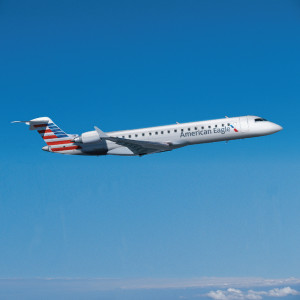
American Airlines had 14 aircraft delayed on the tarmac at DFW airport as a result of a minor snowfall in the Dallas / Fort Worth area. 9 of these flights were American Eagle flights and 5 were American Airlines flights.
No doubt American Airlines will moan and groan over this and claim the weather precluded them being able to do anything. Sorry but when you control 3/4ths of the airport terminal capacity and it isn’t a major storm with lightning, you don’t have many excuses here.
The weather was miserable on that day. Light to medium rain fell until around the noon hour and then snow fell for several hours following that. The snow fall didn’t accumulate fast and certainly didn’t completely kill visibility. Delays such as these at DFW airport on the part of American Airlines just doesn’t compute under most circumstances. It was possible to disembark people and park aircraft. It’s notable that Christmas Day actually isn’t even a very heavily traveled day.
Now the latest news has Tom Horton holding a non-executive chairman of the board position until some time in 2014 (that’s more a compromise than I expected) and Doug Parker assuming that role afterwards.
The company is expected to be valued at $10.5 to $11 Billion with about $3 Billion of that credited to US Airways. The boards of each company are expected to meet mid–week and I expect an announcement on Thursday morning by my best guess.
It should be interesting to see how much the smile on Tom Horton’s face is strained and whether or not he takes credit for the merger.
Digging into news items more today, I have found more explanation for this desire to have Tom Horton remain as Chairman of American Airlines.
Apparently it is the American Airlines Board of Directors who are pushing for this and some even for an executive chairmanship and in the interests of “protecting” the board on the promises of revenue synergies being promised from the merger.
What’s interesting to me is that the board, largely unchanged over the last year, wasn’t pushing for this kind of conservatorship more than a year ago.
Questions I would ask are these:
Why is Doug Parker’s track record of return on investment at US Airways inferior to Tom Horton’s track record given the profits that Parker and his team have realized with an inferior airline network?
Why is it preferential to put controls on Doug Parker in this merger that we wouldn’t, for instance, put on Tom Horton himself in a stand alone exit from bankruptcy?
Why are AA’s interests valued so highly in this merger and US Airways interests so low?
As an unsecured creditor, would I not want to see the management team in charge be the people who have the best chance for success in the marketplace and who do return shareholder value since my “payback” will largely be in the form of an equity stake in the company?
And, if #4 is true, why would I want to constrain that with leadership that while fiscally good has ignored the revenue picture for 10 years or more?
I sense overreaching by the board and when I consider the composition of AA’s board of director’s, I think I know why. AA’s board is dominated by financial interests who favor conservation of capital in all situations. They are one of the most conservative boards you could find on an airline and most independent directors lack direct airline experience.
US Airways board is very different. It is seeded with airline experience, entrepreneurial experience and is generally more diverse both in geography as well as industry.
Again, let me point out that Doug Parker is no fool. He has an excellent education and has had excellent multi-airline experience which was founded on a long stint in finance at American Airlines itself and has since managed America West/US Airways for a 12 year tenure with great success in returning a disadvantaged airline organization to health despite severe industry economic challenges and ever increasing competition from very large SuperLegacy airlines. that’s the guy you bet on and that’s the guy you don’t hamstring.
If Doug Parker or his team were foolish, unwise or inexperienced, they would not have achieved consistent successful results that largely outshine the rest of the industry.
And I would remind AA’s Board of Director’s that they chose to ride the Gerard Arpey horse and they chose to ride the similar legacy in Tom Horton with the results of a company entering into bankruptcy because of an inability to lead and an inability to generate increasing revenues. The strategy was waiting for other airlines’ costs to rise and meet their own. What makes you think your entity is so much more valuable today than it was 14 months ago?
Terry Maxon with the Dallas Morning News is reporting on the Aviation Blog there that the solid rumour is that Tom Horton will be non-executive Chairman and Doug Parker will be CEO of a merged US Airways and American Airlines.
Since Terry rarely gets things wrong, I believe that this is the almost certain outcome.
It’s likely that I will take flak for this but I don’t like it as an idea. Tom Horton as non-executive chairman would have seemed like a good compromise last May or even last July. Not now.
Horton & Company have clung too hard to their ideas and I fear that even as non-executive Chairman, he’ll wield too much influence if only by being able to second guess Doug Parker and his team.
Let’s not forget that, according to Horton, Tom Horton was the guy to think of a merger long before Parker.
And then there is the branding fiasco and multiple superfluous announcements about change, often scheduled to take place in 2017 or later.
Sorry but I think Horton interferes and prevents success more than he helps. And the Board of Directors as well as the unsecured creditors would be wise to find another non-executive Chairman before letting this happen. Ask Gordon Bethune to do it. Ask Doug Steenland to do it. Ask someone else.
In fact, I think that finding someone else to serve as non-executive chairman could be the very best thing for this company. I really do. But Tom Horton should not be the one to serve in that role. He’s a lightening bolt for controversy among employees and a potential critic of Doug Parker as he sets off to do something very, very hard in the best of circumstances.
Let me point out that if it is about wanting to reward Horton for something, there is nothing preventing the company from awarding him stock and/or options in this deal. Nothing really. Horton will work again, too. He is a very, very talented finance guy and there are companies who need his skills.
It will be much cheaper to bribe him away from this than it will be to have him hovering over Doug Parker and trying to wait in the wings hoping Parker will fail and he can take control again. Seriously, don’t do this. It hurts the chances of the merged company and at best it doesn’t help.
The Fort Worth Star Telegram SkyTalk blog has a story about a bond analyst blasting the American Airlines management for their latest request to extend their deadline for presenting a plan for bankruptcy exit. In her note to investors, Gimme Credit Vicki Bryan said:
“AMR management has been coming off as more arrogant than confident, in our view, with destructive diversions and posturing that almost has boarded on the ridiculous. From CEO Tom Horton’s “revelation” back in July that the merger with US Airways actually was his idea in the first place (oh really? If so, he apparently couldn’t pull it off. See our note on 7/25/12) to the unveiling last week of expensive (and unappealing) corporate rebranding and garish new livery on planes that most likely will be owned by somebody else soon,”
This is what I mean about putting the cart before the horse in this process. There are way too many attempts to pre-emptively announce developments and changes to control the outcome. At what point does a board of directors or an unsecured creditor’s committee direct that their inclinations and desires are what controls an outcome rather than the CEO’s desires. Even if that desire is a multi-million dollar payout if they exit as a stand-alone organization.
And let me ask you this: Why should multi-million dollar payouts to an executive team take precedence over what is the right outcome for those holding AMR debt?
I found a blog being maintained by an American Airlines pilot yesterday that was quite the experience. Unlike most, this pilot was an ardent defender of Tom Horton and credits him with moving the airline forward through the large aircraft orders made and for making a case to grow the business to the board of directors all prior to Gerard Arpey’s resignation. This blogger also contends that a merger will merely bring the America West / US Airways cat fight over seniority into the Allied Pilots Association and that stand alone is a better thing for pilots. There is more there but we’ll leave it alone now.
I have a few specific and general thoughts here.
First, crediting Tom Horton with the aircraft order strikes me as overly generous. More so the financing as being innovative. To be true, things were negotiated in these orders that have the manufacturers generally providing financing for these purchases and I’m entirely unsurprised at this since the order was largely a historic one and getting a piece of it required the manufacturers to make an attractive deal. But if we’re to credit Tom Horton for this order, let’s also credit him for the company devolving into bankruptcy as well. We tend to pin that on Arpey alone and the truth is that Tom Horton was as much a right hand man in the operation of the airline (often to the exclusion of many other capable executives such as Dan Garton) and if we’re handing out credit, let’s hand out all the credit.
As for being the man to grow the airline, I would also point out that Tom Horton has possessed enough influence at the company pre & post Gerard Arpey to have already brought a great deal of influence into this direction. He did have Gerard Arpey’s ear and let’s not portray the relationship that existed between the two as fundamentally different. It just wasn’t. Again, if Tom Horton was a visionary, his vision appears to have been ignored entirely until Arpey’s departure and we know that that just isn’t true.
Let’s also note that Tom Horton served as CFO for AT&T until it was purchased by SBC (Southwestern Bell). During his time there, he essentially presided over AT&T not succeeding and needing a merger to survive and hence the merger/acquisition by SBC. It has long been said that Horton realized he wasn’t going to replace the CEO and that current CEO of SBC, Randall Stephenson, had the inside track. This in fact turned out to be true when Stephenson replaced former SBC/AT&T CEO Ed Whiteacre.
Enough of that. The truth is that as I think of the conversation as it surrounds this merger between US Airways and American Airlines, it always boils down to arguments about seniority amongst labor. I agree that integration of work forces is an important element in this merger and any other mergers among airlines. The idea that a smooth integration is the norm of a successful merger is not correct, however.
We tend to look at the Delta/Northwest merger as the way it ought to always be done. In truth, I wish it were that way but that was a very, very special case and even in that one the pilots nearly did the merger in but for the leadership of Lee Moak in that process.
In reality, mergers between airlines are almost always messy. Integration is always difficult. Successful airline mergers shouldn’t be measured in those terms. In fact, I would argue that if the merger grew the airline, its revenues and its profits after a 5 year period, it was successful. Messy or not. (You’ve still got time United but the clock is ticking.)
The labor issues always revolve around seniority and a system of union representation that dates back more than 50 years. The union system and its focus on seniority has made life exceptionally difficult for those employees for decades. Today, among almost all legacy airlines, there is no job portability. A pilot who merely finds dissatisfaction with his employer cannot leave and go to another airline without starting literally at the bottom-most rung again. This is a major barrier to portability.
And if those same employees had some portability, I think that we would discover that airlines wouldn’t be in such a bad financial position in terms of labor costs and airline employees would actually be able to “vote with their feet” when an airline management treated them poorly.
Mind you, I’m not arguing against unions. They’re the choice of the labor force. I’m arguing against the idea that seniority and job security should be the overwhelming issue in representing their interests. At the end of the day and in light of the furloughs and layoffs and ever increasingly slowed advancement that exists at an airline, is seniority really providing job security anymore? And how about job satisfaction?
At the end of the day, airline employees love their inherent jobs but they’re also inherently disssatisfied with their management, their wages and their quality of life. The roadblock to fixing those dissatisfactions is seniority. This makes me wonder when someone is going try to come up with a better model for the future.
Wouldn’t it be great if an airline Captain with Airline A could quit a bad job and go to work for Airline B and be compensated on the basis of his experience and qualifications immediately instead of having to sit at the bottom of a seniority list and forever be “beneath” his peers who started at Airline B at the beginning of their careers?
And wouldn’t it be interesting to see airlines compete for airline pilots on the basis of that experience? Remember that a desirable airline pilot isn’t just one with 10 or more years of experience. It’s a person who has shown good judgement, safe judgement, efficiency and a can do attitude. If I’m starting an airline, that’s who I want. And an airline startup can’t really get those guys. They’re stuck with the airlines they work for by and large.
Seniority imposes too much pain on both the employee and the employer at this stage in the game. It is hurting competitiveness among airlines and impacting employees/labor in a very negative way over the long term.
Alaska Airlines and American Airlines announced an expanded code share agreement between the two airlines on Monday. The focus is on American Airlines putting its codes on Alaska Airlines routes from the San Francisco Bay Area and Alaska Airlines putting its codes on American Airlines routes from the Los Angeles area.
Alaska is ready to do business with anyone that it makes sense to do business with. For them, this is about expanding options with another airlines to gain incremental benefits.
For American Airlines, this is about more than just gaining some incremental benefits. This is about expanding a partnership with an airline on the West Coast and making the argument that the current AA leadership team is ready to work on the airlines’ revenue problems with a bankruptcy exit.
The next step for AA will be announcing an expanded code share with Jetblue in the Northeast.
Will it work? Well, personally, I think not. Code shares like these are what you actually make of them. To date, American Airlines hasn’t really made much of its domestic code shares because it has always preferred to capture the all the revenue for itself in most domestic situations. They don’t mind the incremental benefit to their foreign route network and anything that puts a passenger on a flight for a good fare is OK with them but it isn’t their focus. Other airlines often try hard to drive sensible synergies with their code shares but American’s team just doesn’t seem to do this much.
Financial analysts aren’t fooled by these moves nor are those on the unsecured creditors committee. What existing creditors and bondholders want is an airline that has long term viability for realizing profits that look a lot more like Delta’s. A patchwork plan of code shares doesn’t get them there.