|
October 17, 2009 on 12:38 pm | In Airline Fleets, Airline Service | No Comments
Almost everyone who follows the airline business and the airlines themselves continue to insist that people buy overwhelmingly on price and there is quite a bit of evidence to support that general feeling. The best example is that among legacy carriers serving a particular non-stop route, when one airlines lowers their price, the other airlines can and do see a drop in their bookings for that route if they don’t match that price.
There is a lot of truth that individual routes can be seen as nearly perfect competitive environments. Any airline executive worth his salt will tell you that when an airline opens up a city pair, they look upon it as growing another business. Each route is a “business” to be developed and nurtured and maintained.
Legacy airlines are the masters of being all things to all people. Low cost carriers are the masters of high frequency/low cost models. Leisure airlines have learned how to serve market with low frequency but high value.
But what do most people want? That isn’t ever as clear as people want to believe. The dynamics between two cities change over time and adjusting to those changes is essential to maintaining that “business”.
My father, once a very senior airline executive, told a story to me long ago that I’ve never forgotten. His airline, Braniff, served the Dallas / NYC route with a daily late afternoon flight that for years was a huge money maker because it was flown primarily by businessmen. In the mid-1970’s, they noticed that traffic on that route began to erode ever so slightly and even a small erosion worried an airline even back then. Then he happened to take the flight to do some financial business in NYC on behalf of the airline and he realized the problem.
Business between the two cities had begun to change. Traditional businessmen such as bankers or leaders of large corporations had continued to fly that flight because their model was to go to NYC the night before, conduct some business until 2 or 3 in the afternoon and then fly home to be in their own homes by mid-evening. But entrepreneurship had begun to flower and more and more businessmen/entrepreneurs saw that as a waste of time for such a trip. They wanted to work until late afternoon and fly home as late as possible in order to maximize their time there.
So Braniff added a second flight in the early evening that allowed businessmen to work until 4:30pm, go to the airport and catch the 7:30pm flight home which put them back in Dallas late at night but which met their needs to stay as long as possible to maximize their work. As a consequence, both flights began to do much better because even the entrepreneurs could recognize that when their work was done, it was time to go home and if it was done at 2pm, they went to the airport and caught the early flight home. Traditional businessmen began to be expected to be more efficient and when they couldn’t leave at 2pm, they knew they had another option for later in the day. Braniff began to own that route again. Frequency was the answer.
I would argue that when two or more airlines “own” a route, service is often going to be the discriminator. But what form of service will be necessary? Is it options in seating that allow a traveler to have more legroom? Is it more frequency? Is it some form of a meal? Is it WiFi or video on demand?
For 30 years airlines have worked to harmonize their fleets, reduce the different number of equipment types and flatten their service offerings to the lowest common denominator. Particularly the legacy airlines. But for the past 10 years, we’ve seen new airlines offering more segmented choices on each flight and those airlines are the ones who continue to earn a profit, experience growth and satisfy shareholders.
There have been some half hearted experiments with increased choice and segmentation. Delta had Song airlines offering more entertainment and a brighter, cheerier environment. United had Ted airlines which was economy oriented. But I suspect that it wasn’t necessary to change the brand so much as it indicated a need to offer more choice on the aircraft.
I think in the future we’re going to see more choices in seating on airlines. The low cost only passenger wants price above anything else. The business traveler needs an economy choice (to satisfy their company’s desire to economize) that offers a little more room. I think we’ll see different seat pitches offered and different service choices (a la Frontier) offered as well. This is an area where Frontier has pioneered change and seen positive results. Same for jetBlue. Those airlines continue to earn an operating profit and grow.
Legacy airlines are going to have to be more flexible in fleet, fleet configuration and they’ll even have to consider offering things like meals and entertainment. There already is a move to do this among certain airlines. Continental is adding LiveTV to their fleet. Delta/Northwest has recognized that having a varied fleet allows them to “tune” their service to the demands and continue to earn a profit.
When an airline can adjust capacity on a route by season, month or time of day, it can continue to make money. When it has just two choices of aircraft to use on a route and both have more capacity than needed, they start to lose money. (Hello AA.)
I think that one day one legacy airline will have the guts to start advertising in markets that speaks to “real world” experience on their line versus the airline that “owns” the city. For instance, I think Continental could come into the Dallas market and already argue that yes, you have to connect in Houston to go to NYC but if you do, more often than not you’ll get there in the same time with better service than flying American Airlines who has an untrustworthy on-time record and who treats their passengers to old aircraft and little or no service. Someone will have the guts to start trying to change the perceived value of travel.
The truth is that there is a great difference between legacy airlines on any two city pairs. The key is to identify that difference and communicate it to the traveler. Right now, that really doesn’t happen. An airline such as Continental shouldn’t attempt to compete with AA on price alone. They should offer the real differences such as a meal on flights of 3 hours or more, LiveTV, equipment that is as much as 10 years newer or more than AA and a staff that enjoys doing its job. They should offer incentives for changing airlines and trying them once such as a guaranteed business class seat for the price of AA’s economy seat.
It will happen in some form. It has to. The newer airlines such as Frontier, Airtran, jetBlue and Virgin America have all proved that offering more choice on the aircraft works. Even Southwest has recognized that it has to offer more choice in order to retain their very valuable business traveler. What’s more important is that even some passengers who buy on price alone have realized that the incremental extra cost of one or two of those “extras” is worth it once again.
Filed under: Airline Fleets, Airline Service by ajax
No Comments »
October 9, 2009 on 10:57 am | In Airline Fleets, Airline Service, Airports, Deregulation | No Comments
The Cranky Flier had a post today discussing Continental’s new moves in LAX which include new flights to Hawaii. Continental will have an all 737 base in the Los Angeles area with two 737’s serving new flights from Orange County to Hawaii. It made me think.
Back in the pre-regulatory days, flights from the mainland US to Hawaii were served by large aircraft such as the 707, DC-8 and, later, the 747, DC-10, L-1011 and even the 767. The routes allowed airlines to serve huge numbers of customers with large aircraft and make money. Braniff International had the franchise for Dallas to Honolulu in the 1970’s and served it with a 747 and an amazing 16 hours per day utilization.
Then deregulation came and airlines slowly began to develop new routes. It was no longer necessary to fly to a “gateway” city to catch a flight to Hawaii. More and more cities found themselves being served with those routes to Hawaii. Again, Braniff International, at one time, had a 747 flight from Portland, OR to Hawaii. (It carried little traffic, however.)
There was some consolidation after airlines learned that not everyone in a particular city was dying to fly to Hawaii. But the big change for Hawaii has been ETOPS or twin engine flights overseas. This allowed airlines to serve smaller markets with aircraft both capable of the loads as well as the distance. The truth is, when the airlines don’t have to feed 150 passengers a day to a gateway city but can fly them directly, they make more money. 20 years ago, I would have chuckled if someone told me that 737-700 aircraft would fly to Hawaii from the mainland.
Boeing and Airbus have different views for the roles of widebody, large capacity aircraft. 10 years ago, Boeing forecast that the market would continue to fracture with more and more direct routes being employed as opposed to large capacity hub to hub flying. Airbus, however, believed that the crowded skies would force more large capacity hub to hub flying onto the airlines. It turns out that Boeing was more right.
The markets drive these changes and when an airlines can make more pure profit using right sized aircraft flying direct, they will. Yes, the legacy airlines of the US (and other parts of the world) continue to follow a hub and spoke model primarily but they’re all learning that more direct flying where the loads fully justify it is a good and profitable thing.
Accordingly, this is where I think Boeing continues to have a winning strategy with its 787/777 product line. Yes, there are a few airlines capable of filling an A-380 and those airlines will make money from using that aircraft. But as more and more nations open up their skies to more competition, that is going to change. Having the right aircraft for the right route will be key to a manufacturer’s success and Boeing seems to have a better feel for the world market whereas Airbus seems more plugged into the Euro/Middle East markets they already do so well in.
I’m no longer sure there is a real place for the new 747-8 aircraft. Boeing’s 777-300 is just as capable in almost every case and carries a massive number of passengers without being so big that it adds risk during seasonal low periods. The same is true for the 777-200.
And what happens when aircraft such as the 787 family begin flying? This family is roughly 767-sized in capacity but its range is far greater and that means even more markets can be accessed via long haul direct flying. An international airline can probably make more money (through passengers *and* cargo) using the 787 and 777 families for more direct flying with aircraft that are “right sized” for the markets than they can using much of the Airbus family.
Airbus has one aircraft model suitable for this right now. The A-330. the A-340 is essentially dead since it under performs against the 777 in virtually any mission. The A-330 is right sized for a number of the current markets and many more of the future markets. The A-380 is suitable for only a few markets and those are already dwindling for some airlines. For instance, QANTAS has introduced the A-380 on their routes to the US. However, with a new Open Skies treaty between the two countries, there are also new entrants to the market like V Australia and Delta who are vying for customers with United and QANTAS very competively. Those airlines understand that it will take a while to develop their routes and build relationships with airlines in both countries to feed traffic but it will happen. As that traffic shifts from what was originally two airlines (QANTAS and United) to four airlines (QANTAS, United plus V Australia and Delta), what happens to each airlines’ loads?
It’s notable that QANTAS flies the 747 and A380 to the US and United flies the 747 exclusively. The new entrants are using the 777-300 and 777-200 for their flights. The 787 and it’s longer range capabilities will quite possibly fracture that market even more by making it possible to fly from the interior of the US to Australia instead of having to use a west coast gateway city. At that point, I don’t know that QANTAS has a use for very many A380s or 747s and, additionally, they don’t have any right sized aircraft for the route(s) until they start receiving their 787s which are late and somewhat deferred.
The Airbus A350 is capable of competing on many 777 routes and while it does have slightly lower trip costs vs the 777, it also has less revenue capabilty because it can’t haul as much cargo on the same missions.
The world’s airline routes are going to continue to expand internationally and at a far greater rate than traffic grows between any two nations. Having the right equipment for the right moment is going to be key for any international airlines survival. Those who don’t plan for it now and have it arriving in the next 5 to 10 years are going to wither to a slow death.
Filed under: Airline Fleets, Airline Service, Airports, Deregulation by ajax
No Comments »
October 6, 2009 on 3:38 pm | In Airline Fleets, Airline Service, Airports | 2 Comments
In my last post, I mentioned that I was traveling Airtran. My flight was from Dallas / Ft. Worth to Newport News, VA (Patrick Henry Field). The Newport News airport is close to Williamsburg, VA where I have family and far more convenient than Richmond or Norfolk which are far more common for flying into that area.
First, I’ll mention my booking and check-in experience. Airtran’s website works pretty well these days and even accommodates the pre-payment of checked luggage when you do your online check-in. My biggest criticism of the Airtran site is that you have to go through many different pages to complete the reservation and/or check-in process. I suspect many airlines will be adding more pages to their processes if only because of the a la carte nature of the new airline business model.
I’ve mentioned in other, earlier posts that some airlines are developing and implementing electronic boarding passes to be carried on one’s PDA. During my struggle to maintain 3 sheets of paper for each day of travel, I began to long for being able to use such a system on Airtran. On my two leg trip from DFW to PHF via ATL, I had to have 2 different boarding passes on two separate pieces of paper (why, I don’t know since they are to be scanned) and I carried my receipt for pre-paying my checked baggage in case of trouble when I arrived at the airport. Having those boarding passes and that receipt on a PDA would help immensely with simply managing the paperwork.
DFW to ATL (Boeing 737-700) Seat 18A: This aircraft was clean and generally well cared for but my particular seat kept wanting to recline without being asked to do so. As a consequence, I kept raising my seat back during the 2 hour flight and found my back feeling a bit strained after awhile. As a rule, I don’t recline my seat when sitting in coach on such a flight simply because it’s truly discourteous to do given the little leg room and personal space that is afforded in coach. Ordinarily, I enjoy the Airtran 737 because they use a nice Recaro seat that seems to fit my body very well. This flight was an anomaly compared to previous experiences.
The gate agents loaded the plane quickly and efficiently and the flight attendants and other Airtran staff were quick to “solve” any passengers problems with stowing carryon luggage. They did it politely but firmly and kept people moving. As a result, the boarding process actually felt streamlined and we were able to push back precisely on time.
Arriving in Atlanta, I remembered what I really don’t like about Atlanta’s airport. It isn’t the terminals, the crowds or the often required dash to another concourse for your next flight. It’s the taxi time from the terminal to the runway or vice versa. It is as if you land and then travel another 40 miles to the terminal. It feels excessively long and since your aircraft is usually behind another, you get the unpleasant aroma of burning kerosene to keep you company. That isn’t Airtran’s fault though.
The Atlanta terminal is just as I’ve experienced it in the past. Despite common complaints, you can actually move quite quickly from one gate to another as long as you’re sensible enough to get your info and read a terminal map. If you can’t do that or won’t learn how, then you deserve what you get. One thing I did notice about the ATL concourses was that the stores goods seemed to be priced much more fairly than usual. They weren’t selling $3 bottles of water or $2 candy bars. Yes, the prices were a little more expensive than the average convenience store but reasonably so.
ATL to PHF (Boeing 717-200) Seat 21F: I like the Boeing 717. Yes, it’s a tad smaller but there is something about that aircraft that suits me very well. Again, this aircraft was well cared for, staffed by flight attendants who acted as if they enjoyed going to work and my seat worked properly. This flight had an even longer taxi time than my inbound flight but once it reached the runway, we took off quickly and seemed to get routed on a very direct path out of ATL.
Both flights had a drink service with pretzels and both services were done with good cheer. As we approached PHF, I remembered something peculiar about flying into that general area. For some reason, the approaches feel like you arrive at high altitude and the pilot suddenly dives the airplane to the airport. It seems as if every flight I’ve taken to that general area finds the aircraft shuddering and straining to slow down and lose enough altitude to land at the airport. Touchdowns are always very firm and positive instead of being floating greasers.
PHF is a great little airport. It’s secondary to Norfolk but served regularly by both Airtran and Delta. Airtran with mainline equipment and Delta by a mix mostly dominated by regional jets. It’s convenient to most of the southern area of the peninsula bracketed by the York and James rivers. Best of all, flights to PHF tend to be about $100 cheaper than similar flights to Norfolk or Richmond, VA. The airport is very clean, feels very new and is easy to navigate. You can get to I-64 in just a couple of minutes drive and be on your way to just about anywhere you need to go in the area.
I’ve always liked Airtran. They offer a superior coach product compared to most legacy airlines and they continue to adjust to the changing environment in ways that, if not exactly accomodating, are at least less punishing than most.
Next post will be my return flight(s).
Filed under: Airline Fleets, Airline Service, Airports by ajax
2 Comments »
April 15, 2009 on 3:27 pm | In Airline Fleets, Airline News | No Comments
USA Today’s Today in the Sky Blog has written about American Airlines’ new 737-800. Except, it isn’t new to the fleet. AA has had quite a few 737-800 aircraft in the fleet for 10 years now. What’s new is that they’ve started getting new deliveries and they’ve apparently found a way to reconfigure the aircraft for a total of 160 passengers (incuding Business Class) which is 12 more than their current configuration on the “old” aircraft.
So, how did they do that? By using new seats and reconfiguring their gallies essentially. What AA *claims* is that you, the passenger, will have just about as much room (31″ pitch so, no, not really) as what you might experience on a MD-80 aircraft (about 32″ and only a 1 in 5 chance of a middle seat versus a 2 in 6 chance). Indeed, they suggest that you might be more comfortable with the new seating.
Maybe. If you are young, slender and somewhat short in stature, I suspect they might be right. If you are tall, older and heavier, I suspect you’re in for greater discomfort in the real world. The seats are “slimmer” which means they’re a bit thinner both in their frame construction as well as their padding. This means that for relatively svelt people, a change isn’t felt but for a man-sized, well, man, you’re probably gonna feel a harder, less comfortable seat. In addition, the seats are a “cradle” type that is supposed to save the passengers knees behind you. Maybe, just maybe that will happen. I continue to call for reclining those 31″ pitch seats to be disabled. They cause more hostility and problems than they offer in comfort.
What really incenses me is the photo shown HERE on USA Today’s site. Why? Because it shows a svelt flight attendent sitting in an exit row seat. Yeah, loads of room there. What I would like to see is a 230lbs business man sitting in a conventional middle seat somewhere else on that aircraft. Please take two photos: One distance shot and one of his face. I want to know just how painful that seat is.
Here is an interesting fact: When American Airlines had their More Room in Coach program going on, their 737-800 aircraft seated just 134 total people. Now they’ve boosted that to 160 total seats. I guarantee you that space was not carved out of Business Class so where did they achieve enough room to fit 26 more seats?
Filed under: Airline Fleets, Airline News by ajax
No Comments »
April 1, 2009 on 9:01 am | In Airline Fleets, Airline News, Airline Service | 1 Comment
UPDATE: This was an April Fool’s Day Joke.
Southwest Airlines has announced the creation of a new subsidiary airline tentatively named Atlantic Express which will serve routes between New York City and London. The new subsidiary airline will be staffed by current Southwest Airlines crews and has placed an order with Boeing for new 747-8 Intercontinental aircraft.
Southwest Airlines CEO and President Gary Kelly is quoted at the 9am news conference saying “We looked at every kind of aircraft we could use for this route but the only one that made sense is the 747-8i. As most people know, we prefer new aircraft and our business model depends on both passenger volume and frequency. We went to Boeing and negotiated for the best deal possible on 10 new Boeing 747-8i aircraft to serve this route.”
There has been frequent speculation on what cities Southwest would use to serve New York City’s La Guardia airport (Southwest obtained 7 slot pairs to operate at the airport just a few months ago) and it would appear the question is answered now. Southwest will serve La Guardia once a day with flights from Chicago-Midway and Houston-Intercontinental feeding connecting traffic to 5 daily round trip flights to London-Heathrow airport.
Southwest’s / Atlantic Express’ new New York City schedule and aircraft can be viewed HERE.
Filed under: Airline Fleets, Airline News, Airline Service by ajax
1 Comment »
February 9, 2009 on 10:41 am | In Airline Fleets, Airline News, Trivia | No Comments
Happy Birthday 747
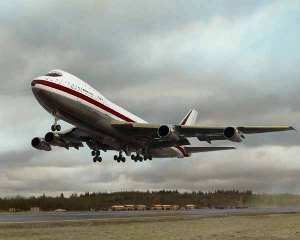
photo credit: Boeing photo
Today is the Boeing 747’s 40th Birthday. Or, at least, I count it as such since today marks 40 years since the legendary jumbo jet took its first flight.
Filed under: Airline Fleets, Airline News, Trivia by ajax
No Comments »
January 16, 2009 on 1:00 am | In Airline Fleets, Airline News | No Comments
James Wallace of the Seattle Post-Intelligencer is reporting today on Airbus and notes a Wall Street Journal report that quotes Tom Enders of Airbus saying:
He disclosed that the A380 superjumbo program remains troubled by teething problems in its industrial phase, and that the company now expects just 18 deliveries of the world’s largest passenger aircraft this year, down from a previous target of 21 that was revised from 24 last year.
I optimistically forecast that Airbus would *increase* its deliveries over their projected schedule in this post.
That’s a significant reduction in deliveries for Airbus and the A380. What it means is that Airbus will suffer financially on that program even more now that they will be unable to receive the forecasted revenue for 3 of the A380 deliveries. The list price fo the A380 is about $320 million for each aircraft. Even with significant discounts, that 3 aircraft reduction in the schedule means reduced revenue of nearly $1billion.
It would seem that, this time, the problems are that the computer models for production of the aircraft did not take into account the effects of gravity on the aircraft structure itself and, accordingly, some assemblies and parts won’t fit correctly on production aircraft.
Filed under: Airline Fleets, Airline News by ajax
No Comments »
January 4, 2009 on 10:00 am | In Airline Fleets, Airline Service, Death Watch | No Comments
And now we come full circle back to the United States and Europe. Both have highly developed, highly competitive airline markets. Each has both LCC type carriers and legacy carriers (and Europe’s legacy carriers are the former national flag carriers in many respects.)
This won’t be a rebuilding year. To the contrary, both markets really need one large airline to be removed from the market. In the case of the United States, I firmly think that should be United Airlines but in Europe that is a harder guess. If I had to pick an large airline in Europe for the surprise of the year, it would be Lufthansa. They are, by all accounts, a great airline but I smell trouble in that group. First, they have been buying into airlines that have been unable to survive on their own. That lack of survival, in many cases, isn’t because of poor management but just a lack of market share being available to them.
Lufthansa has bought SWISS, for instance. I’m not sure why and I’m not sure if they can tell us why. They could have just as easily taken SWISS’ business and left them in a heap. Further, Lufthansa has a lot of Airbus A340 aircraft. Those airplanes just don’t compete on high capacity, long haul routes anymore. What’s more, they also have orders in for the Boeing 747-8, another large capacity, four engine aircraft. Their competitors, Air France/KLM and British Airways, have seen the light in buying more and more Boeing 777 aircraft for their long haul, high capacity routes. It costs less to operate them and they make more money as a consequence. So, going out on a limb here, I say we’ll discover that Lufthansa is nearly insolvent some time by the end of 2009.
Both markets in Europe and the US will continue to face challenges in costs (fuel and more particularly labor) and LCC competition will continue to press air fares downwards. The real solution for large legacy carriers won’t be found this year. Expect more losses (with some exceptions such as SWA and jetBlue) and more merger talk in general.
Here are a few more random predictions:
- United Airlines will ask Glenn Tilton to resign and hire an experienced airline executive. One possibility will be Doug Steenland, most recently Northwest Airlines CEO and now Vice-Chairman of Delta.
- Southwest Airlines will, for the first time, examine adding another aircraft type to their fleet. My guess is it will be the Embraer 170/190 series.
- Airbus will land a major order for aircraft from a traditional Boeing customer in the United States. My bet is that Delta orders more Airbus A330 aircraft.
- China and Japan will drop their regional jet programs or, at the least, defer them for up to 5 years.
- Bombardier will announce a major order (more than 20 aircraft) for the Q400 Turbo-Prop from a US Airline.
- If fuel prices remain steady, Airtran will seek to form a small mid-western hub.
- Last but not least, one LCC type carrier such as jetBlue or Virgin America will attempt to fly to DFW Airport (wishful thinking on my part.)
Happy New Year Everyone.
Filed under: Airline Fleets, Airline Service, Death Watch by ajax
No Comments »
January 3, 2009 on 10:00 am | In Airline Fleets, Airline Service, Deregulation | No Comments
In keeping with the theme set with yesterday’s post, let’s continue on with some predictions.
The MIddle East
Emirates, Qatar and Etihad: All airlines that have aggressive growth plans (both in fleet size and the capacity of their aircraft) that don’t seem to be based in reality. While each of those airlines has successfully developed themselves into eastern hemisphere global airlines, what’s next? There are few opportunities to grow to the United States or the Far East (both range and regional prejudices apply there) and that leaves Europe (somewhat saturated already) and Africa (not a real place to grow due to low demand). But they have to fill an amazing number of widebody aircraft they’ve ordered. We won’t see a merger or a bankruptcy here but I do believe we’ll see these airlines start to reconsider the orders they have on the books and they will slow their growth by deferring these orders.
China
China’s airlines have been on a buying binge as well but, again, with a weakening domestic economy as well as a weakening international economy, they have no place to go. Like the Middle East contenders, they are likely going to start deferring orders as well.
The Far East
Airlines based in Taiwan, Korea, Japan, Thailand, Indonesia and Singapore will all maintain their status quo more or less. There is some possibility that some orders may be deferred but I will bet that some airlines will actually make new orders for new aircraft although not for growth but for greater operating efficiency.
Australia
QANTAS and its affiliate Jetstar have made major investments in new aircraft and major plans in new market development. However, development of new routes in the Far East and Southeast Asia will slow or even contract as reduced demand continues. What’s worse is the new competition they’ll experience on their routes to both Europe and the United States. I expect some order deferrals (probably for the 787) and growth plans will be slowed or deferred altogether as they retrench in the face of competition.
Virgin Blue / V Australia will be challenged in several ways. They’ll likely continue to do well in the Australian domestic market but now they face competition in the Australia / United States market not only from QANTAS, Air New Zealand and United Airlines but also from Delta. There will be too many airlines chasing too few seats in this market and the two most vulnerable airlines, in my opinion, are United and V Australia. United because its service product pales in comparison to any of the other airlines and V Australia because their business model is based more on economy travel than business and first class.
South America
We’ll not see any real growth (with one exception) and we’ll likely not see any real failures here either. The governments of South American countries tend to jump in and save their national airlines when doom is near.
Aerolineas Argentinas should be Argentina’s Alitalia but I suspect a takeover of this airline from Grupo Marsans (a Spanish conglomerate) by the Argentine government will happen sometime this year. Aerlineas Argentinas will continue to muddle through with a incoherent fleet of Airbus aircraft funded by the government and Argentina will see no growth and possibly some severe contraction in their markets because of a failed air traffic system and a very weak economy.
Brazil will continue to be stable more or less but existing Brazilian airlines will have to now contend with David Neeleman’s new airline, Azul. Neeleman (who holds dual citizenship in Brazil and the United States) understands Brazil and will be offering a highly competitive, high service airline founded with Embraer E-190 aircraft that are very well suited to the Brazilian market. It will be jetBlue all over again in Brazil for the next 5 years. However, I expect this new Neeleman airline will one day become an international airline flying both in South America as well as to Europe and the United States. I’ll go ahead and predict this development for 2014 and they will use Airbus equipment.
Africa
Not much to say here. African airlines come and go with stunning frequency and usually without much notice. Delta will continue to develop routes to Africa but this will be aimed towards the very few, relatively stable, major cities Africa has. South African Airways will find someway to continue to exist but I expect a switch from Airbus aircraft in their long haul services (A340 aircraft currently) to a Boeing fleet using the 777-200LR and 777-300ER and GE engines. This switch alone could make them profitable. My prediction is that we’ll hear about a Request For Information (RFI) or a Request For Proposal (RFP) by the end of the year but more likely at this year’s summer airshow in Paris. It will be a small order, at first, and quite possibly contingent upon Boeing finding new owners for the A340 aircraft they already own.
India
With their new, highly competitive market, India has become a rather intense version of the US market. With a weakening economy here as well, I look for consolidation and liquidation as the answer. Look for Kingfisher to merge with someone else such as Jet Airways with Jet Airways being the name retained by the end of 2009. Another possibility will be forced mergers and/or liquidations by the Indian government particularly if the current party loses power. The rather laissez faire experiment in airline deregulation in India has left a bad taste in many people’s mouths, most particularly in the opposition parties not currently in power. India’s current Prime Minister Singh holds degrees in economics and is widely credited with economic reforms in India but the fractured and unsuccessful airline industry is something for the opposition to make a point of.
Stay Tuned for Part III
Filed under: Airline Fleets, Airline Service, Deregulation by ajax
No Comments »
January 2, 2009 on 11:57 am | In Airline Fleets, Airline Service, Airports, Death Watch | 2 Comments
It’s always fun to make predictions about the coming year, right? Of course, I may well review my predictions in December of 2009 and decide against doing it again.
Boeing 787:
This aircraft will finally experience its first flight and I believe it will occur on or about its new scheduled time (early April). For Boeing, credibility is now at stake and they really do have to begin meeting deadlines. Financial analysts are becoming too skeptical of the company for comfort and airlines want their airliners. Boeing does have a reputation for being able to pull itself together and get something done in a crisis and that should serve them here.
I also believe we’ll see both static airframes begin their tests and new build airframes begin to flow from Boeing in about 6 months. My prediction? The 787 will prove to be a very capable aircraft and will meet or exceed its performance promises.
Airbus A380:
Airbus met its revised schedule of delivering 12 A380 airliners in 2008 . . . barely. Originally it was scheduled to deliver 13 in 2008 and 25 in 2009. Now Airbus says it will deliver 21 in 2009. However, it is becoming clear that Airbus is now quickly learning how to build these aircraft and turn them out. I predict they’ll exceed their 21 goal in 2009 by at least one aircraft.
Boeing and Airbus:
Both aircraft makers will begin to speak about the future of short to medium haul aircraft again. With milestones for the 787 and A380 being met, I suspect they’ll become more comfortable in speaking of the future of their aircraft lines. Look for discussions on both the 737 and A320 aircraft families and what interim technologies might be employed to improve their performance. I suspect we’ll hear about both weight saving materials being adopted as well as the potential of new incremental improvements on existing engines. Particularly the CFM-56 engines used by both makers.
US Airlines:
First, let’s take a look at my deathwatch candidates. The sudden and precipitous drop of oil prices allowed each of them to take a breather. Midwest Airlines, however, continues to speak little, fly only a little and its investors have got to be running out of patience. I still believe that they’ll ultimately go away. How they do it is the question. Rather than bankruptcy, I believe it will either be a sale or as a subsidiary airline of Delta/Northwest with the latter being most unlikely. Who will they be sold to? Good question. Perhaps Airtran will get what they wished for and develop indigestion.
Frontier continues to muddle along but faces rather intense labor strife still. I think their situation improved not only because oil prices dropped but because United continues to offer some of the worst product in the industry and because Southwest slowed its growth and took a breather. While I firmly believe United will do nothing to improve its product, I do think Southwest will return to its goal of killing Frontier as a Denver competitor some time in the late spring. I suspect Frontier will emerge from bankruptcy this year but I also firmly expect them to be out of business or acquired by December of 2009. Who buys them? I’ll bet on Jet Blue. The aircraft fleets are compatible and Jet Blue has to start building a hub somewhere else in order to continue to experience strong growth. Frontier gives them that chance. The long shot? American Airlines. Why? Because Frontier is working with AMR’s Sabre Reservations system now.
United Airlines, my favorite airline to hate. The Cranky Flier loves to rag on Alitalia and I love to rag on United. United has lost a tremendous amount of value over the last year and continues to have some of the highest hourly costs of any US airline. They’ve done nothing to improve labor relations, their service product or their fleet efficiency. Glenn Tilton is hated by airline pilots but I predict he is goint to be hated by investors before the end of summer. What happens? I’m really not sure. The best thing that could happen is for them to liquidate. However, I think some airline will see some value there and attempt to buy United and make use of its assets. Who? The logical choice is Continental but I believe they’ll hold on to their independent streak. So my next guess is a US Air / United V 2.0 merger will come about. Could it work? I doubt it but Doug Parker (CEO of US Air) wants another merger and United offers hubs he doesn’t have and some aircraft fleet compatibility. I’ll go “all in” and bet that we see a US Air / United Airlines merger announcement by December of 2009.
Moving on from the death watch, let’s look at other US Airlines for a few minutes.
American Airlines will maintain its status quo but will begin to feel pressure to conclude some union contract negotiations this year as financial analysts begin to view their lack of progress less and less favorably. CEO Gerard Arpey will begin to feel the heat but barring a large mistake on his part, will retain his position as CEO. One possibility, however, will be bringing on a potential successor as President of the airline.
Southwest Airlines will also mostly maintain its status quo but I will predict that by late summer its new CEO Gary Kelly will be under fire from both employees and investors for his shotgun approach to growth. It is beginning to look like it is unplanned and what people most value in Southwest is its ability to form and execute a coherent plan. There will be no mergers, no real growth and a sinking stock price by December but I think Mr. Kelly will hold onto his position until 2010 barring a major unforeseen development.
Continental, the best kept secret. Continental will maintain its status quo with, perhaps, very moderate growth in the international sector while it waits to see what happens domestically. They’ll enter the Star Alliance (exiting from SkyTeam) but discover it offers little value to them as well. I don’t think they’ll seek to merge with anyone in the next year but if they did, I’d pick them for going after someone like Alaska Airlines rather than United or US Air.
Stay tuned for Part II.
Filed under: Airline Fleets, Airline Service, Airports, Death Watch by ajax
2 Comments »
November 14, 2008 on 1:16 pm | In Airline Fleets, Airline News, Airplane Spotting, Trivia | No Comments
Using FlightAware.Com, I’ve been able to see some (but I don’t think all) of the government flights from around the world heading to Washington D.C. for the G20 Economic Summit. So far, I have identified these:
The British Prime Minister on British Airways Flight 001
The Indian Prime Minister on Air India Flight 001
The Argentinian President on Aerolineas Argentinas Flight 1001
The President of the Indonesian Republic on Garuda Indonesian Flight 001
The President of South Korea on Korean Airlines Flight 63
The Prime Minister and his government on Japanese Air Force Flights 1 and 2
The Russian President and his government is on the Russian State Transport Flight 9031 and Russian State Transport Flight 9001.
The Saudi Arabian government is flying in on Saudi Flight 1B
The Chinese government is flying in on Air China Flight 17
The President of Mexico is arrving on Mexican Air Force Flight 001.
No doubt there are others that are not being tracked inbound. The mix of aircraft will include a 777, several 747 aircraft, Airbus A330 and A340 aircraft, a 757, IL 76, IL 62 and IL 96 aircraft from Russia and even a 747-SP (Saudi Arabia).
Filed under: Airline Fleets, Airline News, Airplane Spotting, Trivia by ajax
No Comments »
November 11, 2008 on 10:44 am | In Airline Fleets, Airline News, Airline Service | No Comments
Southwest Airlines has just announced a new codeshare with Mexican airline Volaris (partially owned by billionaire Carlos Slim.) Like Southwest’s codeshare agreement with WestJet, this allows Southwest to gain access to international markets. With these agreements with WestJet and Volaris, Southwest gets access to all of North America and gets to work with two airlines that have similar (not the same) operating environments.
I’m quite certain that these new codeshare routes will, in fact, boost Southwest’s revenues (as well as the revenues of these other participants) and I’m sure both relationships will prove to be rewarding in many ways other than just money. If one airline could operate throughout North America, it really would look very similar to this codeshare arrangement.
These two new arrangements for Southwest found me pondering how it could be done better than just a simple codeshare. One way to further integrate without attempting a merger (something all three airline’s governments are very unlikely to allow) would be operating an interchange.
An interchange was a fairly common tool in previous decades within the United States. The idea is that two (or more) airlines operate the same equipment on a route that is shared. One of the most famous interchanges was when Braniff operated the Concorde from Dallas to Washington D.C. where an Air France or British Airways crew would take over and fly the aircraft across the Atlantic to either London or Paris. At the time, each time the Concorde arrived in Washington, the aircraft would be “sold” to Braniff who would then hang new ownership papers in the cabin and change the registration temporarily for operation in the United States. Obviously that kind of inconvenience would not be tolerated today between airlines but there really isn’t a reason for it either.
Wouldn’t it be interesting to see Southwest operate such an interchange with each of their partners. A Southwest aircraft could be used to fly an international interchange between Canada, Mexico and the United States with only crews changing between focus cities for each airline. For instance, imagine a B737 flown from Toronto to Chicago by a WestJet crew where a Southwest Airlines crew would take over and fly it from Chicago to Houston. In Houston, a Volaris crew could take over and fly that same aircraft to Mexico City (Toluca) and then turn it around for a return trip.
The advantage is that customers never have to leave the aircraft and it would therefore permit a more seemless network for transitioning from one country to another. The only problem with that scenario is that Volaris has an Airbus A320/A319 fleet and while WestJet flies the 737, they are partial to the 737-800 type instead of the 737-700 aircraft preferred by Southwest. Nonetheless, it does cause one to think about the possibilities that might exist between the three airlines.
It also points to other opportunities for other airlines. Codeshares are good and convenient for airlines but they still require a passenger to travel from one hub to another hub and when it comes to international connections, it does force the passenger to often de-plane, clear customs and transition to another part of an airport to continue on to a destination. Sometimes that isn’t all that painful but more frequently it is a great inconvenience to the passenger and a barrier that many avoid.
With airline alliances relatively stable now, many could choose to adopt similar (if not the same) types of aircraft and offer trans-global interchanges for both companies and their passengers. It also would allow them to further standardize their service and even possibly take advantage of fleet flexibility between partners. For instance, what if QANTAS and American Airlines shared a portion of their 787 fleet and allowed it to “flex” between North America and Australia according to seasonal demands?
I suspect there are many more opportunities to be had from both codeshares and, possibly, a new version of interchanges between airlines.
Filed under: Airline Fleets, Airline News, Airline Service by ajax
No Comments »
October 31, 2008 on 10:02 am | In Airline Fleets, Airline News, Airline Service | No Comments
Delta / Northwest is not only big with respect to the number and type of airplanes they have, they are also big for the number of hubs they are currently operating. Conventional wisdom continues to bet that some of those hubs will be closed or rationalized just as it bets that the airline fleet will be reduced.
My guess is that there really won’t be a reduction in hubs of any real significance with the exception of two. This new airline has two hubs in close proximity, Memphis and Covington/Cincinatti, and each serves similar markets. However, rather than being combined into one, I suspect that Memphis will likely be de-emphasized into a “focus” city with more connecting traffic routed through Covington/Cincinatti. The yields in each city are very good but Covington/Cincinatti is by far the city with the best yields. Memphis is likely to remain as a focus city because it is a good gateway to the central midwest section of the US.
All other hubs in the US such as Atlanta, Minneapolis / St. Paul, Detroit, and Salt Lake City have the airline as a dominant carrier and there is no reason to combine any of them with respect to the routes they serve.
Now, both airlines operate significant flights from gateway cities such as Los Angeles and New York and it is quite likely that the airline will work hard to combine some flights going to the same cities. For instance, flights from the New York area going to the same destinations in Europe will be combined to raise the load factors on the equipment being used. However, Europe presents an interesting problem because Northwest has been in a close relationship with KLM and has used Amsterdam as a “hub” to connect to other cities in Europe. Delta, on the other hand, is used to flying direct flights to a variety of cities in Europe without a hub or close partner. I suspect the relationship with KLM will be reduced so that Delta can raise the loads on its own flights to smaller European cities.
Northwest comes to the table with a hub in Tokyo, Japan and they have 5th Freedom Rights to pickup and carry traffic from Tokyo to other cities in Asia. On the surface, that would appear to be a very valuable asset. However, the value of that arrangement was far greater when the political climate in Asia was much different and the range of aircraft made it more convenient to fly to a central hub. Today, it can be much more profitable to fly direct to a variety of Asian cities using newer, long range aircraft such as the Boeing 777 and the about to be introduced 787. I have no doubt that the Tokyo hub will be retained in some form because the yields from traffic originating in Tokyo to other Asian cities is still well worth the effort but I suspect that there will be a renewed emphasis on point to point flying as things evolve in the new airline.
The thing most likely to change at Delta’s hubs will be the aircraft equipment. With a wide variety of equipment to choose from, it would be unsurprising to see a shift of long haul aircraft between the hubs in order to improve yields, load factors and even to explore new routes. That will be done slowly and carefully so that Delta doesn’t have to service too many different types of aircraft at each hub. Once again, aircraft being used at various hubs to service various areas will probably be rationalized. It would be unsurprising to see A330s shifted to longer South American and African routes with B767-400’s moved to trans-atlantic routes originating in MSP and DTW.
Los Angeles will probably see a greater concentration of 747 aircraft being used on trans-Pacific flights. New York and Atlanta will probably see 777 aircraft moved in for long range, point to point flying to destinations in India, South America and even Asia.
At present, Delta has 4 different types of long range aircraft in the 747, 777, A330 and 767 with another on the the way (787). Since Delta already operates GE powered 777-200ER/LR aircraft, they’ll likely place an order for some 777-300ER aircraft and use those to replace the aging 747 aircraft. That will reduce flying by one type. The A330 aircraft will be retained until a fleet of 787-9/10 aircraft can be purchased and then the A330 will likely be let go. Delta’s 767-400 aircraft is fairly new but it will probably suffer the same fate as the A330 in being replaced by 787 aircraft in the future. Suddenly, two basic types with 2 sub-types between them can service all the long haul routes and, at the same time, offer some harmony at each hub.
I do wonder if Northwest’s 787 orders will be switched from Rolls Royce engines to GE GEnx engines. That would permit Delta to operate two basic aircraft types that would use the same brand of engine and engines that share some basic design philosophy as well.
The tricky part of managing all of these hubs for Delta will be the domestic fleet which is comprised of Airbus A320 series, Boeing 737 series, DC-9 series and MD80/90 series aircraft. Because it is more efficient to perform maintenance on a domestic fleet that keeps the aircraft close to a maintenance center, I do wonder which hubs will get which aircraft. Both Airbus and Boeing offer good choices for domestic fleets in the A320 and 737 series. The DC-9 fleet is old and will be retired over the next couple of years so it isn’t a factor. The MD-80/90 aircraft isn’t exactly old but it does become somewhat of an orphan and they don’t offer the fuel effiency that the A320 and 737 offer. It’s quite possible that Delta will retain both the A320 and 737 series and simply order more of both until they can choose a next generation domestic fleet type from Boeing or Airbus. I do believe that the MD80/90 fleet will be selected for retirement in the next 2 years.
The exciting part of this merger will be watching the decisions that Delta makes about its new future.
Filed under: Airline Fleets, Airline News, Airline Service by ajax
No Comments »
October 24, 2008 on 11:19 am | In Airline Fleets, Airline News, Deregulation | No Comments
The Fort Worth Star Telegram Sky Talk Blog has written about the APA pilots union representing American Eagle Pilots now has a new contract and there are a few things of interest to me. First, this contract got negotiated in almost absolute silence. There was no real posturing in public and neither side managed to say inflammatory things to the press.
Second, the instructions to the APA (Allied Pilots Association) negotiating team was to obtain real life improvements to the pilots quality of life and work. Increased flexiblity (for pilots) and other tangible but not necessarily measurable changes were obtained but no salary concessions were given. American Eagle got a contract amendment that apparently satisfied both sides needs.
Now, American Eagle pilots are not overpaid to begin with but they are well paid and they do have a pathway to upgrade into American Airlines’ mainline system which is a bit unusual for a regional airline. American probably did not need to obtain wage concessions but I suspect that they wouldn’t ever mind paying less too.
The really striking thing about this development is that American Eagle pilots apparently realized that there were no wage gains to be made but they *could* obtain a better quality of work life. Such concessions from American Eagle may have cost them little or nothing to give. Both sides won.
This is in direct contrast to the Allied Pilots Association representing American Airline mainline pilots. These guys have decided that there need to be “givebacks” and that their world is severely impacted by executives who won bonuses. Personally, I do agree that awarding bonuses to executives when the company has *not* financially performed nor rewarded its lower level employees is wrong. Very wrong.
However, if AA pilots think that there is room to give back $3 Billion (yes, that Billion with a “B”) in wages, they are kidding themselves. If they think there is room give back $1 Billion, they are kidding themselves. I suspect they could gain quite a bit of work life improvements themselves if they were willing to offer some concessions on productivity.
And they face yet another problem. In This Blog Entry, I describe the history of how pilot compensatioin began and why it is a problem today. American Airline pilots realized that with the announcement that AA is buying new Boeing 787 aircraft, the old model might not fit for compensation. You see, the 787 is considerably lighter (as a function of its high carbon fibre reinforced plastic construction) than it would ordinarily be. Much lighter. A very dim light has come on over their heads and they have begun to realize that, perhaps, pilot pay should be based on criteria having to do with something other than weight and distance.
You see, the new 787-9 aircraft are capable of carrying almost as many people just as far as a 777-200 but with a lot less weight. The pilots will want compensation equal to or at least close to a 777 pilot and they’ll begin to look for justifications for that. Those justifications will inevitably lead to a discussion on all pilot pay because future aircraft such as the 737-RS will also likely be constructed in such a way as to offer the same capacity at less weight as current generation 737 models.
For once there will need to be a rational agreement on how to pay pilots that involve new measurements instead of the ones in use for 80 years. This is an opportunity for AA to obtain some sort of deregulation on the cost side of the equation and set new negotiating precedents for other union relationships in the future.
Filed under: Airline Fleets, Airline News, Deregulation by ajax
No Comments »
October 20, 2008 on 10:06 am | In Airline Fleets, Airline Seating, Airline Service | 2 Comments
These days there is much ado about various First Class and Business Class services on a variety of airlines. The introduction of the A380 brought a new level of first class service from Emirates, Singapore and QANTAS. Even their business class on those aircraft are more in line with First Class on any other.
A week ago, I visited the Fort Worth air show at Alliance Airport. While that show (and most others) tends to be oriented around military aircraft, I did get to tour the new Pink Ribbon American Airlines 777. Like all 777’s tend to be, it was an impressive 3-class aircraft. At least for First Class and Business Class. Indeed, I actually thought that the Business Class arrangement on that aircraft was as good as First Class with respect to how I would value it on space and comfort. AA’s First Class separates you more from fellow passengers but I don’t think its seat or entertainment is necessarily any better.
In any case, what I wonder about is Economy Class. In this airline world, Economy Class remains largely what it was 30 years ago. If anything, instead of rising in service or comfort, it has, perhaps, fallen just a bit. Seat pitch is reduced. The seating itself tends to be older and less comfortable on most airlines. There is rarely entertainment and only on international flights.
In my world, I put a premium first on seat pitch, then seat width and then on seat location (the opportunities to get either a window or aisle seat.) In almost every case, entertainment means nothing to me. While I acknowledge that it *does* excite some people, I would wager that if you gave a person a choice between a 34″ pitch seat with no entertainment and a 32″ pitch seat with entertainment, you would sell more of the former. At least on most domestic flights.
There appears to be no game changer for Economy Class. There is no incentive to improve economy class service for almost any airline. American’s 3-class 777 offers 2-5-2 seating (imagine sitting in one of those 3 middle seats) that is not one iota more comfortable in any way. The one amenity, that I could observe, was a personal entertainment screen. That was it. I sat in the economy seat and it did not seem, to me, to be any different in pitch, width or general comfort than a AA MD-80 seat.
There really isn’t any incentive for most airlines to improve this experience either. By operating fortress hubs, the airline knows that most economy class passengers are a captive market. There really isn’t much choice when choosing an airline for most destinations. The only incentive for an airline to change seating comes from either being able to fit more seats onto an aircraft or to provide a seat that lasts longer.
Delta is going to introduce such a seat using Thompson Cozy Suites. You can see more about it HERE. It is more comfortable and it does allow Delta to add some seats to their aircraft but they also have contract to use it exclusively (at least for a while). jet Blue and United do offer some economy plus seating but they market it poorly. Most passengers are unaware of it as an option to search for and only learn about it at check-in as an upgrade option.
Wouldn’t it be nice to see a game changer for economy class for once? A seat that offers some comfort and space even if it costs just a bit more to purchase. Keep the free soda and coffee. Keep the entertainment because I can carry a tiny MP3 player for music and I really prefer a book to a TV show anyway. Keep the food and the pillows and the blanket because I can dress appropriately and probably sleep better with just a touch more room. Find us a seat that we can sit comfortably in for 3 hours and I’ll buy your ticket every time.
Filed under: Airline Fleets, Airline Seating, Airline Service by ajax
2 Comments »
October 15, 2008 on 1:40 pm | In Airline Fleets, Airline News | No Comments
The Fort Worth Star-Telegram is hosting a video produced by American Airlines to show their idea of the 787 flying in AA colors. You can watch it HERE.
Apparently someone in the media department of AA doesn’t know about the inability to have a “polished” fuselage yet.
Filed under: Airline Fleets, Airline News by ajax
No Comments »
October 15, 2008 on 11:55 am | In Airline Fleets, Airline News | No Comments
American Airlines just announced that it intends to purchase up to 100 Boeing 787 aircraft between 2012 and 2020 reports the Dallas Morning News Aviation Blog.
What I’m most curious about is this: What color will they paint them? American has had the tradition of not painting their aircraft although they have painted American Eagle aircraft white (they had to since most of the regional jet aircraft *must* be painted due to the alloy used for their skin) and they did paint their A300 aircraft grey (for the same reason as the regional jet aircraft).
The 787 is made primarily of carbon fibre reinforced plastics and will not be able to be polished. So, what color will they paint them? Grey? Doubtful just because grey doesn’t really represent their image well. White? Possibly but then they begin to blend in with several other airlines. Could this force the introduction of a modified or new identity for American Airlines?
Filed under: Airline Fleets, Airline News by ajax
No Comments »
October 1, 2008 on 2:11 pm | In Airline Fleets, Airline News, Airline Seating, Airline Service | No Comments
USA Today’s Today in the Sky blog brought attention to Porter Airlines announcement that they’ll be entering the Chicago (MDW) to Toronto (City Centre) market. Porter Airlines flies sub-500nm routes using Bombardier’s Q400 aircraft, a turbo-prop commuter airplane.
The Q400 offers 4 abreast seating (no middle seats), near jet speeds and a 34″ pitch economy seat for up to 70 passengers while using as much as 40% less fuel (per seat) than mainline or regional jet aircraft. Makes you wonder why more airlines don’t use this aircraft, doesn’t it? Me too.
Porter Airlines is flying this aircraft on exactly the right routes. They experience similar block times as mainline jets (the time used from departing the gate and arriving at the next gate) with a better than average on time record in part because this aircraft can use shorter, less crowded runways and also because it flies in less congested airspace (from 15,000 to 25,000 ft).
I would love to see an airline like this operate in the Midwest area or Texas as I firmly believe it is a winning model. Porter Airlines will have to prove this out in Canada and perhaps one day someone in the US will take notice.
Filed under: Airline Fleets, Airline News, Airline Seating, Airline Service by ajax
No Comments »
September 25, 2008 on 10:32 am | In Airline Fleets, Airline News | No Comments
Northwest Airlines shareholders approved their merger deal with Delta Airlines this morning. Delta shareholders meet to approve the merger this afternoon.
While this is for most purposes a pro forma part of the process, it is another step forward in this merger.
What I continue to wonder about is the new corporate identity. Will Northwest’s heritage and history survive in some small way? I’ve seen some concepts done by people that turn the Delta “widget” into point on a compass. PlaneBuzz has some images that show it looking something like THIS.
And I must say I like the concepts. I do think the circle on the fuselage is a bit busy but it works on the tail just fine. I suspect, however, that the Delta identity will remain the same and Northwest’s identity will fade away as airplanes and uniforms are changed over.
Filed under: Airline Fleets, Airline News by ajax
No Comments »
September 1, 2008 on 3:56 pm | In Airline Fleets, Airline Service, Airports | No Comments
How do you regulate airlines? You don’t.
You regulate the airports instead. Rather than constrain airlines by route awards and fare regulation, the better model is regulate airports and we already have an agency that is well suited to the job.
Major airports, including those secondary airports in major cities, should be regulated by the regular auction of slots. By auctioning these slots twice a year, airlines would be forced to consider the value of flying into an airport against the costs imposed on them by infrastructure and resources. Currently, most large airports in the United States that suffer from congestion do so because of unlimited slot availability or overly high slot allocations per hour. By setting hourly caps and making those slots available at a price, airlines will have to align their operations according to the value of operating a flight into the airport and the value of monopolizing those same resources would be greatly reduced.
What this means is that airlines who have to pay a high price for a slot at an airport such as JFK will be more likely to use that slot for an airplane carrying a larger number of passengers rather than wasting the slot on a regional jet carrying very few. This would have the effect of shifting those regional jet flights to times of the day when airport use is relatively light. Critics of such a plan (including airlines) would decry it as a loss of service for people in smaller communities and as interfering government regulation against free enterprise.
Nonsense. Airlines should remain free to operate routes of their choice but they should only be permitted to use public facilities (and that is, in fact, what an airport is) in a way that benefits the whole rather than just their network. Passengers from Binghamton, NY may have to realize that because they offer so few passengers, it may be necessary to fly at different times of the day and experience some longer connection times because there is no economic argument for them to experience the same service levels (or frequencies) as someone who lives in a major metropolitan airport.
By auctioning slots a couple of times a year, you force an airline to weigh the opportunity costs of operating flights into an area on a regular basis. If Airline A cannot make a revenue argument for flying from Syracuse, NY to JFK at 5:00pm in the evening, then they won’t buy the slot for that route. If, on the other hand, they can make the revenue argument for 3:00pm, they will.
In addition, it will force more competition upon the airlines for serving such airports because Airline B may be willing to pay more for a slot as a function of having lower operating costs and the airline who manages their costs will be rewarded with greater revenue rather than Airline A who has held on to slots under the current “use them or lose them” regime in place at capacity constrained airports.
Put another way, if Airline A, a legacy carrier, cannot justify bringing 10 regional jets into an airport such as JFK at 5pm in the evening, and Airline B and C can justify bringing in 5 mainline aircraft each into the airport at the same time, the greater whole is better served. Rather than enjoying those slots as a monopoly, the airlines are forced to regularly evaluate the economics and cannot engage in predatory pricing to deny other airlines opportunities.
The follow on effect of such regulation is that the patterns of demand on airport infrastructure would smooth out some which means airlines and airline facility labor demands would also smooth out resulting in greater productivity on a unit basis. Airlines would have less incentive to “sit” on gates they’ve leased for peak demands and the barriers to entering a crowded market would be lessened. If American Airlines has the same number of flights into JFK but they come in more spread out over 24 hours, they need fewer gates and airlines have no incentive to hold those gates for their exclusive use if they cost them money without producing revenue.
Does it favor trunk route flying at peak times? Yes and it should. An airport like JFK (or ATL or DFW or ORD) should see predominatly high capacity aircraft arriving and departing at those times. It is more efficient for both the passenger as well as the airline. It should not be possible for an airline to fly a regional jet between two major cities during the day because of the opportunity cost of doing so. Right now, airlines are using low capacity regional jets to boost frequency on hub routes and the incremental cost of those passengers makes it more expensive for passengers flying that same route on mailine aircraft.
If the FAA auctioned such slots at airports, they would have a revenue source for additioning staffing at peak times and an incentive for redesigning airways and air traffic control to boost slots at airports.
It would also have the effect of providing a dis-incentive to people who want to fly a corporate jet into a busy hub airport at a peak time. Such jets offer maximum inefficient use of airport infrastructure at the worst times. Currently, landing fees offer no disincentive for such aircraft who want to use the airways (modern corporate jets fly at the same altitudes as commercial traffic) and airports (these jets are light and pay small landing fees presently). The greater good is not served when 4 business people travel from Cleveland to NYC in a Falcon business jet at 8am on a Monday. Those people should be traveling on a Continental 737 or 757 to NYC.
Likewise, major airlines will have an incentive to right-size their fleets to their routes. A major carrier will no longer be able to justify “holding” a lot by operating a larger aircraft on a route than necessary because the cost of that slot (presently almost non-existent) will rise to a point that requires a business justification for operating the right aircraft for the right route. Put another way, a legacy carrier might operate a larger MD-80 on a peak time route, at times, that enjoys only a 50% load capacity just to “hold” that slot for better times. Under an auction model, that airline can only justify the right aircraft for the right route at the right time and no more. That legacy carrier might find it of far greater benefit to operate the same route with a Embraer 190 that enjoys a 90% load factor and 30% lower operating costs.
If anything, this pattern of regulation serves to boost competition and efficient use of facilities which, in the end, does benefit the consumer *and* the taxpayer.
Filed under: Airline Fleets, Airline Service, Airports by ajax
No Comments »
|
|
|

