|
October 1, 2012 on 1:00 am | In Airline Fleets | No Comments
United Airlines CEO Jeff Smisek has recently made some comments about the airline and its fleet with particular attention to the 787.
Smisek notes that the range, efficiency and passenger capacity opens up new point to point routes for the airline such as Denver to Japan. These are the kinds of routes we can expect from US airlines who take on the aircraft and the 787-9 will be used to upgrade service on those routes originally developed with the 787-8.
Smisek also reiterates that United doesn’t see the A380 as an airplane for them (and I agree) and does acknowledge that the 747-8i is being looked at (but likely not very seriously) and notes that it has a lot of airliners on order. I strongly suspect that United would rather purchase the 777-X rather than buy either the 747-8i or A380. In addition, I think he sees a lot of aging 777 aircraft that would be better replaced with a 787-10 or 777-X as well.
But Boeing has slipped its authorization to offer plan for the 777-X to late 2013 or early 2014. Most think that Boeing doesn’t need to offer the 777-X now and that waiting to see the final definition of the A350-1000 will help them.
I think that you can’t lead in an industry from behind. Waiting too long for to see what your customer does leaves you playing catch up and if that customer delivers on its promise, it doesn’t matter what you can do to better the situation, people will buy what’s available.
If you think I’m wrong . . . just look at what Airbus pulled off with its A320NEO against Boeing who is still lagging behind and who has a “me too” offering at best.
Filed under: Airline Fleets by ajax
No Comments »
September 30, 2012 on 1:00 am | In Aircraft Development, Airline Fleets | No Comments
The 787 has been delivered to several different customers now and it is worth looking at who has received their aircraft thus far:
- Air India (2)
- All Nippon Airways (14)
- Ethiopian Airlines (1)
- Japan Airlines (6)
- LAN (1)
- United Airlines (1)
And many are set to be delivered in the near future. Airlines such as LOT, China Southern, QATAR and Hainan Airlines should all be receiving their first 787 aircraft as well.
Notice anything yet? With the exception of United Airlines, all of these airlines are far away from the North American continent. It exposes just how much US based airlines have *not* been thinking far ahead for the past decade.
And it shows just how far they have to go to catch up with the efficiencies that other airlines will be enjoying in the near future. One has to ask oneself how it is that Air India has two 787s already and Delta, American Airlines and US Airways have . . . none. With none on the horizon.
Yes, United Airlines will be receiving more and more as time goes by but they are the only ones for the near future.
Airlines have to be managed tactically (short term) at any one moment. But they must be planned strategically and failing that, you’ll see their fortunes decline considerably at some point.
Filed under: Aircraft Development, Airline Fleets by ajax
No Comments »
September 26, 2012 on 1:00 am | In Airline Fleets | No Comments
ANA airlines of Japan has upped its order for the 787 by 11 more aircraft. The airline has exercised options for 11 more 787-9 aircraft based on its operational experience with the airliner to date.
Great news for Boeing as it is, I believe the first “top up” from an airline operating the 787 and given that it is ANA, it’s a great blessing for the aircraft.
I expect that we’ll see more airlines asking for more aircraft over the next 12 months with a strong focus on the 787-9 and a strong demand for an announced 787-10 (with appropriate range.)
Filed under: Airline Fleets by ajax
No Comments »
September 10, 2012 on 10:44 am | In Airline Fleets | No Comments
Curiously, I find myself a bit impressed to learn that Singapore Airlines has received its 19th and final Airbus A380 now. Singapore Airlines was one of the first airlines to order the A380 and other than Emirates, has the largest fleet of A380s for now. I’m impressed because it does seem that Airbus has reached a bit of a milestone when it’s filled all existing orders for the A380 to an airline.
By all accounts, Singapore Airlines is very happy with its A380 aircraft and doesn’t miss the 747 whatsoever. The 747-400 was largely replaced by the A380 and the 777-300ER.
The only other airline with a quantity of A380s similar to that is Emirates and it has 90 A380s on order rather than the 19 that Singapore Airlines has.
QANTAS has taken delivery of 12 A380s and won’t take delivery of 2 more until 2014 and after that the remaining 6 won’t be delivered until 2018.
Lufthansa now has 10 of 17 ordered and will receive the remaining 7 between now and 2015.
It is curious to me that no airline other than Emirates has more than 20 of these aircraft ordered. Most orders are actually in the single digits or the very low double digits. The top 5 orders for the A380 are:
- Emirates: 90 ordered, 23 delivered
- QANTAS: 20 ordered, 12 delivered
- Singapore: 19 ordered, 19 delivered
- Lufthansa: 17 ordered, 10 delivered
- Air France: 12 ordered, 8 delivered
- British Airways: 12 ordered, 0 delivered
The bottom 5 orders for the A380 are:
- China Southern: 5 ordered, 3 delivered (with a small amount of doubt about the remaining 2 to be delivered)
- Kingfisher: 5 ordered, 0 delivered (and no expectation that this order will ever be fulfilled)
- Transaero: 4 ordered, 0 delivered
- Air Austral: 2 ordered,
- Kingdom Holding Company: 1 ordered
One begins to wonder if the production rate for the A380 isn’t a bit aggressive if it only supports a tiny handful of prime customers and really only one “huge” customer (Emirates).
Filed under: Airline Fleets by ajax
No Comments »
August 27, 2012 on 1:00 am | In Aircraft Development, Airline Fleets | No Comments
Airline industry analyst, Richard Aboulafia, gets it. He’s written his monthly letter and addresses almost exclusively the mis-steps that Boeing has been engaged in. You can read it HERE.
Even if they seem like me too’s, I want to dig in here. The 787 and its launch was a signal event for Boeing in that they managed to not really do anything innovative for nearly 2 decades prior to that. The 777 did embody some innovation, yes, but it also had a lot of roots in evolution too. The 787 signaled that Boeing was to raise the stakes considerably.
The effect was to make the market start responding to Boeing rather than see Boeing react to its competitors. That was a very good thing. Even despite the 787 problems, Boeing managed to command the attention of both customers and its competitors. Admittedly, that has been diluted somewhat by Boeing’s “McDonnell Douglas” approach to the 747-8i.
In the narrow body race, Boeing barely got on the train. It got on but barely and even today there are things we just don’t know about the 737MAX that we already do know about the A320NEO. It’s taking a bit too long to reveal the 737MAX, in my opinion.
The market response to the 777-X concepts was an unqualified “We want it!”. You could not have had a more positive response to the ideas being floated and those responses were notable both for Aboulafia’s reasons as well as one other: They came from just the right mix of airlines. The kind of airlines that are near ideal as a mix of customers. You should never, ever ignore that.
More importantly, not only is the defection important psychologically and within the market. Here’s another problem: When these customers defect, you may not get a chance to address your mistakes with them for 20 or more years. That makes a defection very, very bad in terms of impact to a business like Boeing.
Finally, a capital intensive business such as Boeing doesn’t win by tossing rewards to its shareholders. It wins by being brave *and* right, over and over again. To be right in a business that requires engineering innovation to provide the gains that airlines want in performance, YOU MUST BE BRAVE ENOUGH TO TRY.
Boeing just signaled that its losing its courage. Not good. Not good at all. Aim for excellence, execute to get to that goal and you will win and thrive. Wait to see what the other guy is doing in order to provide something just 1% better leaves you exposed to being a has been.
Filed under: Aircraft Development, Airline Fleets by ajax
No Comments »
August 1, 2012 on 1:00 am | In Airline Fleets | No Comments
Allegiant Airlines has announced that it will be acquiring up to 19 Airbus A319 aircraft via lease and/or purchase and it expects the first aircraft to enter the fleet in the 2nd quarter of 2013. Allegiant presently operates a large fleet of very used MD-80 aircraft and recently began flying 757 aircraft as a small sub-fleet to support overwater, long distance routes.
The A319 will support growth initially and represent an aircraft that matches seat count for the MD-80 while offering far greater range. Range will equate to growth opportunities at Allegiant.
Allegiant believes that the changing market for used A319 aircraft now matches what they originally found for the MD-80 as they began as an airline. It’s true that the A319 has never been a very popular aircraft in general and is on a downward slide presently. Major airlines prefer the A320 and A321 which offer vastly superior seat costs. The 737-700, the A319’s competitor, is also seeing a downward slide in value although not nearly as great.
Rather than be alarmed at Allegiant’s adding a new aircraft type, I would suggest that this is good news all around. Allegiant will benefit from far better seat economics and will be able to obtain aircraft much easier on an on-going basis. I fully expect that they’ll look for other good deals on A319s to replace their MD-80 aircraft.
Rather than put them at a disadvantage, I expect that this will allow Allegiant to compete even more aggressively against Low Cost Carriers (Southwest, JetBlue) as well as Ultra Low Cost Carriers (Spirit who already uses the Airbus A319 and A320).
Don’t expect a more comfortable aircraft. Allegiant will cram as a many seats possible onto this aircraft. Expect roughly 150 seats and compare that to US Airways’ A319s which have 2 class seating for a total of 124 seats or United Airlines’ A319s which have 3 class seating for a total of 120 seats. Allegiant notes that it might be able to fit more than 150 seats if an additional overwing exit is added. Spirit’s A319s have 145 seats with a seat pitch of about 30″ so I expect that Allegiant is planning on a 29″ seat pitch and that is not a comfortable seat in the United States.
It’s a good purchase for Allegiant and signals the direction that residual lease values will have on both A319/A320 as well as 737-700/800 aircraft as the A320NEO series and 737MAX series get ordered by major legacy airlines. This is exactly what lessors didn’t want to see happen to the aircraft they hold but it was largely unavoidable and particularly so when one sees major airlines upsizing their aircraft considerably.
Filed under: Airline Fleets by ajax
No Comments »
July 13, 2012 on 1:00 am | In Airline Fleets | No Comments
United Airlines and Boeing have announced the United purchase of the Boeing 737 finally. This hasn’t been much of a secret for almost 2 months but it does contain a small surprise.
United is buying 50 737-900ER aircraft immediately to start replacing older 757-200s which really wasn’t on the radar screen based on the rumor mill. However, this makes sense as well. United has some pretty old 757-200s with 45 in their fleet that are 21 years or older which are all original United Airlines 757s with Pratt & Whitney PW2000 engines. Engines that no one regards as the superior choice for a 757.
United owns a total of 93 P&W powered 757s of which 84 will be 20 years old or older as of next year. There are just 9 more P&W aircraft that will be 19 years old or newer. It’s not hard to guess that the very oldest are being replaced with 737-900ER aircraft as fast as possible and almost certainly because the old Continental already has excellent operational experience with that very aircraft. They know it can do the job today.
All of the original Rolls Royce powered Continental 757s are 18 years old or newer with the bulk of those considerably newer. The Rolls Royce powered 757s remain a very viable aircraft to use for those long and thin routes to Europe and trans-continental routes in the United States. Those will get replaced eventually but with later build 737-9MAX aircraft.
United says their 100 airplane order for the 737-MAX will be for the -9MAX and that those could be used to replace old aircraft or to expand the fleet. Trust me when I say that those will be replacing old aircraft as the remaining 757s will be 20 years old or older by the time the -9MAX starts delivering in quantities to United.
Is this bad for Airbus? I think not. Boeing almost certainly won this fight on price and that’s OK. There are still quite a few Airbus aircraft from the (old) United fleet that will require replacement as well. The oldest are nearing 20 years old but don’t require replacement quite yet so there isn’t a firm order for their replacement quite yet. Airbus will compete for the A320 replacements in a few years and will have a real chance at winning as it should have some production slots for time appropriate deliveries.
The A319 aircraft are fairly new and a sub-fleet really. I expect that if United sees an opportunity to unload these aircraft and replace them with E-195 or, perhaps, a CSeries 300, they will.
There are lots of aircraft orders to come over the next few years. Both United and Delta really haven’t addressed all their needs here in the United States and even US Airways will need to start thinking about the next step some time soon.
Filed under: Airline Fleets by ajax
No Comments »
June 11, 2012 on 10:34 am | In Airline Fleets | No Comments
Air India and Boeing have come to an agreement on compensation for 787 delays allowing first delivery of a 787 to proceed to Air India. Air India has been making noise about compensation since 2008 and has often floated a number approaching $1 Billion.
The big driver in Air India’s push for compensation is its own horrific management. One could do 4 or 5 blog posts on that alone. The Indian government hasn’t pushed for a rational operation and the integration of the two airlines, Air India and Indian Airlines. Right now, the airline has a too many constituent groups fighting for the work and the entire company is overstaffed by the tens of thousands. No one in India wants to anger constituent groups such as pilots unions as the political implications stretch far beyond just the airline itself.
Furthermore, the Indian government has pursued trade policies that are hostile towards foreign companies in an attempt to gain all the economic benefit it can from these companies and often in an internationally unfair manner.
Playing hardball with Boeing was a mistake, however. The aircraft that Air India ordered are too easily sold to others clamoring for the 787. Ironically, Boeing could probably sell these aircraft for more than the sale price to Air India. Boeing could afford to take the long view despite the problems that it has experienced with the 787 and production.
Air India needs these aircraft. They will serve routes in a fuel efficient manner and help “right size” the company. It inevitably was going to have to figure out how to pay for these aircraft and get them into service. They are not, however, the magic bullet for Air India’s problems. We’ll talk about that in another blog post in the future.
Filed under: Airline Fleets by ajax
No Comments »
May 23, 2012 on 8:44 am | In Airline Fleets | 2 Comments
Southwest Airlines’ Boeing 717s are going to be subleased to Delta with deliveries of about 3 per month starting in 2013. Southwest thinks this is good for them as it gets their basic aircraft type back to one (the 737) and Delta thinks this is good as it is getting a cheap fleet type that can meet needs in the 100 seat category for longer “regional” flights.
Delta is a fan of the McDonnell Douglas aircraft and the 717 is just that. They are typically robust, long lasting aircraft and the cost to purchase these is often so low, they make sense even when their fuel efficiency isn’t the best.
One aspect of this deal seems a bit odd. I’m rather surprised that Southwest, Boeing and Delta didn’t work a deal to take them fully off Southwest’s books and transfer ownership either to Delta or create new leases for Delta. Both airlines are big Boeing customers and I would think that Boeing would want to facilitate a win/win deal between the two airlines.
Filed under: Airline Fleets by ajax
2 Comments »
May 17, 2012 on 1:00 am | In Airline Fleets | No Comments
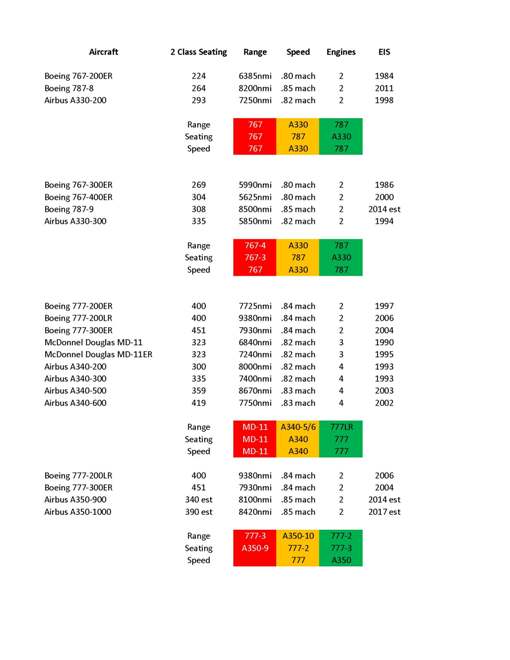
We could spend tens of posts evangelizing for one manufacturer over another in the Airbus vs Boeing wars. I spent some time wondering how it is each overcame the other at various times and decided to chart their respective aircraft on seating, range, speed and engine count. It’s not hard to see why the 767 got trumped by the A330. The A330 was the logical growth aircraft. It had the right seating, range and speed.
Similarly, it’s not hard to see how the 787 is trumping the A330 and 767. It hits the sweet spot in seating (not too large, not too small) while killing competitors on range and speed. The same is true between the 777 and the A340 (and I’ve thrown in the MD-11 for comparison). Again, the 777 trumps its competitors soundly in all three categories.
But most remarkable of all is seeing just how the 777 stacks up in present form against the A350. Now I understand why Boeing continues to be the preferred aircraft so far. The A350 competes and even competes reasonably well but it still doesn’t really trump the 777 and in some cases, it doesn’t get close to beating the 777.
See the results below:
Filed under: Airline Fleets by ajax
No Comments »
May 10, 2012 on 1:00 am | In Airline Fleets | No Comments
QANTAS is deferring delivery of 2 Airbus A380 aircraft until the 2016 and forward time period in an effort to lower costs in order to compete more successfully with Virgin Australia.
It’s a bit of a blow to the A380 program in some ways and it adds to the pain of cancelled orders from China for the A380 as well. However, Airbus will be able to deliver the aircraft to other airlines at present. I suspect that airlines with a substantial A380 fleet are finding the aircraft quite successful on the routes it can be deployed on and I know that Lufthansa regards it as having lower seat mile costs.
However, I continue to believe that there are only so many routes it can be deployed on to earn regular profit. QANTAS would take delivery of these if there was enough demand as they are replacing aging 747-400 aircraft. Lower seat mile costs are great but only if you can fill the aircraft regularly all year round.
I’m not sure all airlines are doing a very good job with that and Lufthansa’s choice in having both the 747-8i and A380 kind of speaks to the fact that while seat mile costs are important in the equation, filling the aircraft is just as important. A full 747-8i earns more money than an A380 at 85% load factor.
The A380 will continue to sell . . . slowly. It will continue to be delivered and it will continue to get deployed on various routes but it remains a niche aircraft at best. That’s OK, so is the 747-8i. The real profit earners going forward are going to be the 777 series from Boeing and the A350 from Airbus.
Filed under: Airline Fleets by ajax
No Comments »
March 29, 2012 on 8:26 am | In Airline Fleets | No Comments
It’s funny, some people think Southwest showed some LUV for the Airtran 717 fleet when the merger was announced between the two companies. In fact, Gary Kelly simply said that, at that moment, the 717 was intriguing to SWA and certainly not a harmful aircraft to Southwest’s fleet plans overall.
After the merger, Gary Kelly started talking about how they don’t fit and they don’t want them.
The 717 is a good aircraft and it would fit some of Southwest’s flying quite nicely but . . . it would complicate scheduling and I think that’s what Mr. Kelly doesn’t want. If Southwest has a 737-700 go technical at an airport, it’s not a problem to drag another 737-500/700/800 up to the gate and hand it over to the pilots and flight crew to use for their needs. You can’t drag a 717 up to the gate and hand it over to the same pilots.
I think the 717 is leaving and I think it will be gone in 2 to 2 1/2 years. Holly Hegeman of Plane Business says they are going to Delta and its a done deal. I say they’re leaving and they’ll find homes somewhere. Boeing Capital if nowhere else. Delta probably could and would be interested in them as they are cheap and fit a seat count that Delta had and no longer has in its mainline fleet. (DC-9-30/40/50 aircraft are leaving the fleet)
The real shame, in my opinion, is that the 717-200 wasn’t expanded into a longer range 717-300/300ER aircraft. I think that would have breathed real life into that airframe and I think it wouldn’t have hurt the 737 line at all. But it became an orphan and, as such, it became unattractive to most airlines. That said, it will remain in the world for at least another decade if not more and it’s got some highly efficient engines that justify its purchase when combined with the used market price for a 717.
Filed under: Airline Fleets by ajax
No Comments »
February 28, 2012 on 1:00 am | In Airline Fleets | 1 Comment
The turboprop airliner is arguably one of the most fuel efficient aircraft that an airline can use today. It’s true that turboprops were justifiably unpopular when the first generation regional jets came along but they’ve improved dramatically and offer seat costs that just can’t be matched by those same regional jets.
So why is American Eagle eliminating ATR flying in both Dallas and Miami and subbing in 50 seat regional jets?
The ATR aircraft are being returned to lessors and if the lease rates were an issue, one would expect a negotiation to reduce those lease costs. In fact, one would expect that to be pretty easy to do.
This is the aircraft that should be used for those flights to regional cities in Texas and it should provide economics that would make retaining those regional jets seem silly. The trip lengths are no different. The comfort level is no different. But for some reason, American Eagle wants to use its Embraer 135/140/145 aircraft on those routes instead.
I would think that we would see those Embraer dumped in favor of buying *more* ATR aircraft. Yet, American Eagle plunges ahead following the same corporate insanity that the mothership is engaged in. What is the definition of insanity?
Filed under: Airline Fleets by ajax
1 Comment »
February 27, 2012 on 10:53 am | In Airline Fleets | No Comments
The current and future product lineup for both the 777 and 787 is now becoming more clear for the next 15 years or more. The 787 line is expected to be pumping out more and more 787-8 aircraft for current customers and the 787-9 is expected to fly in 2013 with deliveries taking place shortly thereafter. Those two aircraft slot themselves just under the current 777-200ER/LR which is still an attractive aircraft to many airlines.
The 787-10 is conceptual but, I think, a near certainty to arrive as a replacement for the current 777-200ER/LR. Range will be the factor on this but Boeing should be able to provide with with similar range and capacity (passengers and cargo) as the 777-200ER with improved efficiency. Suddenly, we have a 787 lineup with 3 aircraft capable of meeting the needs of airlines from the 767 range to the original 777 range and which also covers the current A330 lineup as well. It also allows airlines to operate a mixed fleet to rightsize aircraft to routes using the same aircrew for each.
Additionally, the 777-X lineups move upwards with the 777-200 and 777-300 getting about 50 seats more capacity each with similar range as today. These new variants will benefit from a larger, lighter composite wing and new generation GE90 engines that benefit from GENx technology. The expectation is that such aircraft can also deliver from 15 to 20 percent improvement in efficiency as well.
Now you have 5 aircraft derivatives from two models covering 98% of all widebody needs with class leading efficiency that brackets Airbus’ offerings in the A330/A350 models. That’s a powerful sales tool when you consider that the current 777 pilot can transition to the 787 (and vice versa) in about 8 days of differences training. I would expect that the new 777 variants may well be designed with flight decks that take that transition time down further or which may well make it possible for a pilot to be flexible across the entire 787/777-X line.
This will be attractive to airlines around the world. One airline can buy 5 variants that will seat a range of passengers from 242 seats (Boeing 3-Class Configuration) to 410 seats (Boeing 3 Class Configuration) with increments from the 787-8 forward being about 30 seats per aircraft, just where airlines like to see things.
I would expect that airlines would likely operate “skips” in their choices. A 787-8 operator might also own the 787-10 and 777-9X, for instance. A 787-9 operator might also own the 777-8X, as another example.
Flexibility and range are the key weapons here and they become very, very attractive to airlines both in the United States as well as abroad. These won’t be airliners designed to the demands of middle eastern airlines such as Emirates (who always want more range and capacity) but, rather, to the airlines that comprise the rest of the world.
I think we’ll also see range in excess of 8000 to 8500nm as being not necessary either. In other words, I don’t expect airlines to continue to try to build variants with more and more range. Yes, it would be nice to offer an airliner that can fly from London to Sydney and earn money and that may even be possible with the next generation 777 aircraft. However, it’s virtually the only market left that cannot be served by airliner and that makes it a pretty small one for aicraft. As such, I would expect that their might be a high performance 777-8X offered to those airlines capable of doing the mission profitably but that will come later rather than sooner unless it is deamed necessary to selling aircraft to the airline.
Filed under: Airline Fleets by ajax
No Comments »
February 21, 2012 on 12:25 pm | In Airline Fleets | No Comments
American Airlines Chief Commercial Officer, Virasb Vahidi, has apparently been given the task of promoting the idea that American Airlines be allowed to farm out more flying to regional airline partners which is currently against the contract AA has with the Allied Pilots Union.
American wants the ability to send flying up to 88 seats out to regional partners using as much as 255 aircraft (50 to 70 seat flying is limited to just 47 aircraft right now) or 50% of the mainline fleet, whichever is greater.
Of course it does. Because this is what makes it competitive against airlines like Delta and United Airlines who already have the ability to access regional airlines for that kind of flying. The concept of right sizing aircraft to demand is perfectly sane and I would go so far as to say it is way overdue for many airlines. All too often, we’re seeing high frequencies of 50 seat (or less) jets to destinations that would be better served with 2 or 3 frequencies of a 70 seat jet.
But I have to ask a question: Am I the only one who sees the continued farming out flying to other entities as a stop gap measure? At the end of the day, it feels economically inefficient compared to simply being able to operate the aircraft you need to operate within a consolidated infrastructure at labor rates that make sense. When do pilots and other flight crew recognize that it really is no difference to fly an Embraer E-170 for a regional at a lower pay rate than it is to accept flying that same aircraft for a mainline airline? And, in fact, the ability to upgrade via the seniority system becomes easier, no?
Let me suggest something radical here for American Airlines and its unions: Bring it all under the AA roof and negotiate competitive pay rates for each class of aircraft based on seat count. Be smart and pay a living wage and consolidate the flying into something more rational than what exists today between other regional and mainline airlines. Be aggressive and find those savings in the forms of productivity, employee reward and using one infrastructure to win against the other SuperLegacy airlines.
Mind you, this requires unions such as the APA to concede that low pay rates are required for small, regional flying and productivity gains are necessary to beat the competition. This requires AA to recognize that it has to reward its employees for those productivity gains and for accepting those lower entry level pay rates. That’s pretty radical for both parties.
It seems to me that regional airlines all to often are killing themselves over contracts for flying using airliners that are just stupid to use in this economic climate. 40 seat Embraers are still being used simply because of scope clause contracts that leave airlines no other choice. It artifically raises the cost of tickets and leaves those same regional airlines stuck with aging equipment that has no value on the used market and which is unreliable for the flying its being asked to do today.
I’m suggesting sanity and I realize that suggesting that in the airline industry is foolhardy on many levels. But . . . airlines figured out capacity control. They figured out some revenue enhancements via a la carte pricing. Why can’t unions figure out how to grow jobs and provide more stability for its work force overall?
Consider the impacts to a regional airline pilot who is new to the business. Under the current systems, this guy may bounce around several times and each time he/she starts anew at a regional airline or mainline airline, they start at the bottom. Wouldn’t be nicer to enter into one seniority system, enjoy a relatively stable if fairly low income in a relatively stable base with an upgrade path that can span your career. Isn’t that worth giving more productivity and accepting the lower wage given the quality of life and quality of work improvements that come along with that?
I would suggest that if AA wants to really compete and by AA, I mean both management and labor, why not get radical and try something that takes competition to another level? If you do, you potentially cut down SuperLegacy airlines at the knees on the cost side and win more business which translates into potentially far greater profits. Imagine just how nervous Southwest Airlines gets with that kind of productive, rewarding system showing up in its own backyard?
First you have to show up at the negotiating table with an attitude of wanting to embrace a real change on both sides. Trust is needed and trust has to be given. This can’t be about who gets to screw who. It’s got to be about two parties coming together to save their asses against all others. That requires a bold move in these days.
Filed under: Airline Fleets by ajax
No Comments »
January 16, 2012 on 1:00 am | In Aircraft Development, Airline Fleets | No Comments
Aspire Aviation has revealed that Boeing has issued an RFP to GE and Rolls-Royce (with speculation that Pratt & Whitney got included) for a next generation engine for the 777-8X/9X development. The target appears to be about 100,000lbs of thrust (and I’m sure Boeing would like to hear about a growth path to that as well.)
With the combination of new technologies for the fuselage, composite wings that are likely a bit larger and a lower fuel consumption, these new aircraft would definitely be A350 beaters in every category. The current 777 lineup performs well against the performance definitions for the A350-900 and based on comments from A350-1000 customers, the 777-300ER probably isn’t equaled on long haul routes.
A revised 777 that upgrades the -200LR with more seats and as much range, capacity and cargo capacity would clearly be of interest to many airlines. A -300ER that also increases its capacity with equal or better range would also be of great interest to many. Boeing has rightly identified that its the -300ER that is likely the sweet spot in size (or a little larger) for most airlines requiring a high capacity/long range airliners for routes.
The A380 will be around for a long time. It won’t be a big seller over the next decade and will only ever be a success if there is enough growth on long haul trunk routes to require that aircraft. The 747-8i remains an interim solution from Boeing and it still hasn’t garnered much interest from airines. In fact, many airlines have downsized from the 747-400 in favor of the 777-300ER.
Trunk routes will remain but there will be fewer of real importance and requiring a VLA. The 787, A350 and 777 all permit airlines to fly more point to point routes and earn profits. Ultra long haul flights are likely to remain more in the style of “long and thin” than “long and fat”. After all, just how many people are likely to fly from Houston to Auckland, New Zealand even with network feed? Answer: Not enough to require a 777 or 747 for quite some time.
I do think Boeing has the right idea in offering a revised 777 instead of an all new design in this category. The 777 still incorporates some fairly cutting edge technology and with a revised composite wing alone could probably continue as a category winner.
Filed under: Aircraft Development, Airline Fleets by ajax
No Comments »
January 13, 2012 on 1:00 am | In Airline Fleets | No Comments
When airlines began to use 757 aircraft for flights between the US Northeast and Europe, it was innovative to say the least. Using the aircraft’s 4000nm range, it became possible to serve those long, thin routes with non-stop flights that haven’t been possible with a single aisle airliner since the 707 and DC-8.
757s are aging aircraft now and even with winglets, some airlines are seeing the time come for them to retire these planes. Many speculate that Airbus or Boeing will develop some derivative of the 737 or A320 to replace the 757 on those routes and while it is something that I think airlines would have some interest in, it’s highly unlikely to happen. Despite how much new life the 757 found on those routes, it’s still a very small subset of 757 flights.
Even today, most 757 flights are in the domestic United States and even the trans-continental flights are a subset of all 757 flights. In point of fact, most 757 flights are not trans-Atlantic or trans-continental in nature. The trick with those long flights is to have an aircraft with enough power to carry not just passengers but a good load of cargo and a more ideal aircraft would have closer to 5000nm of range as well.
Once you find the engines (which need to be in the 40Klbs of thrust range), you still have to build an aircraft that can economically carry 180 to 200 passengers and a full load of cargo 4500nm to 5000nm. In point of fact, that starts to sound an awful lot like the 767. And it’s notable that the 767 is still being produced.
I would argue that the airliner that airlines might buy is a 767-200LR that is lightened and which has more efficient engines. Engines that, say, would look something like a downrated GEnX engine. Perhaps an engine derivative of those now being used on the 747.
I don’t think we’ll ever see an airliner like the 757 again. It was always a bit of a misfit in the airline world in that it was designed in the 1970s and had to succeed in the 1980s and 1990s. Its sweet spot was just a bit too high performance for most routes that airlines needed it for. It succeeded as a design and in production but it was not nearly as successful as the 727 or 767.
But I do wonder what a lightened 767 with modern, efficient engines would do for airlines on those trans-Atlantic routes. Or on routes from North America to South America. Or on US mainland to Hawaii routes. There might be just enough use for Boeing to do one more derivative of that airframe and get something out of it. It wouldn’t be impossible to see such an airliner becoming a KC-46B tanker model as well.
Filed under: Airline Fleets by ajax
No Comments »
December 15, 2011 on 1:00 am | In Airline Fleets | No Comments
Southwest is clearly positioning itself to operate a family of aircraft. They also clearly see a strong need for the -800 (5 more aircraft ordered) and I think they recognize a need to enjoy all the fuel efficiency benefits available to them at this point in the company’s life.
SWA has made its intentions to compete in major markets and at major airports throughout the country. Those airports require more capacity per flight in order to grow and enjoy health profits. In light of their challenges in getting slots to operate from NYC airports as well as slots for Washington (National), I suddenly wonder if the -900 and MAX9 won’t enter into the picture. If they can get enough frequencies in and out of those airports to operate an accomodating daily schedule, they can at least benefit from larger and larger aircraft.
The question is what to do about their traditional smaller markets that have enjoyed a lot of Southwest service. Many of those markets get served with 737-500 aircraft or they enjoy the -700 by being a part of follow on service to another destination. For example, my mother flew to the DFW area last week on SWA by going nonstop to ABQ and then onwards (on the same aircraft) to Dallas.
This is how Midland, Lubbock, Amarillo, Oklahoma City, Tulsa, and Little Rock enjoy more frequent service with mainline aircraft. In fact, each of those cities enjoys 5 daily round trips each except Little Rock which has 6. That is on Southwest alone and does not include service provided to the DFW area by American Airlines/American Eagle who offer as many or more frequencies using primarily ERJ-140 aircraft and a few MD-80s. But once Love Field in Dallas becomes available for non-stop flights to destinations within the 48 states, those cities suddenly don’t look so good for the mainline aircraft they have today. I don’t think they’ll lose that kind of service entirely but I do think that such cities will see reduced service or they’ll need smaller aircraft.
In light of Southwest’s order, I no longer think they are necessarily going to embrace the CSeries. The truth is, more and more, the turbo-prop offers the right economics for those flights. And, yet, I’m not sure SWA wants to be a turbo-prop operator. So I wonder if we’ll see Southwest morph into a larger, more mainline airline that starts to ignore those smaller cities it has so successfully served for decades.
I also notice that while they’ve made their orders today work for a stable fleet count, they can also change their minds and grow if opportunities present themselves. It’s a flexible plan and I like that. Southwest *will* order more MAX airplanes but the follow on orders will be in single digits mostly and very incremental over time. Southwest will likey obtain more options as time passes but mostly it will use the ones it has today strategically.
Finally, time for another prediction. I think we are going to next see Ryanair jump on the bandwagon for new aircraft. Odd favor the MAX and I’ll predict that their goal will be a 250 aircraft order that focuses more on the MAX than it does on replacing existing aircraft in their fleet. When? If it’s Boeing they really want, it will be very soon. I would expect it to happen in the next 30 to 40 days. If they truly want to evaluate Airbus against Boeing, then I’ll guess that we’ll see an order announcement somewhere in March or April.
Filed under: Airline Fleets by ajax
No Comments »
December 14, 2011 on 1:00 am | In Airline Fleets | No Comments
Well, it’s 150 firm orders for the MAX and another 58 for the 737NG. Close enough to my own predictions that I’ll gloat for a moment.
I’m done.
Southwest becomes the launch customer for the 737MAX and this becomes Boeing’s biggest order ever. More importantly, it’s the ring of legitimacy that Boeing hears in its ears now.
Filed under: Airline Fleets by ajax
No Comments »
December 10, 2011 on 1:00 am | In Airline Fleets | 3 Comments
Well, it’s starting to bubble out in the media that Southwest is close to making an initial order for the 737MAX. Rumours say it will be a 100 aircraft order. If negotiations are beginning to finalize, I think it will be for far more aircraft than that.
Southwest currently has 550+ aircraft in its fleet. Of those, 195 are not Next Generation 737s (-700s). Those aircraft need to go sooner than later but Southwest only has 133 orders for 737s and of those, 20 are for the -800. (Southwest also holds 37 options and 98 purchase rights.)
Of the next generation fleet, 370 are -700s and while those seem awfully new, quite a few are getting rather old as well. Southwest was the launch customer for that aircraft and owns the first one built. They don’t need replacement in the next 3 to 5 years but they will need replacement in latter part of the decade.
My prediction is an order for 200 and another 200 to 300 options. I think they’ll choose the CFM Leap56 engine and I think the mix will be weighted towards the 737 MAX 8. I don’t think the MAX 7 will be ignored but Southwest is growing and it is able to fill the MAX 8 but it will still have a healthy and relatively new fleet of -700 aircraft for its short haul and long/thin routes to use.
Southwest actually doesn’t generally order “big”. Typically, they order a few aircraft at a time. But if they choose the MAX (and they will), there is no reason to not take advantage of Boeing’s desire to get a major airline into the order list. American Airlines was a hail mary pass and now Boeing needs a credible 737 user to endorse the aircraft. (Lion Air wasn’t it.)
Filed under: Airline Fleets by ajax
3 Comments »
|
|
|

