|
December 5, 2011 on 12:37 pm | In Airline Fleets | 1 Comment
Airbus COO John Leahy is opining that United Airlines will ultimately add the A380 to its fleet because, in his opinion, it is the only way to be competitive in the Asia Pacific markets United serves.
I would suppose that anything is possible but I would also offer that I think this is highly unlikely for the near term. By that, I mean you shouldn’t go looking for a United announcement about this over the next 5 years.
United already struggles to figure out what to do with its 747 aircraft (as do most US based airlines) and that’s based on the fact that people here in the United States are looking for direct, non-stop flights rather than trips that require a flight to a “hub” city first.
The A380 might ultimately fit into the Asia Pacific strategies for both United and Delta but I don’t see it right now. Other than the ability to “concentrate” more passengers onto a single flight, the A380 doesn’t offer these airlines anything more than what they already have in their current and planned fleets. The idea that people *want* an A380 because it is an A380 is a bit foolish at best.
What people want is market competitive inflight service and the best available travel time. That can be accomplished profitably with the 777 and 787 fleets that these airlines will have.
Filed under: Airline Fleets by ajax
1 Comment »
December 2, 2011 on 1:00 am | In Airline Fleets, Airline News | No Comments
One of the things to come out of American Airlines’ bankruptcy filing is that they intend to ask permission to get out of 24 aircraft leases. That would be 20 very old MD-80 series aircraft and 4 Fokker 100 aircraft.
All are currently parked in Roswell, NM.
American has had those Fokker aircraft parked for a very long time and never found buyers or lessors for them. The MD-80 aircraft are just plain worn out and too costly to fly.
It’s not a stupid move on the part of AA with respect to its costs. It will, however, no doubt anger lessors who were earning quite a nice revenue stream on parked aircraft. It isn’t always wise to anger the leasing world when you have big plans for fleet renewal. If it remains only these aircraft, the damage to reputation will be miminal at worst.
I think, however, this is just the tip of the iceberg. I suspect we’ll see many, many more MD-80 series added to that list for no other reason than they have little or no value to AA when they can get shiney new, efficient airplanes from Boeing and Airbus.
Filed under: Airline Fleets, Airline News by ajax
No Comments »
November 29, 2011 on 1:00 am | In Airline Fleets | No Comments
Now we see some rumour developing that United Airlines is in talks to make a 200 aircraft single aisle purchase. This has credence due to the fact that United has about 200 aircraft that are some of the oldest around (these are 757s and 737s mostly from the original United Airlines) and those aircraft are likely having a real impact on the bottom line as a result of fuel costs and maintenance.
I think we’ll see an order and I suspect that order may well go all to Boeing. It may be named United but it is run by Continental executives now and those executives have found ways to effectively use the 737 on their routes. Furthermore, I think Boeing may be able to offer earlier delivery positions than Airbus can.
What might we see? I would look for a sizeable portion to be 737-900ER aircraft with some 737-800s. In addition, I think we may well see a follow on order for the 737MAX aircraft again in the -800/-900 configurations.
The current fleet of Airbus A319s are “good enough” and while some of the A320 aircraft are getting older now, they aren’t quite old enought to start planning retirement of until those older 737-500 and 757-200 aircraft are replaced. About 1/3 of the A320s were delivered in the mid 1990s with the balance showing up from around 2000 and on. Almost all of the A319s arrived in the early 2000s. There is maneuvering room left with those fleets.
Airbus will want to keep United but I think they’ll struggle to offering the delivery positions that United will need. Those positions are needed now and over the next 7 to 10 years. Airbus has sold most of those positions. The only way to offer early positions is to increase production even more.
And both Boeing and Airbus are struggling to figure out how to increase their production beyond their plans for production rates that will already be historic for commercial airliners. It would require another production line and even more suppliers for airliners that are now fairly obsolete in light of the A320NEO and 737MAX.
Look for an order announcement in the next 1 to 3 months and my bet is on a 200 to 250 aircraft order of 737s with about 100 of those coming from the 737MAX line.
Filed under: Airline Fleets by ajax
No Comments »
November 24, 2011 on 1:00 am | In Airline Fleets | No Comments
American Airlines has chosen to receive Airbus A319 aircraft and A321 aircraft in its first round of deliveries from Airbus as a result of this summer’s order. So far, it isn’t know how many of each will be received.
The A319 choice surprised me somewhat. Some speculated it would be ordered as a gap filler between AA’s 160 seat 737-800 and its largest regional jet, the CRJ-700 which has about 65 seats. AA’s MD-80 aircraft are configured with 140 seats. The A319, in American Airlines configuration, should have about 126 seats based on my research into how other SuperLegacy airlines are using the aircraft. Delta has 126 seats on its A319s, United has 120 seats (but with Economy Plus in the mix) and US Airways has 124 seats. I expect American to meet or beat Delta’s seat count.
I myself didn’t expect the A319 to be selected because it is heavier aircraft and the costs to operate it are similar to the A320 much as what has developed between the 737-700 and the -800 on the Boeing side. I actually thought that something such as the CSeries might get considered as that gap filler. The A319 offers a bit more flexibility on payload and range but the CSeries would offer better trip costs most likely.
Unlike many, I don’t regard the CSeries as a program that will fail.
The A321 was the no-brainer. It will fill the 757-200 role nicely on most domestic routes. I would expect these to be configured with about 185 seats on anything but specially configured international aircraft. US Airways has 183 seats on its A321 aircraft but, again, I expect American Airlines to beat that number by a few seats. Current American Airlines 757-200 aircraft have 182 or 189 seats depending on the mission its configured for. I expect we’ll see something close to 189 seats for AA’s A321s with the remaining 757-200s to be reconfigured for those long, thin trans-continental and trans-Atlantic flights.
But here is the real surprise for me: The A319s will have CFM engines and the A321s will have IAE V2500 engines. While you can choose from either manufacturer on both airframes, American has decided that commonality is trumped by mission performance evidently. Again, I would have expected American to probably go with CFM on both airframes if only because they do have some experience with the engines as a function of owning the 737-800.
However, the IAE is reportedly the better performer for longer duration flights and it would appear that the planners at American would prefer to optimize performance of the aircraft according to its expected mission as opposed to reduce costs by having a common engine family. Contrary to what some may think, I think that’s the right decision. SuperLegacy airlines will own enough of an aircraft/engine family to enjoy economies of scale and it is no longer necessary to try to maximize cost benefits by sticking to one aircraft type and one engine.
In other words, buy the aircraft and engine that best fits the expected mission should be the purchase strategy we’ll see not only from American Airlines but other SuperLegacy airlines as well.
Filed under: Airline Fleets by ajax
No Comments »
November 18, 2011 on 1:00 am | In Airline Fleets, Airline News | 1 Comment
Emirates has signed a deal with Boeing this past week for 50 more 777-300ER aircraft with a list value of $18 Billion. It’s a big deal for Boeing and a big one for Emirates although Emirates is rather used to making big deals.
Emirates already has the largest fleet of 777 aircraft and they like and use the -300ER very effectively on their routes. They also have 50 A350-900 and 20 A350-1000 on order. And let’s not forget the the massive number of A380s still to be delivered.
That’s a lot of capacity. Consider that Emirates uses the -300ER in capacities ranging from 354 seats to 442 seats. I suspect that some of these -300ERs will replace -200LRs which will then be used to replace A340-500s that are not nearly as economical as the -200LRs. In addition, I think even more of the -300ERs will replace some aging -300/-200 standards currently used for high density flights to cities in medium haul range of Dubai. That will also reduce the number of Rolls Royce Trent powered 777s in their fleet and convert the focus more fully to GE90 engined 777s. That said, there will still be quite a few -300ERs coming online as additional capacity.
Can they fill those aircraft? Regionally, Emirates serves cities that are mega-dense with populations and make money doing so by cramming as many people into coach as possible. Globally, Emirates is expanding to new cities in ways that does make one wonder if there is much low hanging fruit left for them. Take for instance their new flights to cities such as Seattle, Dallas, Buenos Aires, Dublin, Harare, Lusaka and Rio de Janeiro. Not a one of those cities is a mega dense destination such as those flights they’ve had to cities already served.
I continue to question the viability of Emirates in light of the evolving landscape for point to point routes around the world made possible by the latest generation aircraft coming online.
This order also gives Emirates a whip to use on Boeing. Boeing is now talking about what the next generation 777 should look like. It is a given that we’ll see a new wing and likely new or improved engines as well. Increased use of composites is also probably a given. Some think the -200LR gets stretched a bit with the goal of similar range and the -300ER gets stretched more with a goal of more payload over existing range.
Neither of those configurations necessarily makes Emirates thrilled. Emirates model is based on high capacity, long range flights and they’ll want to see more range with similar payloads in lieu of more capacity with similar range. To an extent, neither option is mutually exclusive. Airlines such as Emirates can configure aircraft for less than high density capacity and get more range. But only to a point.
This order gives Emirates and its CEO Tim Clark the opportunity to start bludgeoning Boeing into building a high capacity, ultra-long range aircraft that they need and want. Its become clear that the A350-1000XWB is not going to be that aircraft. Not the way Emirates wants them. Emirates will threaten order cancellation if it doesn’t get its way with a definition of those next generation 777s that meets its needs.
Will Boeing crumble? I think not. Boeing has rightfully valued Emirates as a customer but also recognizes that meeting the missions of other airlines is more important than just one airline. It doesn’t like all its eggs in one basket and building an Emirates 777 will result in other airlines being less than enthusiastic for the aircraft. However, I do think that Emirates can nudge Boeing into more performance overall and that would be good for everyone involved.
Filed under: Airline Fleets, Airline News by ajax
1 Comment »
November 16, 2011 on 1:00 am | In Airline Fleets | 2 Comments
Allegiant Airlines has come to an agreement with Scandinavian SAS to buy 13 more MD-80 aircraft for its fleet. Kind of a yawn announcement, isn’t it?
Allegiant uses the MD-80s and makes a strong profit doing so. They get praised for business model and frugal operating plan and deservedly so.
To a point.
Yes, the capital costs are extremely low. Yes, Allegiant can operate them with density that makes them profitable.
No, Allegiant can’t count on that working for the future. Airtran got started operating extremely old DC-9 aircraft and did pretty well for a time. Then its executives realized that fuel would be an issue and it started buying new aircraft. New, fuel efficient aircraft such as the 717 and 737-700.
Fuel and maintenance costs *will* become an increasing problem for Allegiant. Don’t kid yourselves. The MD-80 aircraft are strong but they are old and they have been ridden hard and put up wet by airlines around the world. That takes a toll.
The smarter move would be to start transition to the *next* cheap aircraft to buy. In my mind, that’s the 737-300. They’re only getting cheaper and they offer a pathway to continue on as an airline. Airlines will be dumping their older 737s in favor of the newest offerings and the older 737s such as the -300 will only get cheaper.
It also offers a pathway into a family of aircraft that can be purchased to fit a variety of needs.
The status quo can be great. But in this case, I think the status quo hurts Allegiant far more than helps in the next 5 years.
Filed under: Airline Fleets by ajax
2 Comments »
November 15, 2011 on 1:00 am | In Aircraft Development, Airline Fleets, Airline History | 2 Comments
 (Flickr) (Flickr)
I got asked what I thought of the A340 last week by a reader of FlyingColors and decided to give some thought to that subject and write a post.
The truth is, the A340 was probably the first Airbus aircraft that I really liked visually. I liked the slender appearance of the widebody fuselage and I liked the four engines and how they were hung on the wing in a proportion that just seemed a bit sexier than other 4 engine aircraft.
I liked Airbus’ approach to the A340/A330, too. I’ve always been fond of the parts bin approach to creating value for a customer and the A330/A340 development was certainly that.
A fuselage that got borrowed from its first twin-aisle aircraft and CFM engines that were derived from the A320 aircraft. Need a medium range hauler? Use our A330. Need a long range widebody? Try our A340. Going trans-Atlantic? Use our A330 and if you’ve got trans-Pacific routes, we have this lovely 4 engine aircraft for you.
And you got to have pilots that could fly both.
It was a beautiful approach and a real answer to what was needed at the time. It was way better than McDonnell Douglas’s offering in the MD-11 and Boeing really didn’t have an aircraft that even fit the needs at all.
ETOPS was changing the game at the same time, however. So was engine development.
The MD-11 was a bit flawed in that it really needed a truly new wing and better engines to achieve its mission. But the ever frugal derivative player, McDonnell Douglas, played things just a bit too frugal.
The 747 was simply a different class of aircraft. The 767 was too small and too short ranged to fit the gap.
Airbus did a great job with those aircraft in offering a sweet spot solution for both capacity and range and then made a strong business case for both of them by making them as common as possible. You cannot blame any airline who went that route. It was, in the context of the times, the perfect solution.
What we didn’t really count on was engine manufacturers being willing to truly make game changer engines and ETOPS going far past anything anyone could envision. The 777 was born and it was an even bigger game changer. First an aircraft that solved the A330 problem just a little bit better. Not fantastically better but it offered just a touch more capacity and bit more cargo capacity and it did it with engines that were more revolution than evolution.
The A330 has survived because of its improved derivatives and any airline using them makes great money.
The A340 got hampered by a few things. It needed a bit better wing and better engines (and finally got both in the A340-500/600). The CFM engines were a great choice going in but the Rolls Royce Trents were the answer to a question that got asked a bit too late.
Airbus bet on 4 engines being preferred for long haul, trans-oceanic routes and given the dominance of the 747 in that market, it wasn’t a bad bet. Their mistake was in underestimating Boeing’s ability to look forward. Boeing saw the possibilities in ETOPS and extra high by-pass engines that were more reliable than anyone could have conceived of a generation earlier. And it should have given its customer base at the time.
Airbus was hampered by a bit of McD disease and by multi-government ownership at the time. It didn’t have enough capital to go “all in” on designs and knew it had to make its business case on flexibility which meant derivatives. In fact, it often only got capital for new investment if that investment benefitted its owners in the form of jobs programs for their citizens.
While thinking about this post, it occured to me that Airbus even produced a 747-SP. The A340-500 derivative. It could fly fantastic distances but without enough passengers to make it cost effective. Then the 777-200LR came along and was capable of doing *that* mission better and cheaper.
The 777-200ER and 777-300ER killed the A340 in all forms (And EADS CFO just admitted it in the press). It could haul more passengers and cargo for the same or longer distances for less money. It was that simple. Boeing made the business case on trip costs and won.
Even if hindsight is 20/20, you can’t say that Airbus made a mistake with the A340. The A340 killed the MD-11 and exposed the weaknesses of owning 747s. It did its job very well but it arrived just a little bit too late to enjoy its success for very long. Timing is everything.
I would criticize Airbus for the A380. Yes, it has made a few airlines some good money. It also ignores the model(s) for long haul travel over the broad spectrum in favor of trunk routes. It will never enjoy the numbers or prevalence of the 747. On the other hand, neither will the 747-8i.
I’m not sure the A350 is the answer either. I don’t think it fits long, thin routes as well as the 787 and its planned derivatives. I don’t think it fits the long, large capacity routes quite as well as the 777 either. Its smallest derivative is an A330 replacement at best and I question whether or not it will ever get built. Its largest derivative so far doesn’t respond to the 777-300 as a game changer either. They are free to prove me wrong.
It’s not that I think the A350 won’t sell. It will. But I think it’s destined to be a player among a fairly small core group of airlines. Much as the A380 is and will be. Boeing took a page from the Airbus playbook and built the 787 to fit a nice, broad piece of medium and long haul routes and positioned itself to answer the largest A350 with a next gen 777 or next gen new build large capacity, widebody aircraft.
Boeing one ups Airbus over the next 20 years with its product line up and does it in a way that has the gaps covered in distance, capacity and service.
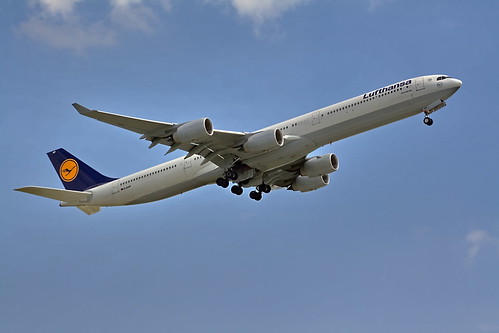
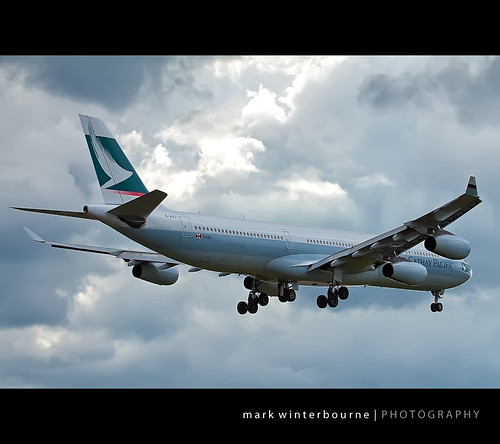
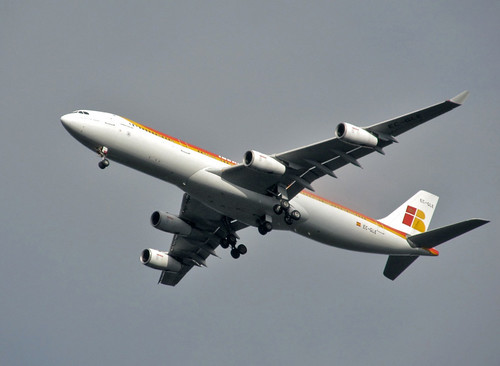
With all of that said, I still think the A340 is one hell of an elegant and pretty airliner. It lends itself to the great airliner liveries of the world. Just look at these:
(All images from Flickr under their Creative Commons License)


Filed under: Aircraft Development, Airline Fleets, Airline History by ajax
2 Comments »
November 10, 2011 on 1:00 am | In Airline Fleets | 2 Comments
Every airline reporting on its quarterly financial performance last month cited fuel as a major impact to their bottom line. Airlines saw significantly higher fuel prices this year compared to 2010 and it’s true that it’s a hit to profits.
On the other hand, it’s notable that fuel hedging contributed significantly to their losses on paper. Why? Because fuel prices did not go up high enough for those fuel hedges to provide benefit. Instead, they went down.
The truth is, it isn’t high fuel prices that are killing airlines. It’s the price volatility that hurts them. Airlines haven’t been able to plan their costs very effectively for the past 3 years. Hedging is supposed to “smooth” that volatility and it will except that it also causes paper losses which reflect negatively on the airline when it announces its financial performance.
Is it necessary? I used to think so. In fact, I was a big advocate of fuel hedging not because of the windfall profits it provided many airlines for many years but, rather, because it really did make costs stable. US Airways has stopped fuel hedging and their financial results show that fuel hedging just may not be necessary anymore. Their profits are not taking a hit from hedging contracts that “lose” money.
In fact, US Airways performance is exceptional when balanced against the challenges it has. This is an airline that 6 years later is still effectively operating as two airlines (under one name). It still doesn’t realize that kind of synergies it needs to from its merger. It has serious impacts from labor groups who cannot agree on what day it is much less on who represents them with the company (this would be the pilots) and it still doesn’t have a combined seniority list with one agreement in place with both the pilots and the flight attendants.
This airline also flies from far less popular hubs, contracts with far less ideal regional airlines and has far fewer international flights and even if it could fly more international routes, it lacks the equipment to do so.
But the airlines makes a strong profit. As strong or stronger than the SuperLegacy airlines. The one thing it hasn’t done is announce major paper losses as a result of fuel hedging. It might be time for more airlines to roll with the punches. It’s a highly complex, risky effort that doesn’t appear to be providing the benefits its supposed to.
Fuel price volatility will continue to be a problem. Airlines need stable oil prices and, frankly, so do the world economies. However, let’s not forget that fuel is a problem for *every* airline. They all enjoy the same problem in this area.
I expect that we will see airlines focus more and more on fuel economy over the next several years. We’re already seeing it in some airlines such as American Airlines who has finally realized that if it dumps its MD-80 aircraft, it can not only enjoy double digit improvements in fuel efficiency, it can fly more people as well. That doesn’t mean that airlines with Next Generation 737s or Airbus A320 series aircraft will be dumping their fleet for new aircraft. They won’t.
It does mean that we’ll see older aircraft from the 70’s and 80’s going away. Yes, that means MD-80s but it doesn’t mean MD-90s (which use a far better engine). The other aircraft it points to are those that many may not have considered.
The 767-200ER is already clearly a candidate for removal and the 767-300 isn’t far behind it. These are 1970’s design aircraft and with engines of similar caliber. There are no more improvements and as fuel climbs, these aircraft become quickly unattractive even when completely paid for. The 757 is entering into this territory as well. I would expect that we’ll see a number of these begin to be retired or sold off for cargo work. Again, these are 1970’s aircraft and while their amazing performance lent them a lease on life, they’ve become very expensive balanced against other aircraft that can perform 90%+ of the same missions.
Say goodbye to the older 737s. I’m talking about the 737-300/400/500 series aircraft. These are efficient, for their time, but very inefficient when compared to the latest modesl coming off Boeing’s line. They had a short extension to their usefulness but you will see these depart rapidly from US based fleets over the next 1 to 3 years.
The oldest A320 series aircraft are now due for replacement as well. Some are older than those inefficient 737-300 aircraft and no longer have the fuel efficiency that the latest Airbus offerings possess. They *seem* like a new aircraft. I’ll point out that the A320 aircraft started deliveries in the late 1980’s (1988) and several US airlines such as United own some of the oldest models.
Look for airlines to “upsize” their aircraft. Southwest is doing this by buying the 737-800. For a tiny bit more in costs, Southwest can fly significantly more passengers on routes that are seeing enormous demand. They can make more money for a tiny incremental cost in fuel and one additional flight attendant.
Finally, buying blocks of the A320NEO and 737MAX will make an airline look smart. It is universally recognized that while oil prices may one day stabilize, they won’t return to $20/barrel. The airline with the most fuel efficient aircraft will see an advantage. That’s why I honestly believe we’ll see a large order from Southwest Airlines for the 737MAX. It’s a good evolution for the airline and it will continue to fit within its business plan for some time to come.
Why no orders from Southwest yet? Because Southwest is one hell of a good negotiator and recognizes that they have power in the simple fact that if Southwest buys the aircraft, it’s an endorsement that everyone will pay attention to. I expect to see an initial Southwest order for 100 to 200 aircraft sometime in the next 6 months. Southwest will get its deal and Boeing needs Southwest to stamp approval on the MAX.
Filed under: Airline Fleets by ajax
2 Comments »
November 5, 2011 on 1:00 am | In Airline Fleets, Airline News | No Comments
Boeing now claims 600 commitments to its 737MAX re-engined airliner and that’s fairly impressive despite the fact that we know that 100 of those come from American Airlines. But who else is buying is largely a secret so far. Remember, Delta didn’t order the MAX. It ordered the 737-900ER citing its needs being more immediate than the entry into service for the 737MAX.
600 commitments to a paper aircraft is pretty good for an airliner so recently announced. Since Boeing is fairly honest about what it considers an order, we can presume that these “commitments” are formalized in some manner such as orders and/or letters of intent.
But what is the aircraft. 4 months after hearing that the airliner existed when American Airlines announced its order, we still don’t know much at all about this airplane. We’ve heard promises that have the 737MAX outperforming the Airbus A320NEO but . . . that’s all they are. Promises.
So far, we have no firm definition of what this aircraft really will be. As the Wendy’s commercial asks: “Where’s the beef?”
Filed under: Airline Fleets, Airline News by ajax
No Comments »
November 3, 2011 on 1:00 am | In Airline Fleets | 1 Comment
Airbus has announced a provisional deal for Russian airline Transaero to buy its Airbus A380 aircraft. The order is for 4 airplanes at a list value of about $1.5 Billion.
What’s impressive is Transaero’s plans to have these aircraft seat 700 people. The Boeing 747-400 Domestic is capable of seating about 550 people in a high density layout. The Transaero aircraft will be the rough equivalent of adding another 737 to a 747.
Air Austral, another purchaser of the Airbus A380 has announced plans to fly its aircraft with seating for over 850 people. That would be the equivalent of adding a 777-200 to a 747-400.
Will it work for these airlines? Time will only tell but it’s hard to find that many people who want to be crammed into that kind of airliner for a long haul flight at any price. Current A380 operators are making money with their aircraft but only on extremely high density, high profit long haul routes.
There are only so many routes in the world and, more importantly, there are only so many airports that can accomodate the A380. In Russia, the only one is Domodedevo.
As much as I do not want to fly on such an aircraft, I have to admit that I would like to see what 800 seats on one aircraft looks like.
Filed under: Airline Fleets by ajax
1 Comment »
October 28, 2011 on 1:00 am | In Airline Fleets | No Comments
Richard Aboulafia of the Teal Group has criticized Boeing and Airbus plans to ramp up production on their single aisle airliners and the man has a strong point. Current demand isn’t from growth, it’s simply from the need to replace aging airliners and the thoughts of ramping up production to 50+ per month does smack of hubris.
Some airlines do desperately need newer, more economical airliners. American Airlines is a great example and they’ve made their order. However, what makes sense for AA doesn’t necessarily make sense for another airline. Take Delta, for instance. Delta has a fairly mixed fleet with both Boeing and Airbus products. What it doesn’t really have anymore is that 70’s/80’s fleet of aircraft with really inefficient engines a la MD-80s and what it does have in that category, it’s getting rid of fast.
But what about the MD-90s, you ask? Check out what engine is on that aircraft. It’s an IAE V2500, the same that is sold today on the Airbus A320 series. What Delta is keeping isn’t nearly as old and inefficient as you think and the aircraft are far less capital expensive than new aircraft are. Simply put, Delta is replacing exactly what needs replacement and not buying one aircraft more than necessary.
Other airlines are evaluating the options for what they need in the next 15 to 20 years. Southwest has a fairly new, fairly efficient fleet of 737s and it will want to keep buying new aircraft, too. But what does it need? Right now, it needs the 737-800 and it needs it now rather than later. It needs replacement aircraft for the remaining 737-300/500 aircraft in the fleet and that is being achieved with 737-800s (which replace 737-700s which then replace 737-300/500 aircraft.) But does it need the 737-MAX?
Well, yes and no. It needs the MAX but the airline also is put into an odd position in that it is likely faced with the following scenario: It will maintain a large fleet of NextGen 737s for the next 10 years or more. If it buys the 737-MAX, it will need to hold onto those aircraft for about 20 years. Assuming it can take deliveries in 2017, that means the MAX stays in the fleet for as long as 2037 or longer. However, Southwest knows that a new single aisle airliner will be available around 2025. That’s the airliner that it really needs to go deep on. So, at best, the MAX is an interim solution for airines like Southwest (and Ryanair and others) and you don’t go deep on interim solutions.
The same is true of the A320NEO. For most airlines, going deep on the A320NEO is the wrong decision. Well, for the committed Airbus customer, going deep on the A320NEO isn’t quite as foolish because it is fairly obvious that Airbus *won’t* have a replacement for the A320NEO as soon as 2025. More likely, Airbus wouldn’t roll such an aircraft out until 2030. This is why you’re seeing fairly strong orders for the NEO from existing Airbus customers.
Right now, both manufacturers have deep, deep order lists. They want to extract as much value from those right now as possible because they know that as soon as they do introduce new airliners, those orders will change quickly. The market will become flooded with cheap, relatively new “classic” single aisle airliners with a new single aisle airliner introduction. When the market is flooded with those aircraft, the manufacturers have a much harder time selling customers into their newest and best. So they want to slim those lists down as much as possible right now.
The folly is that ramping up production comes with fairly high costs and the only way to justify those costs is to be able to show that you’ll have an order list that will sustain those high production rates. The manufacturers think the NEO and the MAX will garner enough orders to justify those production rates. That’s the part that is suspect. Yes, initial orders are high(ish) but consider this: Annual production of the 737 and A320 already exceeds 800 aircraft a year. That’s a lot of aircraft and it wasn’t that long ago when Boeing and Airbus could hardly find a buyer for the planes they were producing. I’m talking about 2002/2003 time periods which were a result of September 11, 2001 attacks that reduced air traffic dramatically and killed the finances of airlines around the world.
So, is a growth to 40 aircraft plus or minus a month justified? Probably. Almost certainly. Is growth to 50 or more per month justified? No and I don’t think the manufacturers are going to commit to that presently. Right now, Boeing can reach to the high 40’s without too much trouble. Airbus would struggle with that without making a much larger investment in a new line (such as in the United States.)
The A320NEO and 737MAX aircraft are interim solutions. That’s it. Initial orders will reflect some pent up demand to replace aircraft but it’s unlikely that the pace will continue in a sustained manner. In fact, airlines are being much more prudent in their orders by ordering a few here and a few there to just keep pace with their conservative needs. We won’t see a need for production rates at 50 or more per month until a manufacturer gets off its duff and builds a new single aisle aircraft.
Filed under: Airline Fleets by ajax
No Comments »
October 14, 2011 on 1:00 pm | In Airline Fleets | No Comments
China Southern received their first Airbus A380 and I learned something a bit surprising.
That was the 17th delivery of the year and the 58th Airbus A380 to be delivered. For the record, I think that Airbus might have just got its act together on the A380 now.
Filed under: Airline Fleets by ajax
No Comments »
October 14, 2011 on 1:00 am | In Airline Fleets | No Comments
Engine manufacturer Pratt & Whitney solved a big problem by buying out Rolls Royce from the International Aero Engine consortium for $1.5 Billion. Pratt gets to take control of its destiny for engines made for single aisle airliners and Rolls Royce gets to make money from manufacturing them.
What changed? For a pittance (even at $1.5 Billion), Pratt & Whitney no longer has Rolls Royce blocking the IAE consortium from adopting Pratt’s Geared Turbo Fan. But Rolls Royce continues to make money from the consortium by manufacturing the current IAE V2500 engines. P&W bought Rolls off and it was a good deal at twice the price.
This gives Pratt control of pricing for both the V2500 engine as well as its Geared Turbo Fan engines in the Airbus lineup. It can present a financial business case as advantageous as CFM’s with the Leap and Leap56 engines.
It makes sense for Rolls who has never been a big player in engines for single aisle airliners in that it keeps their hand in the mix but lets them move on and focus on their lineup for twin aisle aircraft. It’s notable that P&W hasn’t had a real good core strength in that market for 10+ years now. Each gets to focus their efforts where they are successful and, more importantly, each gets to compete against GE who has good strength in the CFM lineup as well as in the GEnX and GE90 engines.
Filed under: Airline Fleets by ajax
No Comments »
October 11, 2011 on 1:00 am | In Airline Fleets | 1 Comment
American Airlines will outsource heavy maintenance on (4) 757 aircraft to TIMCO in North Carolina within the next month. You might imaginge that American’s Tulsa maintenance union thinks that is just an awful idea.
American says it needs to do this because of a backlog of maintenance at its Tulsa center and the local TWU says that American knew about this maintenance more than a year ago and failed to do anything about it including considering the union’s proposal to keep the maintenance in Tulsa.
Making decisions like this at an airline always involves more variables than most can consider. Do you pay overtime to get the work done internally? Do you have the space to do the work internally? Is your labor force fatigued and unable to keep pace? Is the costs to do it in house higher than outsourcing? Do you want to try outsourcing to see if pursuing a long term outsourcing strategy is worthwhile on a grander scale?
Is this a move by AA to pursue outsourcing? Actually, I kind of doubt it. AA’s maintenance facilities have done their work not just cost effectively but in concert with the unions and the results have shown. Right down to its labor force finding additional cost savings both in time and money as well as showing that AA could save more money by doing certain small items like “tuning” the engines more frequently for more fuel savings.
I think that AA just also recognizes that having a backlog of maintenance on aircraft could cost them flights and those flights represent revenue. On the other hand, the unions have to make noise about it because they are unions, they want to protect jobs and they want to keep their jobs.
The real failure here is in not simply reaching an agreement with the unions over this issue quietly. It sets up the perception that executive leadership isn’t listening and why reinforce that perception among its labor force?
Filed under: Airline Fleets by ajax
1 Comment »
September 10, 2011 on 1:00 am | In Airline Fleets | 4 Comments
Yesterday, I received a comment on a recent post about using turboprops that offered a challenge. They wrote:
”
Gregory, here’s a thought experiment for you. You want to set up an airline in a third world country and you need to start with 3 aircraft. There are 3 major cities within a 200m radius and a populous capital 650m away. The major trunk routes are from the capital to 2 of the three cities. The climate is hot and humid.
Bearing in mind the cost of leasing and ops should be minimised, what equipment would you use and why?”
First, let it roll through your mind for a bit.
Yeah, it’s a tougher question than it looks, isn’t it?
But here is my stab at it. The reader doesn’t offer too many details and that’s OK because what they do offer really sets the stage for the challenge. I can make some assumptions but I cannot make many because they conditions do constrain one a bit more than it appears.
It’s tempting to start right off the bat and just pick a Wonderful Aircraft and be done. But those hot and humid conditions kind of throw one for a loop because that means not just *any* aircraft that seems wonderful. Jet engines need to cool a bit before another take-off, for instance. Take a look at the challenges airlines have had operating NextGen 737s in Hawaii. Turboprops might seem rational but it’s a third world country and you’re hosed if a turboprop goes tech in a remote city that you only have a few station personnel at.
This will also be about frequency on the two trunk routes but routes between the non-capital cities aren’t necessarily high frequency and may not need large equipment for every flight.
And then there is money. You can get lots of funding in a third world country but the cost of capital is higher and that has to be reflected in your decision matrix. Just because you might be able to get brand spanking new 737-800s doesn’t mean you should.
But starting with three old aircraft, even 737-300s, might pose problems since that third world country might be a bit far away from spares.
Let’s begin with what it isn’t going to be. It won’t be 2 different types. It’s tempting but 2 different types in a third world country where I can’t subcontract maintenance is untenable.
It won’t be a Q400 or ATR-72. Love the aircraft but they are a bit more fragile than jets and getting new aircraft immediately is challenging since the production rates are fairly low.
It won’t be a used 737 or Airbus A320. They’re available but those that are available will require leases that, if I succeed, will be difficult to break. Furthermore, used aircraft of that type will be requiring major maintenance sooner than I want as I try to build my airline.
It won’t be a new 737 or A320 either. Very high costs to buy or lease make it a poor choice and I may not be able to fill enough seats on non-trunk routes to make money.
It won’t be a new or used ERJ-140 or CRJ-200 aircraft. Too expensive to operate for the seats they offer and those, too, a touch more fragile than one really wants. They’re cheap to buy but those used aircraft have been heavily used and abused. I don’t need problems cancelling flights.
The CSeries almost feels right but I don’t want to be a launch customer or near launch customer for those. They’ll have bugs to work out and their dispatch rate is unknown for some time. The efficiency and operational costs potential does feel right, however.
I think what I need is an aircraft family that I can right size to my routes. I need my pilots to be qualified to fly all the types. I need maintenance to be lowered by good parts commonality. A reliable dispatch rate is important as well. I need to be able to punish the aircraft to a degree and I need them to be resistant to the challenges of a hot humid environment and ground handling by less than perfect people.
But I need something efficient on seat mile costs because I’m in a third world country and I won’t be charging business class fares. I also need growth potential and the possibility of getting additional aircraft in a reasonable amount of time. I also want someone who is incentivized to help me finance or lease these aircraft.
I want an Embraer. Actually, what I want is the Emraer E-170/190 family. The cost of these aircraft falls right between the turboprops and the mainline jets. They have proven reliability now but engines new enough to offer competitive operating costs. If I expand, I can buy smaller and larger aircraft to fit my disparate routes but the size differences aren’t so great that I can’t substitute aircraft for each other in a pinch.
They’re made in Brazil by a company that does know something about hot and humid. The range is a touch overkill for the requirements but that means I can carry a very dense load. Perhaps even as much as an all coach 29″ seat pitch density for as many as 80 seats on a E-170. I can get as much as 120 seats on an E-195 at that pitch and that provides me a good spread in seat quantities for my future needs.
Take off performance is good for small airports and I can compete with 737/A320 aircraft on seat mile costs (more or less) for those route lengths. I can turn my aircraft as fast as anyone if not faster and get higher utilization than most. If I need to lease, the residual values are good enough to make it an attractive prospect for leasing companies for the next several years. If I want to buy, I have a good chance at excellent financing courtesy of Brazil who wants to promote their shining aerospace company.
I think I’m buying one of these two combinations:
- (3) E-190s with maximum possible seat density but with the least available range.
- (2) E-175s and (1) E-195, again with the maximum possible seat density but with the least available range.
That would give me a capacity of about 342 seats with option one and 298 seats with option 2. If I have to take what I can get, I want option 2. If I can get what I want, I go with option 1.
Congratulations AF, on my first night free in more than 4 weeks, you got me to sit down at a computer and think some more. Thanks for the challenge, it was fun!
Filed under: Airline Fleets by ajax
4 Comments »
September 1, 2011 on 1:00 am | In Airline Fleets | No Comments
Southwest is making it pretty clear that it isn’t all that enamored with the Boeing 717 after all. While it serves a purpose, Southwest thinks its needs can be met by the 737 in a 137 seat configuration or more. The 717, in its current configuration, seats 117.
Southwest is a smart airline and they know best what they need. It’s interesting to me that Airtran has used them effectively but that Southwest doesn’t see any advantages. Yes, it’s true that the more seats, the more money a flight makes. It’s also true that the 717 isn’t the most efficient aircraft going around in light of the Embraer 195 and Bombardier CSeries.
But is Southwest really not in need of that size aircraft? I would argue that ignoring those “third tier” cities any longer may be unwise. Southwest has the United States covered now and growth will come in the form of either more international flying or finding smaller cities to serve with the right aircraft.
Why can’t Southwest use a smaller aircraft? Adding the E-195 or CSeries ought to give them the right sized aircraft for those markets at an operational efficiency they’re accustomed to. I understand not wanting to “hub” their airline but they already do that in the form of many focus cities. Besides, those third tier cities are generally “tied” to one or two major cities at most. For instance, Wichita, KS has ties to Kansas City which is a good gateway city to fly to other parts of the country. Similarly, why not serve Des Moines, IA or Omaha, Nebraska with flights to Chicago or Denver?
There is no reason why Southwest can’t provide the same kind of route structure connecting these cities much in the same “point to point” structure that it currently uses.
I suspect that Southwest is going to work with Boeing to unload these 717s in favor of a 737 MAX order but I also think that Southwest won’t be ruling out a different aircraft in the “regional” class from another manufacturer.
Filed under: Airline Fleets by ajax
No Comments »
August 29, 2011 on 1:00 am | In Airline Fleets | 4 Comments
then why haven’t we seen more purchases of turboprop aircraft for commuter and regional routes? After all, they make sense in that they can offer block times comparable to regional jets for routes 500nm and less. They can take off from less used runways and they have operating costs that are as much as 60% less than the equivalent regional jets. They’re quiet and vibration free and cost less to purchase. And they continue to be used for such routes in many other parts of the world.
I wish I could guess that the problem was scope clauses but it isn’t. Most of these aircraft fit well within the existing scope clauses and I think pilots would accept more turbo-prop flying in their scope clauses if it was asked.
I think the problem is inertia. Airlines got away from turboprops as the first generation regional jets arrived and the customer feedback was exceptionally good. What airlines lost sight of is that the turboprop world changed around the same time and for much the same reasons.
It’s a marketing issue, I think. Airlines haven’t figured out how to sell such a flight and I don’t know why. I’m pretty sure that no one is going to shy away from a lower price and the airlines can offer a lower price *and* make more money with these aircraft.
The one other obstacle is that it takes a leader to see the possibilities and adopt the model. Airlines aren’t managed by leaders anymore. They’re managed by finance men and finance men see the adoption of these aircraft as risk. Why? They’re afraid people will avoid them in favor of regional jets offered by others.
I maintain that it’s a price driven world out there and adopting these aircraft will allow an airline to lower prices, offer the same connections and earn more money. Ironically, if one wanted proof of this, one only has to look at how Horizon Airlines has rejected the regional jet and flown its Dash 8 / Q400 aircraft in support of Alaska Airlines and made a nice patch of money doing it. Stranger still, Horizon is using these aircraft for fairly long flights. Some in excess of the 500nm mile advantage.
So the question is: if costs are a real issue, why aren’t airlines working harder to use the right equipment and earn more?
Filed under: Airline Fleets by ajax
4 Comments »
August 26, 2011 on 1:00 am | In Airline Fleets | No Comments
I have long liked how Delta (and Northwest originally) has focused on its aircraft according to both operational and capital costs. The result of their ongoing analysis has found them keeping DC-9s (now due to leave definitively) far longer than other airlines as well as buying up MD-90s because not only do they suit their routes, their extremely cost effective to acquire and operate.
I like the approach because they continue to analyze their costs with all available context and for both near and long term needs and adjust their approach with more granular control that most airlines ever consider exercising. When it makes sense, they make a move. In the case of the 757s that the recent 737-900ER order will replace, you can have confidence that that kind of analysis was done before ever issuing an RFP.
Not only does this make Delta a “smart” airline, it also signals to shareholders that a fiduciary responsibility is being kept in mind that is both healthy for the airline and healthy for the investor. It’s an extremely rare attitude of “let’s run an airline that earn a consistent profit.” After all, why be in business if you can’t do that?
Filed under: Airline Fleets by ajax
No Comments »
August 25, 2011 on 1:00 am | In Airline Fleets, Airline News | No Comments
Delta Airlines has decided to order 100 Boeing 737-900ER aircraft to replace aging 757 aircraft and I’m underwhelmed. Supposedly the order was won on price and delivery positions and I buy that.
What does surprise me is that this aircraft doesn’t quite have the transcontinental range one would want unless you buy them with 2 auxiliary tanks and then you’re talking about reduced cargo capacity. I don’t think these are being purchased to replace *all* 757s and I don’t think this means that Airbus is out of the game for single aisle aircraft.
I think these purchases are for high density, low fare routes that are being served by 757s. I also think that Delta will manage its 757 fleet (one of the largest in the world) so that it maintains that kind of lift for some years to come. That said, some of those aircraft are getting old and its time for them to go.
In addition, I don’t think this order signals one thing when it comes to fleet planning for Delta. I do not think it means that Boeing is still the preferred provider. I do not think it means that Delta is going to harmonize its fleet more. I think it simply means that Delta needed 100 aircraft with seating for about 180 passengers and that’s it.
Any guesses are just that: guesses. I suspect that Delta remains in negotiations for replacement aircraft for other parts of the fleet and I think that that does not include negotiations with Bombardier for its CSeries aircraft. Whatever second part of this single aisle order is, I firmly believe it will belong to Airbus or Boeing.
Filed under: Airline Fleets, Airline News by ajax
No Comments »
August 20, 2011 on 1:00 am | In Airline Fleets | 1 Comment
Delta has decided to stick with its plans to order up to 200 aircraft in 2011 says CEO Richard Anderson. This despite the sudden economic turbulence and it’s the right move.
Delta has some right old aircraft on its hands. It’s fleet average age is 12 years which isn’t as bad as American Airlines but it doesn’t tell quite the story either. Much of its mainstay narrow body aircraft is *old*. And they’ll only get older while Delta waits for deliveries to start.
What comes in this order? My guess is that we won’t see any game changer orders for any 2nd tier manufacturer such as Bombardier or Embraer. This will be about replacing older A320s, 757s and MD-88/90 aircraft. Those are the aircraft with older, less modern and less powerful engines that are costing big dollars in fuel bills.
I do not see this being about 767s or regional jet aircraft. Nor do I see Boeing 737 replacements coming on line either. It’s unlikely that we see 747s retired in favor of others in this round.
So who are the players? Airbus and Boeing, of course. I’m not sure I see this as either company’s advantage either. Airbus will be pitching the A320/A321 NEOs and Boeing will be pitching the 737s (new and old) and it will be tough to call this one. I think who comes out on top in this order will be determined by who has slots for earlier deliveries of the more re-engined aircraft. If Airbus has slots, it will get orders. We know that Boeing has slots but order delivery dates are somewhat murky, in my opinion.
I do not look for Bombardier CSeries or Embraer E190/195 aircraft to be ordered in this. They’re smaller and Delta has that seat range covered right now.
My best guess? I tilt towards this being Boeing’s order. I think it might be won on price and an opportunity to get re-engined aircraft just a tad earlier than Airbus. However, I do not think that means that Airbus is out of the game on future orders whatsoever. I just think that it may come in the form of a follow on order in the next year and may well include Airbus medium to long range twin aisle aircraft as well.
Filed under: Airline Fleets by ajax
1 Comment »
|
|
|

